 Skip to content
Causes of Houston Crashes and How a Houston Commercial Truck Wreck Lawyer Secures Data
Commercial truck accidents across Harris County stem from various forms of negligence. Common causes include driver fatigue, brake failure, cargo overload, distracted driving, and improper vehicle maintenance. When these incidents occur on busy corridors like Interstate 10, Loop 610, or the 610 Loop, the resulting investigations generate massive amounts of information.
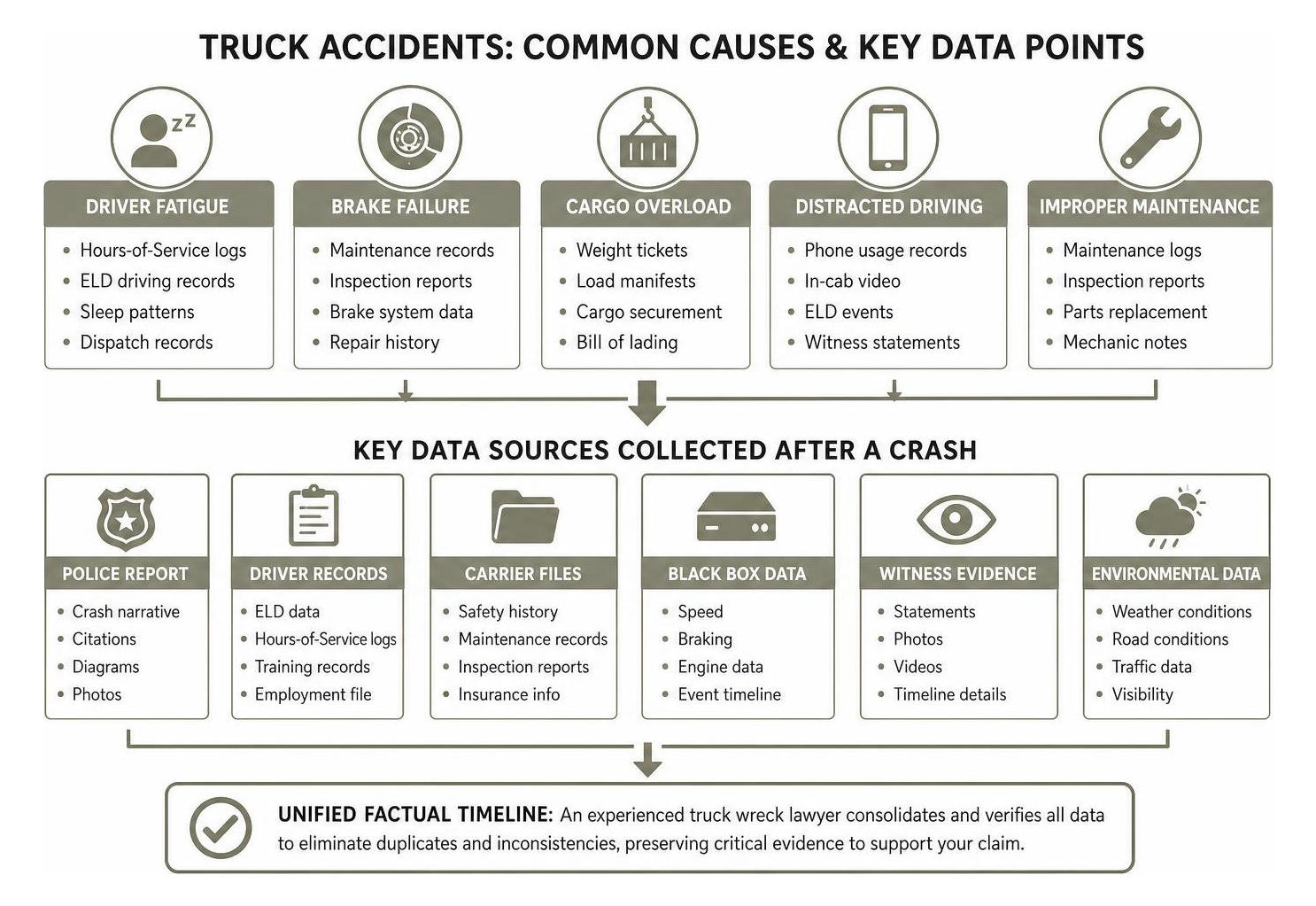
A major challenge in building a strong compensation claim is preventing data redundancy and reporting errors. When crash details are recorded across initial police crash reports, driver logs, carrier safety files, and eyewitness statements, inconsistencies frequently arise. An experienced Houston commercial truck wreck lawyer works to eliminate duplicate, conflicting, or inaccurate records by establishing a unified factual timeline. For a deeper breakdown of legal remedies, review our Houston Truck Accident Injury Lawyer Guide.
Role of a Houston Commercial Truck Wreck Lawyer in Preserving Black Box Data
Modern commercial motor vehicles are equipped with sophisticated digital recording systems. To prove fault, we target several electronic sources:
- Electronic Control Module (ECM) Black Box Data: Captures speed, braking history, engine RPMs, and throttle position immediately before impact.
- Electronic Logging Device (ELD) Data: Records exact hours of service (HOS) to reveal potential fatigue or federal rule violations.
- Driver Qualification Files: Tracks driving history, medical certifications, drug testing records, and background checks.
- Telematics and GPS Logs: Provides real-time spatial positioning, lane drift indicators, and travel speeds.
Trucking carriers often overwrite or clear ECM and ELD records during routine operations. To protect this electronic evidence, a Houston commercial truck wreck lawyer immediately issues formal spoliation letters. These legal notices require the carrier and its insurers to preserve all hardware, software logs, and physical truck components. You can learn more by checking out our resource on All About Trucking Black Box Data.
Avoiding Data Anomalies in Houston Truck Wreck Evidence
Managing evidence in complex crash cases requires the same structural care used in database normalization. Just as database engineers eliminate anomalies to keep information accurate, we eliminate evidentiary gaps to keep a legal claim solid.
Poorly managed accident records often suffer from three main anomalies:
- Insertion Anomaly: Adding a new piece of evidence (like a medical bill) without tying it to a specific injury or treatment record creates incomplete, floating records.
- Deletion Anomaly: Removing a duplicate record (such as an redundant repair report) accidentally wipes out critical context, like the date a faulty brake line was inspected.
- Update Anomaly: Updating a driver’s employment status or carrier details in one file while leaving older records untouched creates contradictory evidence that defense attorneys can exploit.
Applying normalization standards ensures that every piece of evidence—from medical bills to telematics—is logged precisely once, verified, and correctly connected to the underlying liability claim.
Structuring Evidence with Database Architecture and Entity-Relationship Modeling
Organizing trial evidence effectively mirrors structured database design. Using a 3-Schema Architecture framework helps clear up complex evidence streams:
- Conceptual Schema: The big-picture overview of the crash, defining key entities like drivers, vehicles, motor carriers, and injured victims.
- Logical Schema: The detailed map linking entities together, such as mapping driver hours to dispatch directives or vehicle defect histories to maintenance vendors.
- Physical Schema: The actual file organization system where physical bills, digital video files, ECM downloads, and deposition transcripts are stored for quick access during discovery.
This systematic approach prevents lost files and keeps key facts organized during negotiations or trial preparation. Clients seeking strong representation can consult a Commercial Truck Accident Lawyer Houston to guide them through this rigorous evidence collection process.
Entity-Relationship Models in Complex Trucking Litigation
In a personal injury case, an Entity-Relationship (ER) model clarifies how various entities interact. For example:
- Entities: Truck Driver, Motor Carrier, Commercial Vehicle, Third-Party Maintenance Shop, Cargo Shipper, Injured Party, Insurance Policy.
- Relationships: Driver operates Vehicle; Motor Carrier employs Driver; Maintenance Shop services Vehicle; Shipper loads Cargo onto Vehicle.
By mapping these entities, we can trace direct and vicarious liability. If a carrier assigns an impossible delivery deadline that forces a driver to violate federal hours-of-service rules, the ER framework helps establish the link between corporate pressure and the resulting collision.
How a Houston Commercial Truck Wreck Lawyer Uses SQL for Case Data Retrieval
When managing hundreds of pages of medical bills, months of ELD logs, and extensive fleet history, manual file review is slow and error-prone. We use structured, SQL-like data management methods to query case databases efficiently.
For instance, running precise data queries allows us to:
- Filter all ELD records where driving time exceeded 11 consecutive hours.
- Cross-reference maintenance logs to isolate every instance of reported brake failure across a carrier’s regional fleet.
- Summarize medical expense entities by provider, treatment date, and cost code for settlement demands.
Using structured queries streamlines evidence analysis, allowing us to build strong, fact-based claims rapidly.
Ensuring Data Independence and Referential Integrity in Your Legal Claim
Maintaining data independence means that changing how case records are stored or referenced does not alter the underlying facts. Physical evidence—such as photo exhibits, medical images, or crash reconstruction files—remains factual regardless of how it is categorized in court filings.
Referential integrity ensures that relationships between data points stay consistent. In legal databases, foreign keys connect separate tables. For example, every medical bill entry must link to a valid injury entry, which in turn links to the crash event itself. If a link breaks, defense insurers may question whether the medical treatment was actually related to the wreck.
Working with a trusted Houston Big Rig Accident Attorney ensures your case files meet strict evidentiary standards.
| Feature | Structured Database Evidence | Unorganized Case Records |
|---|---|---|
| Data Integrity | High; verified through strict primary and foreign key links | Low; prone to missing files and redundant entries |
| Query Speed | Instant retrieval of driver logs, ECM data, and medical totals | Slow manual review across stacks of paper documents |
| Anomaly Risk | Minimal insertion, deletion, or update errors | High risk of conflicting statements and missed deadlines |
| Trial Readiness | Evidence is linked directly to legal claims and damages | Higher risk of key evidence being excluded or challenged |
Indexing Strategies for Fast Access to Critical Trucking Logs
In complex database systems, indexing speeds up search queries across large datasets. In trucking litigation, indexing works the same way. By indexing telematics, driver logbooks, and maintenance histories by timestamp and location, we can retrieve key facts instantly during depositions or cross-examination.

When a defense witness claims a truck was traveling within the speed limit, an indexed database lets us instantly surface the exact ECM data point or GPS ping that disproves the testimony.
Frequently Asked Questions About Houston Commercial Truck Claims
How does evidence data integrity affect a commercial truck accident lawsuit?
Data integrity ensures that electronic evidence, such as ECM logs and ELD records, remains unalterable and admissible in court. If evidence is poorly handled, missing key metadata, or unorganized, defense lawyers may argue it was altered or unreliable. Maintaining strict data integrity strengthens your claim, making it easier to prove fault and recover fair compensation.
Why is quick data retrieval essential when dealing with trucking company records?
Trucking companies often destroy or overwrite electronic logging data and ECM black box files after 30 to 90 days under federal safety regulations unless legally required to keep them. Quick data retrieval—backed by formal preservation demands and structured querying tools—prevents spoliation and secures vital evidence before it disappears.
What should you do immediately following an 18-wheeler crash in Houston?
- Call 911 and request emergency medical services and law enforcement to document the scene.
- Seek immediate medical attention, even if injuries seem minor at first.
- Take photos and videos of all vehicles, skid marks, road conditions, and visible injuries if it is safe to do so.
- Collect contact and insurance information from all drivers involved, as well as eyewitness contact details.
- Avoid giving recorded statements to insurance adjusters before speaking with an attorney.
- Contact WestLoop Law Firm to begin gathering evidence and protecting your rights.
Building a Strong Claim with Legal Precision
Recovering compensation after a commercial truck crash requires clear, well-organized evidence. From ECM downloads and ELD logs to medical records, keeping data clear and structured is critical when going up against national trucking carriers and insurance companies.
At WestLoop Law Firm, our attorneys combine legal insight with detailed evidence management to fight for crash victims across Houston and Harris County. If you or a family member was injured in an 18-wheeler crash, reach out to our team today through our Houston Trucking Accident Lawyer page to discuss your case and take the first step toward securing the recovery you deserve.