 Skip to content
What to Do After a Tractor Trailer Accident in Houston: Your First Steps
If you need a tractor trailer accident lawyer in Houston, here is what matters most right now:
- Call 911 and get a police report filed at the scene.
- Seek medical care immediately — even if you feel fine. Injuries like traumatic brain injuries can hide for hours.
- Document everything — photograph the truck’s DOT number, license plate, damage, skid marks, and road conditions.
- Do not speak to the trucking company’s insurance adjuster before talking to a lawyer.
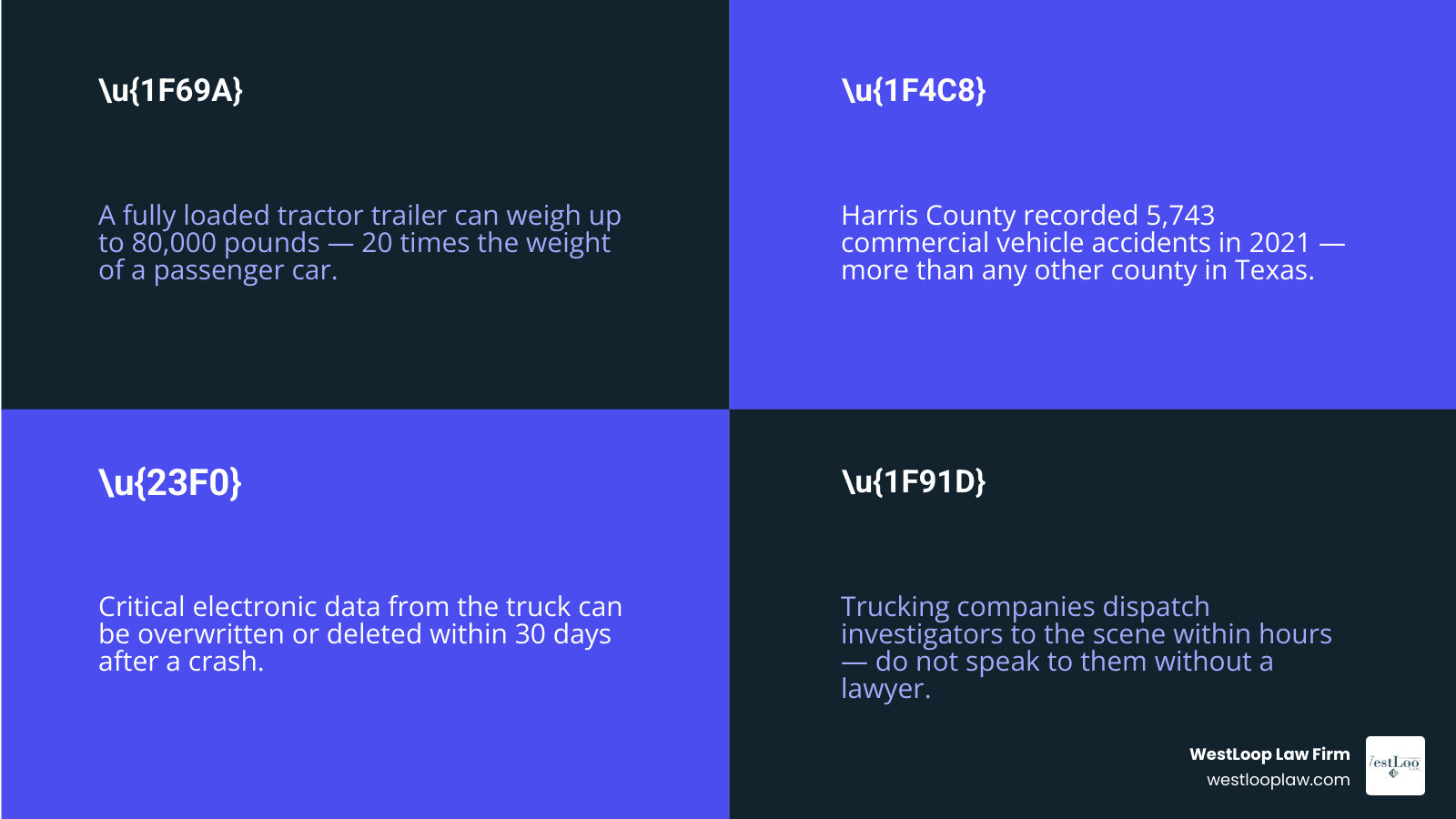
- Contact a truck accident attorney fast — critical electronic data from the truck can be overwritten or deleted within 30 days.
Houston is one of the most dangerous cities in the country for commercial truck crashes. According to TxDOT data, Harris County recorded 5,743 commercial vehicle accidents in 2021 alone — more than any other county in Texas. That works out to roughly one out of every six truck wrecks in the entire state happening right here in Houston.
And these are not ordinary fender-benders.
A fully loaded tractor trailer can weigh up to 80,000 pounds — about 20 times the weight of the average passenger car. When a truck that size hits your vehicle on I-10, I-45, or Loop 610, the results are often catastrophic: broken bones, spinal injuries, traumatic brain injuries, or worse.
What makes these cases even harder is what happens after the crash. Trucking companies dispatch investigators to the scene within hours. Their goal is to protect the company — not you. Meanwhile, critical evidence like black box data and driver logs can vanish fast.
That is why the decisions you make in the first 48 hours can make or break your case.
Tractor trailer accident lawyer Houston further reading:
- Houston semi truck accident attorney
- Houston truck accident settlements
- Texas trucking accident attorney
Why Commercial Truck Wrecks Demand a Tractor Trailer Accident Lawyer Houston

When you are driving along the I-10 Katy Freeway or navigating the tight lanes of Loop 610, you are sharing the road with massive commercial vehicles. The sheer physical disparity between a standard passenger car and an 18-wheeler is the primary reason why these collisions are so devastating. The average car weighs around 4,000 pounds, while a fully loaded tractor trailer can legally tip the scales at 80,000 pounds.
When these two forces meet, physics is never on the side of the smaller vehicle. The impact often leads to life-altering, catastrophic injuries. Victims frequently suffer from:
- Traumatic Brain Injuries (TBIs): Even with seatbelts and airbags, the violent shaking or direct impact during a crash can cause severe concussions, brain bleeding, or permanent cognitive damage.
- Spinal Cord Damage: The crushing force of a semi-truck often results in herniated discs, fractured vertebrae, or permanent paralysis.
- Internal Organ Damage: Severe blunt-force trauma can cause internal bleeding and ruptured organs, requiring emergency life-saving surgeries.
If you or a loved one is rushed to an emergency room like Memorial Hermann Hospital or Ben Taub Hospital after a crash, your immediate focus must be on survival and physical recovery. However, the legal clock starts ticking the very second the collision occurs.
Commercial truck wrecks are not just larger versions of typical car accidents. They involve entirely different legal standards, higher insurance policy limits, and aggressive corporate defense teams. Navigating this storm alone is a recipe for being taken advantage of by powerful trucking companies. To understand the full scope of what you are up against, reading our houston truck accident lawyers ultimate guide can help clarify the massive differences in how these cases are prepared and argued.
Understanding Liability and Federal Regulations in Texas Trucking Claims
Unlike standard passenger vehicle insurance policies in Texas, which require a minimum liability coverage of only $30,000 per person, commercial trucks are heavily regulated. Interstate commercial vehicles must carry at least $750,000 in liability coverage, and many carry policies valued at $1 million to $5 million or more. Because there is so much money on the line, these claims are fought with extreme aggression.
Furthermore, commercial trucking is governed by a strict set of rules known as the Federal Motor Carrier Safety Regulations (FMCSRs). These regulations dictate everything from how many hours a driver can spend behind the wheel to how often the truck’s brakes must be inspected. Some of the most critical federal rules include:
- Hours of Service (HOS) Limits: To prevent fatigued driving, truckers are generally limited to 11 hours of driving after 10 consecutive hours off duty. They are also barred from driving beyond the 14th consecutive hour after coming on duty.
- Electronic Logging Devices (ELDs): Modern trucks are required to use ELDs to automatically record driving time, making it much harder for drivers to falsify their logbooks.
Proving that a truck driver violated these federal safety laws is one of the most effective ways to establish negligence. However, Texas also operates under a system of modified comparative negligence, commonly known as the 51 percent bar rule. Under this law, you can recover damages as long as your share of responsibility for the accident is 50% or less. If a jury finds you 51% or more at fault, you are legally barred from recovering any compensation whatsoever. If you are found partially at fault (for example, 20% responsible), your financial recovery will be reduced by that exact percentage.
Because the trucking company’s lawyers will do everything they can to shift the blame onto you to trigger this 51% bar, having a dedicated commercial truck accident lawyer houston is essential to protect your rights and keep the blame where it belongs.
Identifying Every Liable Party with a Tractor Trailer Accident Lawyer Houston
In a typical car wreck, you usually only sue the other driver. In a commercial truck accident, liability is rarely that simple. Multiple corporate entities often share the blame for a single crash.
Depending on the facts of your case, we can help you hold several parties accountable:
- The Trucking Company: Under the legal doctrine of respondeat superior (vicarious liability), employers are generally responsible for the negligent actions of their employees while on the job. Additionally, the trucking company can be sued directly for its own negligent hiring, inadequate training, or failure to perform background checks on drivers with a history of safety violations.
- The Cargo Loading Company: If a third-party logistics company improperly loads or poorly secures cargo, the load can shift during a turn, causing a catastrophic jackknife or rollover accident.
- The Parts Manufacturer: If a critical component like the truck’s air brakes or steering column fails due to a design or manufacturing defect, the manufacturer can be held liable under product liability laws.
- Third-Party Maintenance Contractors: Trucking companies often hire external mechanics to service their fleets. If a maintenance provider fails to identify or properly repair worn brakes or bald tires, they may share liability for the resulting crash.
Trucking companies often try to dodge liability by claiming the driver was an “independent contractor” rather than an employee. However, federal regulations largely eliminate this defense. If the truck was operating under the trucking company’s federal Department of Transportation (DOT) authority and displaying its logo, the company can still be held legally responsible for the crash.
The Evidence Preservation Checklist: Acting Within the First 48 Hours
The physical evidence in a truck accident case is highly volatile. Trucking companies are legally permitted to destroy or overwrite critical electronic and physical records after a set period of time unless they receive a formal notice to preserve them. This legal notice is known as a spoliation letter.
To prevent the loss of crucial evidence, we must act immediately to secure:
- The Black Box (Engine Control Module / ECM): This device records technical data in the seconds leading up to a crash, including the truck’s speed, braking patterns, steering angles, and throttle position. Many systems automatically overwrite this data within 30 days.
- Electronic Logging Device (ELD) Records: These digital logs show if the driver was operating over their legal hourly limits. Under federal rules, carriers are only required to keep these records for six months before they can legally delete them.
- Driver Qualification Files: This includes the trucker’s commercial driver’s license (CDL) history, drug and alcohol test results, medical certifications, and past safety violations.
- Maintenance and Inspection Logs: These documents reveal whether the trucking company ignored mechanical issues to keep the vehicle on the road.
If you wait too long to hire a legal team, this evidence can vanish forever, leaving you with a much harder case to prove. When you partner with WestLoop Law Firm, we draft and send comprehensive spoliation letters within hours of taking your case, legally binding the trucking company to preserve every shred of data.
Countering Insurance Defense Tactics and Texas House Bill 19
Commercial insurance companies do not stay in business by paying out large claims willingly. They employ a notorious “delay, deny, defend” strategy. They may offer you a quick, lowball settlement before you even know the full extent of your physical injuries, hoping you will sign away your rights for a fraction of what your case is actually worth. If that fails, they will drag out the litigation process, trying to exhaust you financially so you will settle for less.
To make matters more challenging for victims, the Texas Legislature passed House Bill 19 (HB 19). This law allows defendant trucking companies to request a bifurcated trial.
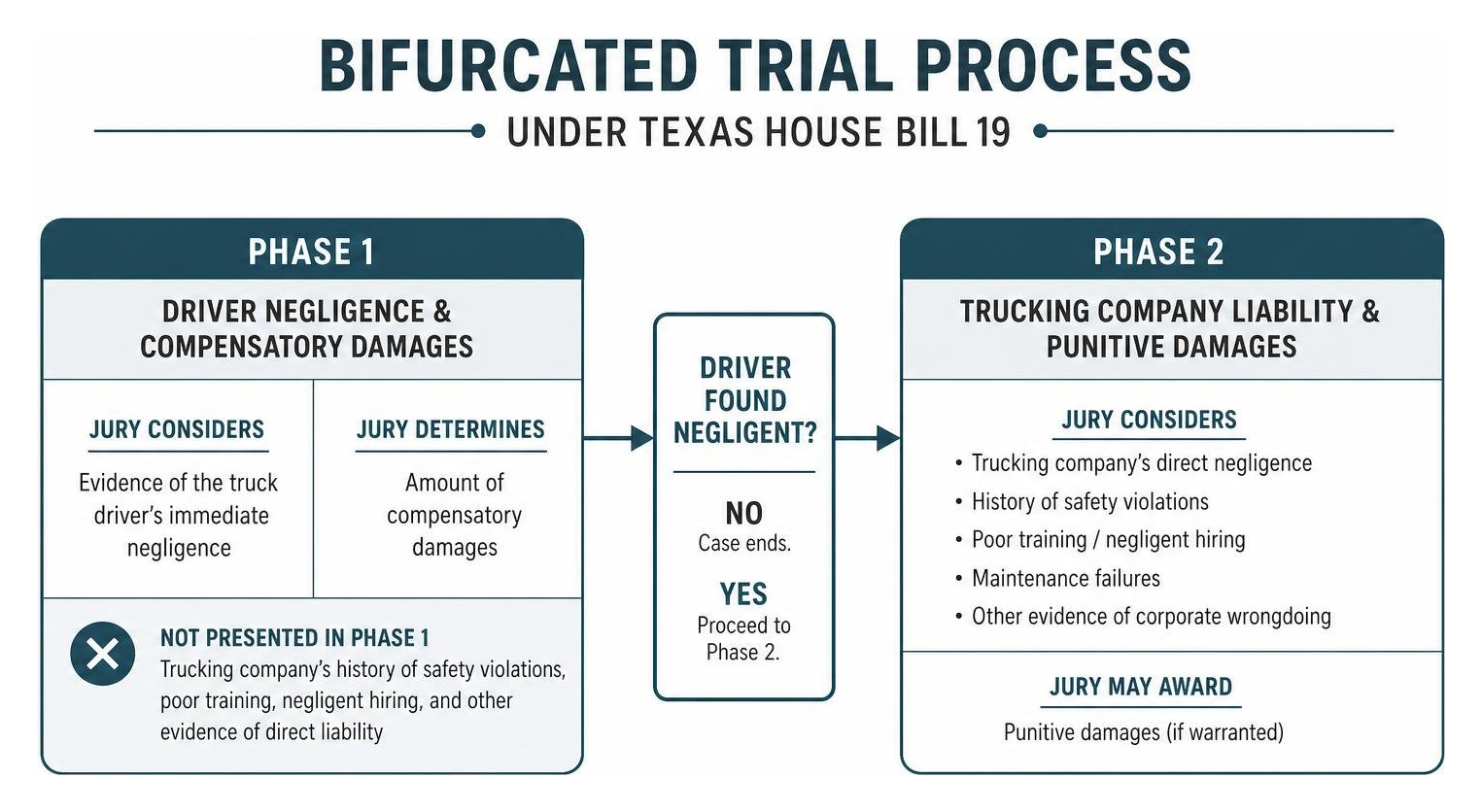
Under this split-trial system:
- Phase 1: The jury only hears evidence regarding the truck driver’s immediate negligence and determines the amount of compensatory damages. Evidence of the trucking company’s history of safety violations, poor training, or negligent hiring is largely kept hidden from the jury during this phase.
- Phase 2: Only if the driver is found negligent in Phase 1 does the trial proceed to Phase 2, where the jury can evaluate the trucking company’s direct liability and consider punitive damages.
This law was designed to protect corporate trucking interests by making it harder to expose systemic safety failures early in a lawsuit. To beat this system, you need a legal team that knows how to conduct meticulous investigations and build an airtight case. We dig deep into driver qualification files and maintenance logs to ensure we have the leverage needed to win, whether in settlement negotiations or in a court of law. To understand how we navigate these complex defense strategies, take a look at our 18-wheeler accident lawyer complete guide.
Evaluating Your Claim: Damages, Texas Laws, and Timeline Expectations
If you have been injured in a collision with an 18-wheeler, Texas law allows you to pursue several types of compensation, collectively referred to as damages. These are split into three primary categories:
- Economic Damages: These are quantifiable financial losses resulting from the accident. They include past and future medical bills, lost wages, loss of future earning capacity if you can no longer work, and property damage to your vehicle.
- Non-Economic Damages: These cover the intangible, human cost of the crash. This includes physical pain and suffering, mental anguish, loss of enjoyment of life, and physical disfigurement or impairment.
- Punitive Damages: Under Texas Civil Practice and Remedies Code § 41.003, punitive damages may be awarded if we can prove by clear and convincing evidence that the trucking company or driver acted with gross negligence. This means they acted with a conscious indifference to an extreme risk of severe harm to others — such as a company forcing a driver to stay on the road while heavily intoxicated or far past their legal driving hours.
If the accident resulted in a tragic loss of life, surviving family members can file a wrongful death claim to recover compensation for funeral costs, loss of financial support, and emotional trauma. Additionally, a survivor action can be filed on behalf of the deceased person’s estate to recover damages for the pain and suffering they experienced in the moments before their passing.
Under Texas Civil Practice and Remedies Code § 16.003, the strict statute of limitations for filing a personal injury or wrongful death lawsuit is two years from the date of the crash. If you miss this deadline, you lose your right to seek compensation forever. For a deeper look at how we calculate and maximize these damages, consult our 18-wheeler injury attorney complete guide.
How to Choose the Right Legal Representation in Harris County
Choosing the right legal advocate is the most important decision you will make after a serious crash. You do not want a high-volume law firm that treats you like a case file number and pushes you to accept a quick, undervalued settlement. You need a team with a courtroom-tested reputation.
When evaluating potential attorneys, look for these critical factors:
- Trial-Ready Attitude: Trucking companies keep close track of which lawyers actually go to court and which ones always settle. A firm with a reputation for taking cases to trial commands significantly higher settlement offers.
- Contingency Fee Structure: You should never have to pay upfront out-of-pocket costs to get justice. A trustworthy firm works on a contingency fee basis, meaning we only get paid if we successfully recover money for you.
- Medical Care Coordination: If you do not have health insurance but need advanced treatment, an experienced firm can issue a Letter of Protection (LOP). This legal agreement allows you to receive necessary medical care from top providers without paying upfront, delaying payment until your case is resolved.
For a step-by-step breakdown of how to evaluate and select the best attorney for your specific situation, read the 18 wheeler playbook how to choose a truck lawyer in houston.
Choosing a Tractor Trailer Accident Lawyer Houston with Trial Experience
The legal departments of major shipping and logistics corporations are backed by massive financial resources. They are prepared to spend whatever it takes to minimize their financial exposure. To level the playing field, your legal team must have the resources and experience to match them step-for-step.
We do this by collaborating with a trusted network of independent professionals, including:
- Accident Reconstruction Professionals: These physical science and engineering professionals visit the crash scene, analyze skid marks, examine vehicle damage, and use black box data to create high-tech 3D simulations of exactly how the crash occurred.
- Financial Economists: If your injuries prevent you from returning to your career, economists calculate the true, long-term impact of your lost future earning capacity, factoring in inflation, promotions, and benefits over your expected working life.
When insurance companies know your legal team has built a trial-ready case supported by bulletproof professional testimony, their willingness to offer a fair, full settlement increases dramatically.
Frequently Asked Questions About Houston Truck Accidents
What is the statute of limitations for a truck accident lawsuit in Texas?
Under Texas Civil Practice and Remedies Code § 16.003, you generally have exactly two years from the date of the accident to file a personal injury or wrongful death lawsuit. However, there is a major exception: if the truck that hit you was owned or operated by a government entity (such as a city maintenance truck or state vehicle), you may be required to file a formal administrative notice of your claim within six months of the crash, or even sooner depending on local city charters.
Can I still recover compensation if I was partially at fault for the crash?
Yes. Texas follows a modified comparative negligence rule (the 51 percent bar rule). You can still recover financial compensation as long as your share of the blame for the accident is 50% or less. Your final financial recovery will be reduced by your percentage of fault. For example, if a jury awards you $1,000,000 in damages but finds you 10% at fault for the crash, your final payout will be $900,000. If you are found 51% or more at fault, you cannot recover anything.
How much is the average settlement for a tractor trailer accident in Houston?
There is no single “average” settlement because every case depends on unique factors. Case valuation is driven by the severity of your physical injuries, the total cost of your past and future medical bills, your lost earning capacity, the amount of insurance coverage available, and whether the trucking company’s conduct warrants punitive damages. While minor injuries might result in smaller settlements, catastrophic cases involving permanent disability or wrongful death frequently result in multi-million dollar recoveries.
Securing Your Future After a Houston Trucking Crash
What truly sets us apart at WestLoop Law Firm is our dual-focused approach. In addition to personal injury law, our legal team has experience in probate court coordination and estate administration.
If a tractor trailer accident tragically results in a fatality, recovering compensation is only half the battle. To file a wrongful death lawsuit or distribute a settlement to surviving family members, a formal probate estate must often be opened in a Harris County probate court. Most personal injury firms have to refer this work to outside lawyers, causing long delays and extra fees. We handle both the personal injury litigation and the complex probate administration in-house, ensuring a seamless, compassionate process for grieving families during their most difficult moments.
If you or a loved one has been injured in a commercial vehicle crash, do not face the trucking company’s corporate legal teams alone. Contact WestLoop Law Firm today to schedule a free, no-obligation consultation. We work on a contingency fee basis, meaning there are no upfront legal fees, and you pay us nothing unless we win your case. Let us help you protect your rights, secure your medical care, and fight for the full financial recovery you deserve. You can also visit our office or find directions to our location via our WestLoop Law Firm Google Business Profile.