 Skip to content

How to Start Houston POA Incapacity Planning
What to do first
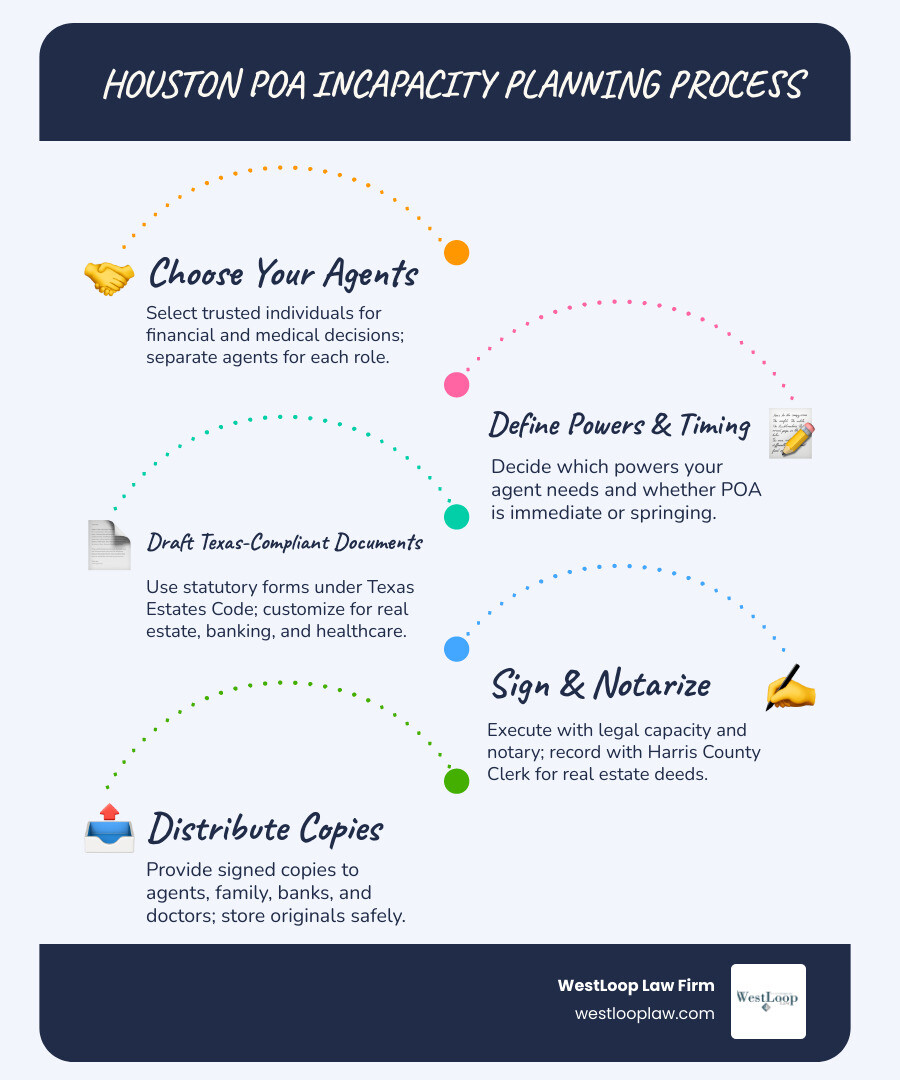
- Start Houston POA incapacity planning while you can still make your own decisions. Choose someone you trust to handle your finances and someone to make medical decisions if you cannot.
- Put those choices in separate Texas financial and medical powers of attorney. Decide which financial powers your agent needs and when they should begin.
- Sign each document under its Texas legal requirements, then tell your agents where to find it.
A durable financial power of attorney can keep bills and other money matters moving after incapacity. A medical power of attorney covers health care decisions. Together, they can reduce the chance that your family will need to seek guardianship in a Harris County court.
Quick look at houston poa incapacity planning:
A sudden medical crisis or progressive cognitive decline can leave your family scrambling to handle everyday legal and financial responsibilities. Whether you are navigating heavy traffic on I-10, commuting across Loop 610, or managing routine affairs near the Texas Medical Center, an unexpected illness or injury can disrupt your ability to make sound choices.
Without proactive planning, your relatives cannot automatically access your single-owner bank accounts, manage mortgages, or sign healthcare consents. By establishing clear legal designations beforehand, you ensure financial stability and personal dignity during difficult times.

Understanding Texas Power of Attorney and Incapacity Planning
A Power of Attorney (POA) is a formal legal instrument where one person (the principal) grants another person (the agent or attorney-in-fact) authority to perform specific legal, financial, or healthcare actions on their behalf. In Texas, these documents are governed primarily by the Texas Estates Code and the Texas Health and Safety Code.
To remain effective when an individual loses decision-making capacity, the document must be drafted as “durable.” Under Texas Estates Code Section 751.0021, durability requires explicit statutory phrasing stating that the powers granted survive the principal’s subsequent disability or incapacity.
When you execute a POA, you do not surrender your own rights. As long as you retain contractual mental competence, you can direct your affairs, manage transactions, or revoke the designation at any time. Texas courts follow clear capacity standards, as illustrated in In re Estate of Vackar (345 S.W.3d 588), confirming that a principal must understand the nature and consequences of executing the document at the time of signing.
Essential Pillars of Houston POA Incapacity Planning
A complete incapacity plan requires several coordinated instruments:
- Statutory Durable Financial Power of Attorney: Governed by Texas Estates Code Section 752.051, this empowers an agent to oversee banking, real estate, business interests, investments, and government benefits.
- Medical Power of Attorney (MPOA): Regulated by Texas Health and Safety Code Section 166.164, this document allows a surrogate to make informed medical care decisions if you become unable to express your own choices.
- HIPAA Release Authorization: Grants healthcare teams permission to share confidential medical records with designated fiduciaries, preventing privacy roadblocks during emergencies.
- Directive to Physicians and Family or Surrogates (Living Will): Outlines direct instructions regarding life-sustaining treatments and end-of-life care when facing terminal or irreversible medical conditions.
Understanding these fundamentals is critical, and reviewing Texas POA laws helps ensure every document complies with current state statutes. Taking steps to protect your family assets with a durable power of attorney shields your household from severe legal and financial disruptions.
Comparing Immediate vs. Springing Powers of Attorney
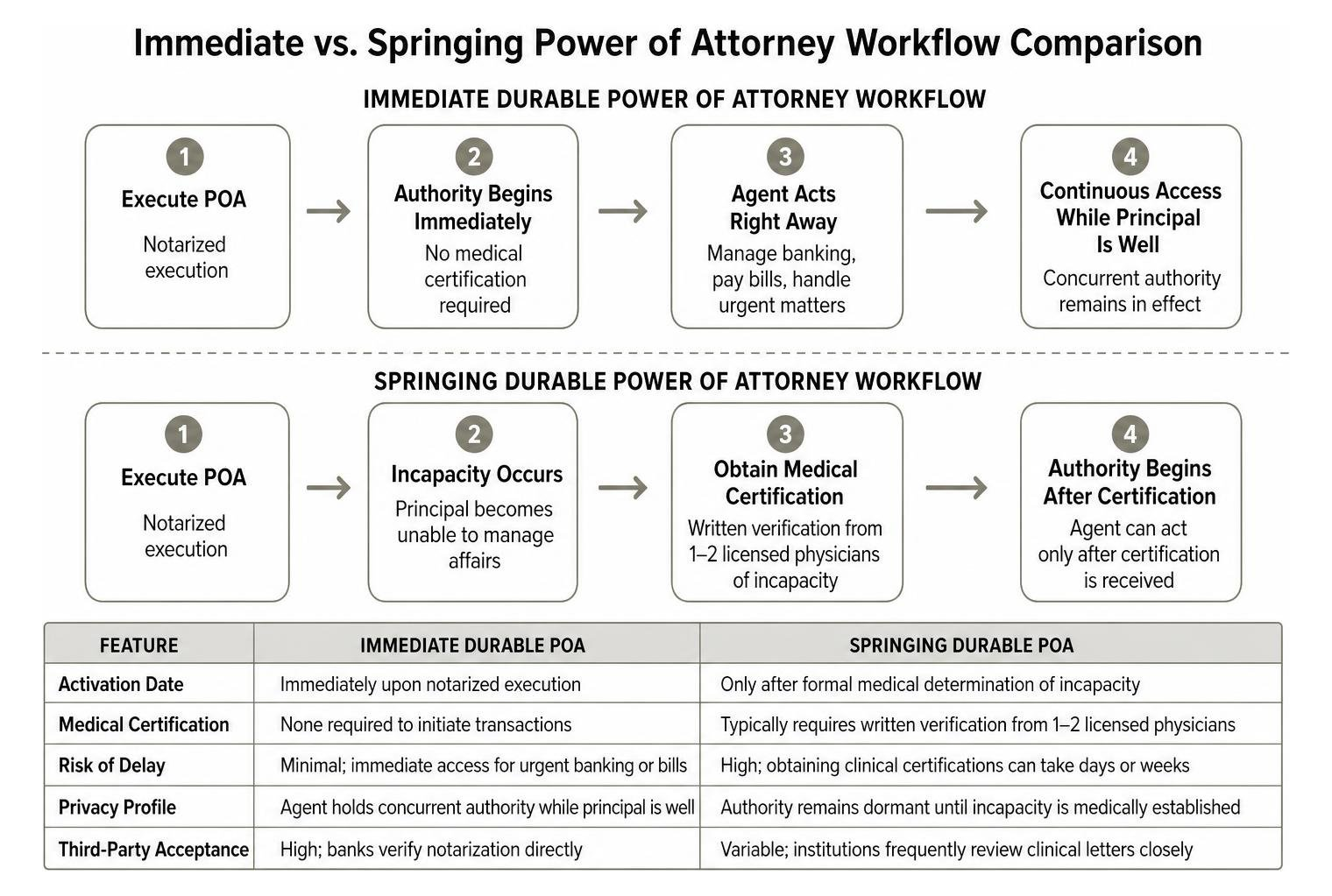
When executing a durable financial power of attorney in Texas, you must decide when your agent’s legal authority takes effect: immediately upon signing or only upon medical certification of incapacity (known as a “springing” power).
| Feature | Immediate Durable POA | Springing Durable POA |
|---|---|---|
| Activation Date | Immediately upon notarized execution | Only after formal medical determination of incapacity |
| Medical Certification | None required to initiate transactions | Typically requires written verification from 1–2 licensed physicians |
| Risk of Delay | Minimal; immediate access for urgent banking or bills | High; obtaining clinical certifications can take days or weeks |
| Privacy Profile | Agent holds concurrent authority while principal is well | Authority remains dormant until incapacity is medically established |
| Third-Party Acceptance | High; banks verify notarization directly | Variable; institutions frequently review clinical letters closely |
While springing powers appeal to individuals who want to withhold authority until it is strictly necessary, they often create practical delays. In emergencies—such as an admission to Memorial Hermann or Houston Methodist—tracking down multiple physicians to obtain written declarations of incapacity can postpone critical financial actions, including paying facility deposits or processing urgent insurance claims.
How to Execute Houston POA Incapacity Planning in 5 Steps
Creating an enforceable incapacity framework requires structured legal execution to prevent future challenges.
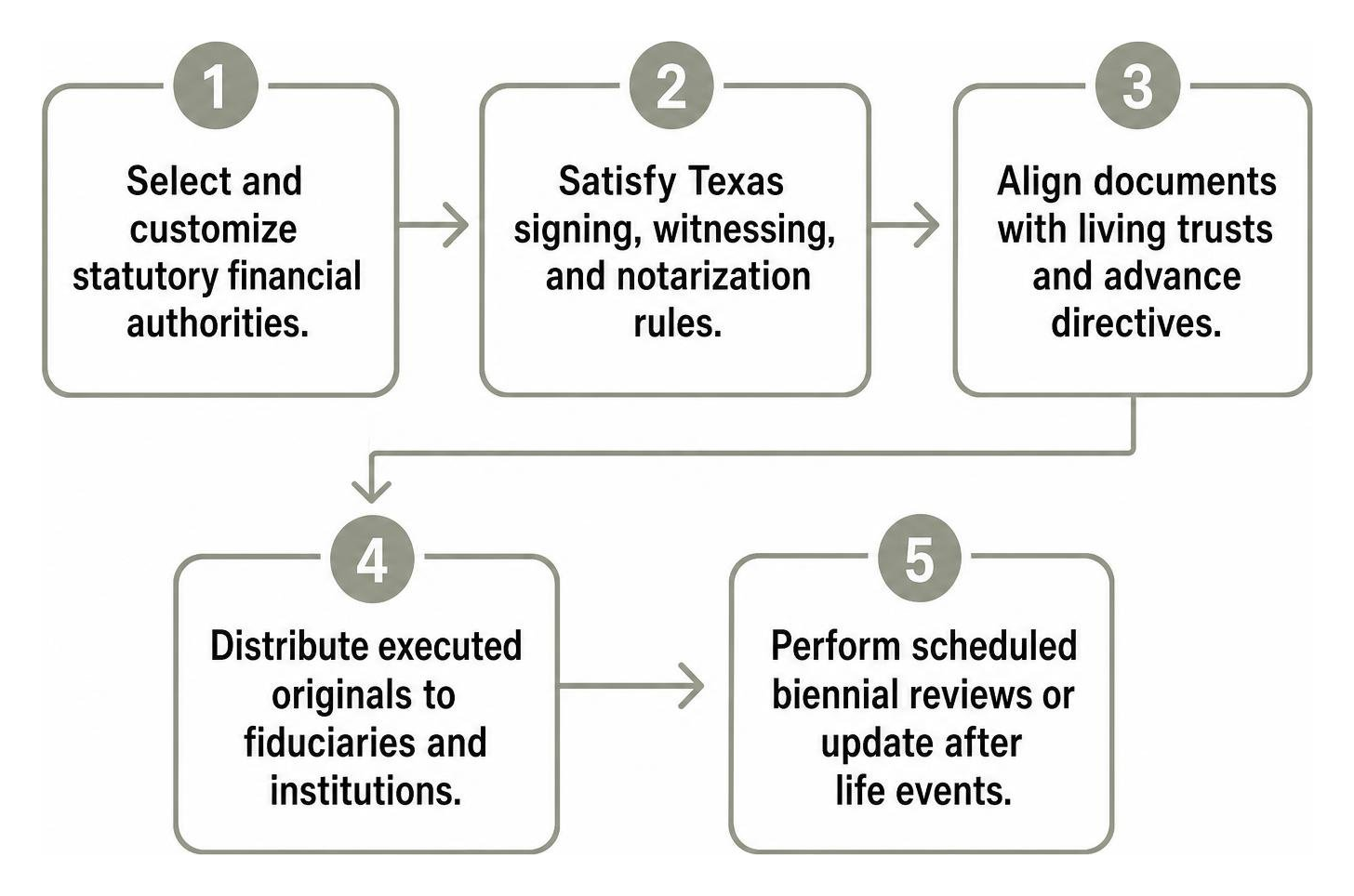
Step 1: Selecting and Customizing Your Agent’s Statutory Powers
The Texas statutory durable power of attorney form allows principals to grant broad or limited authority over real property, banking, tangible personal property, business operations, insurance, retirement accounts, and taxes.
Under Texas Estates Code Section 751.031, certain high-level actions—known as “hot powers”—cannot be presumed. If you want your agent to make gifts, change beneficiary designations, create or amend trusts, or manage elder care spend-down strategies for Medicaid or Veterans benefits, these powers must be explicitly stated in the document. For a thorough walkthrough of these provisions, explore our ultimate guide to power of attorney in Houston.
Step 2: Satisfying Texas Legal Signing and Recording Mandates
To execute an enforceable power of attorney in Texas:
- The principal must be at least 18 years old and of sound mind.
- The document must be signed before an authorized notary public.
- Medical POAs require execution before two adult witnesses (at least one of whom is not related to the principal by blood or marriage and has no claim against the estate) or a notary public.
- If granting authority over real estate, the document must be recorded in the county deed records where the property sits (such as the Harris County Clerk’s Office in downtown Houston).
You can review baseline statutory templates using the statutory power of attorney forms from the Texas State Law Library.
Step 3: Integrating POAs with Living Trusts and Healthcare Directives
A durable power of attorney works hand-in-hand with a revocable living trust. While a trust manages assets titled directly in its name, a financial POA governs non-trust assets, such as retirement plans, tax refunds, motor vehicle titles, or overlooked bank accounts.
Equally vital is coordinating your financial instruments with a living will and healthcare power of attorney to ensure your medical treatment preferences align with your financial resources.
Step 4: Submitting and Verifying POAs with Financial Institutions and Medical Providers
Deliver certified copies of your executed financial POA to your local banks, credit unions, and investment brokers across Houston. Many financial institutions have dedicated legal verification departments that must review and index the POA before an emergency occurs. Similarly, ensure your primary physicians, medical clinics, and regional hospital networks have your Medical Power of Attorney and HIPAA release on file in their electronic health record systems.
Step 5: Safely Storing Original Documents and Scheduling Regular Reviews
Keep your original executed documents in a secure, accessible location, such as a fireproof home safe, and ensure your named agents know how to access them immediately. Revisit your incapacity plan every two to three years or following major life transitions, such as marriage, divorce, substantial asset acquisitions, or changes in your designated agents’ availability.
Avoiding Harris County Guardianship Through Proactive Incapacity Planning
Without valid powers of attorney in place, a sudden disability may leave family members with no choice but to file for court-created guardianship.
In Harris County, guardianship applications are handled through the statutory probate courts located in downtown Houston. These proceedings carry significant drawbacks:
- Substantial Financial Expense: Court costs, attorney ad litem fees, and mandatory filing expenses can quickly drain thousands of dollars from an estate.
- Protracted Timelines: Establishing a formal guardianship takes months of medical evaluations, court filings, and formal hearings.
- Loss of Autonomy and Privacy: The process is a matter of public record. A judge decides who manages your personal and financial affairs, and your guardian must submit annual financial accountings to the court.
Executing durable financial and medical powers of attorney helps you bypass this costly public process. To learn more about how court oversight impacts families, consult our guidance on working with a guardianship attorney in Houston and navigating the probate court in Houston Texas.
Crucial Safeguards in Houston POA Incapacity Planning
Catastrophic traffic collisions along busy transit corridors like I-45, I-10, Loop 610, Beltway 8, and the Grand Parkway can lead to sudden, severe incapacitation. In addition to personal healthcare decisions, an incapacitated individual may have an ongoing personal injury claim filed in venues like the Harris County Civil Courts at Law or state district courts. Under Texas personal injury law, claims are subject to a strict two-year statute of limitations, and an injured person’s recovery can be barred under the Texas 51% modified comparative fault rule if they are found mostly at fault.
Additionally, navigating insurance recoveries—such as Personal Injury Protection (PIP) under an auto policy—requires active legal standing. A properly drafted durable power of attorney grants your agent the authority to hire legal counsel, manage litigation, and protect settlement assets while you recover. Learn more about local banking protocols by reviewing our guide to mastering financial POA bank requirements in Houston.
Managing Third-Party Acceptance and Updating Your Power of Attorney
Texas law provides strong consumer protections to ensure financial institutions honor valid powers of attorney.
Under Texas Estates Code Section 751.206, an institution can refuse a POA only under 11 specific statutory conditions (for example, if the institution has actual knowledge that the agent’s authority has been revoked or has filed a report of suspected financial exploitation with the Texas Department of Family and Protective Services). If an institution wrongfully refuses an enforceable statutory power of attorney, they can be held liable in court for reasonable attorney fees and costs.
Rules for Modifying or Revoking a Texas Power of Attorney
You can revoke or modify an existing power of attorney at any time, provided you possess contractual mental capacity. To revoke a POA:
- Draft a formal, written Revocation of Power of Attorney that clearly references the original document and execution date.
- Sign the revocation instrument in the presence of a notary public.
- Deliver written notice and copies of the revocation to all named agents and every financial institution, healthcare provider, and county clerk where the prior POA was presented or recorded.
Under Texas Estates Code Section 751.132, if you name your spouse as an agent and subsequently get divorced, their legal authority terminates automatically on the date the divorce is finalized, unless your document explicitly provides otherwise. For step-by-step guidance, refer to our article on how to revoke power of attorney in Houston.
Frequently Asked Questions About Houston Incapacity Planning
Does a spouse automatically have power of attorney in Texas?
No. Texas is a community property state, but marriage does not grant an automatic legal right to manage separately titled assets, sign tax returns, access individual retirement accounts (IRAs/401ks), or execute real estate deeds on behalf of an incapacitated spouse. Each spouse must execute separate financial and medical powers of attorney to ensure mutual legal authority.
What happens if a Houston bank refuses to accept my durable POA?
If a financial institution rejects a Texas Statutory Durable Power of Attorney, demand a written explanation citing one of the statutory refusal exceptions under Texas Estates Code Section 751.206. If the institution asks for an Agent’s Certification of Creation and Validity or an Opinion of Counsel, supply the required documents. Continued wrongful refusal exposes the institution to court orders and mandatory attorney fee awards.
How does getting a divorce affect a power of attorney in Texas?
Under Texas Estates Code Section 751.132, the entry of a final divorce decree automatically revokes your former spouse’s legal authority as an agent or successor agent. However, it does not invalidate the entire document if you named secondary successor fiduciaries. If you wish for an ex-spouse to retain decision-making powers post-divorce, you must execute a new POA that expressly affirms that appointment.
Secure Your Legacy with Strategic Houston Incapacity Planning
Incapacity planning is not just about signing paperwork—it is about protecting your independence, your assets, and your family’s future. Establishing clear, enforceable powers of attorney ensures your personal care and financial stability remain intact, even during unexpected medical challenges.
To build a coordinated plan that protects your household and avoids the costs of court-ordered guardianship, contact Westloop Law Firm to discuss your options for estate planning law in Houston. Taking action today gives you and your loved ones lasting clarity, security, and peace of mind.