 Skip to content
Who Should You Call First After a Multi-Car Pileup on Houston’s 610 Loop?
When a sudden collision triggers a chain reaction across four or five lanes of Interstate 610, the immediate aftermath is chaotic, fast-moving, and dangerous. Knowing the precise order of calls to make protects both your physical survival and your financial recovery.
What to do first:
- Call 911 immediately and request Houston Police Department (HPD) and Houston Fire Department (HFD) emergency medical services (EMS).
- Move to a safe shoulder if your vehicle is operable; otherwise, stay secured inside with your seatbelt fastened and hazard lights activated.
- Report your exact location on the 610 Loop, the number of vehicles involved, and any fuel spills, fires, or blocked lanes.
- Avoid speaking to insurance adjusters or giving recorded statements until you have consulted a personal injury attorney.
- Contact a Loop 610 car accident lawyer as soon as possible after emergency responders have stabilized the scene.
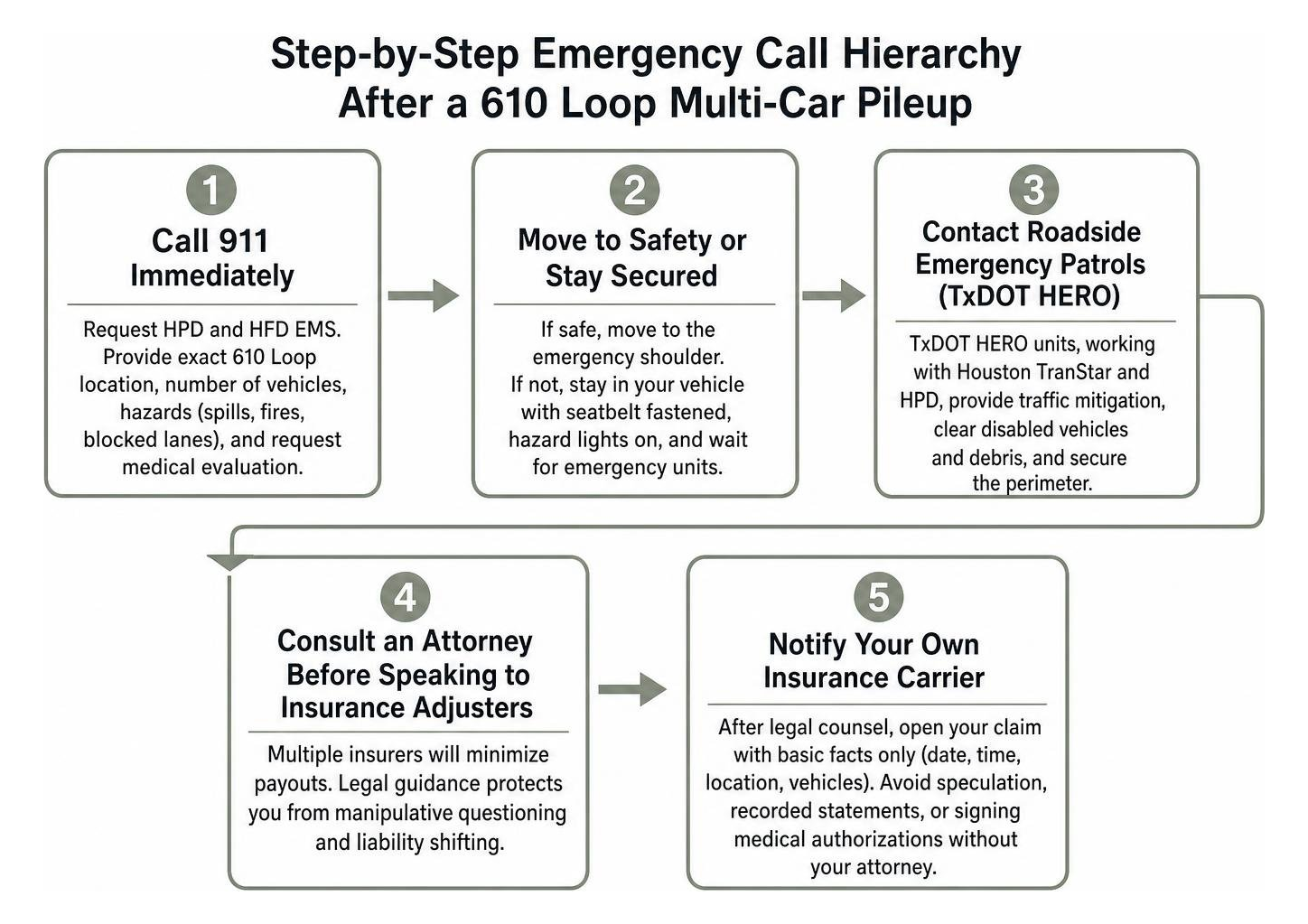
1. Call 911 Immediately for Emergency Responders
Your first call must always be to 911. Request dispatch for both the Houston Police Department (HPD) and Houston Fire Department (HFD) emergency medical services (EMS). High-impact freeway pileups frequently involve severe trauma, vehicle fires, and trapped motorists requiring extrication.
When you speak with the emergency dispatcher:
- State your exact location on the 610 Loop (for example, West Loop South northbound near Westheimer Road or North Loop East eastbound approaching I-69/US-59).
- Estimate the total number of vehicles involved.
- Report any visible fuel spills, active fires, or blocked travel lanes.
- Request immediate medical evaluation for all injured parties.
2. Move to Safety or Stay Secured in Your Vehicle
The 610 Loop carries tens of thousands of vehicles every hour. Secondary crashes are a catastrophic danger in Houston highway pileups. If your vehicle is still operable and you can safely navigate to an emergency shoulder, do so immediately.
However, if your car is disabled in an active lane of traffic near high-speed interchanges like the West Loop by the Galleria or the North Loop near I-45, exiting your vehicle on foot can be fatal. Keep your seatbelt fastened, activate your emergency hazard lights, and remain inside the passenger cabin until emergency units arrive to shield the scene.
3. Contact Roadside Emergency Patrols (TxDOT HERO)
In the Houston metropolitan area, the Texas Department of Transportation operates the Highway Emergency Response Operations (HERO) patrol program. Working in coordination with Houston TranStar and HPD, HERO units provide heavy-duty traffic mitigation, push disabled vehicles off main lanes, and clear debris along the 610 corridor, I-10, and Beltway 8. If 911 has not already dispatched them, emergency services will coordinate their arrival to secure the perimeter.
4. Consult an Attorney Before Speaking to Insurance Adjusters
Once medical personnel have stabilized the scene and treated acute injuries, your next call should be to our legal team. In multi-vehicle wrecks, multiple insurance carriers immediately deploy adjusters to minimize their financial exposure. Speaking to third-party insurance representatives without legal guidance exposes you to manipulative questioning designed to shift liability onto you.
5. Notify Your Own Insurance Carrier
After speaking with your legal counsel, notify your insurance carrier to open a claim. Provide only factual, baseline details: the date, time, location, and vehicles involved. Avoid speculating on speeds, following distances, or the sequence of impacts. Never agree to provide a recorded statement or sign medical authorization forms without having an attorney present.
Why Is Liability So Challenging to Prove in a 610 Freeway Chain-Reaction Crash?
Proving fault after a two-car accident is relatively straightforward. Proving fault in a four-, six-, or eight-vehicle crash on the 610 Loop is an intricate forensic undertaking. Every driver involved often tells a conflicting version of events, and every insurance carrier attempts to blame other motorists to protect its bottom line.
Texas Proportionate Responsibility and the 51% Bar
Texas personal injury claims operate under a modified comparative fault system governed by Chapter 33 of the Texas Civil Practice and Remedies Code. Under this framework, liability can be split among multiple parties, assigning each a percentage of fault totaling 100%.
Under the Texas 51% bar rule:
- You can recover damages if your share of fault is 50% or less.
- Your recovery is reduced by your exact percentage of responsibility (for example, a $200,000 verdict reduced by 15% fault equals $170,000).
- You are completely barred from recovery if you are found to be 51% or more at fault.
In complex highway pileups, defense adjusters aggressively attempt to push your assigned fault to 51% to extinguish your claim entirely.
Unraveling the Impact Sequence: Initial vs. Secondary Collisions
Freeway chain reactions frequently occur during sudden congestion near major interchanges, such as where Loop 610 meets I-10, Highway 290, or the South Loop near Texas 288. Establishing which driver started the chain reaction requires distinguishing between initial impact negligence and secondary rear-end impacts.
Consider a common scenario:
- Driver A tailgates and slams into Driver B, who was slowing down for congestion near San Felipe Street.
- The initial force shoves Driver B into Driver C.
- Driver D, following too closely behind Driver A, cannot stop in time and plows into the wreckage, crushing Driver B’s car a second time.
Determining whether Driver B’s traumatic injuries resulted from the first jolt from Driver A or the subsequent crush from Driver D requires in-depth mechanical and biomedical analysis. Working with an experienced rear-end collision attorney in Houston allows you to accurately reconstruct each collision point and isolate the true at-fault parties.
Our approach to navigating complex liability with a Houston injury lawyer involves deploying accident reconstruction analysts to download electronic crash data, measure crush depths, and calculate vehicle delta-V (change in velocity) vectors to definitively establish fault.
| Claim Factor | Single-Vehicle Collision | Multi-Vehicle Freeway Pileup |
|---|---|---|
| Number of Insurers | 1 to 2 insurance carriers | 3 to 10+ competing carriers |
| Fault Allocation | All-or-nothing (0% or 100%) | Proportionate division under TX Ch. 33 |
| Policy Limits | Usually covers basic damages | High risk of policy exhaustion |
| Evidence Sources | Police report, basic photos | Dashcams, TranStar, ELDs, telematics |
| Investigation Timeline | 2 to 4 weeks | 3 to 12+ months of forensic analysis |
What Critical Evidence Must Be Preserved Immediately Following a Loop 610 Pileup?
Physical evidence on high-speed Houston corridors disappears rapidly. Road crews sweep away debris, rainstorms wash away skid marks, and traffic cameras overwrite digital recordings within days. Preserving evidence immediately is essential for securing fair compensation.
1. Texas Peace Officer’s Crash Report (CRIS)
Law enforcement officers from HPD, the Harris County Sheriff’s Office (HCSO), or the Texas Department of Public Safety (DPS) will compile a Form CR-3 crash report. This document contains officer observations, diagrammed points of impact, contributing factors, driver statements, and citations issued. We obtain these records directly through the Texas Department of Transportation (TxDOT) Crash Records Information System.
2. Houston TranStar and TxDOT Traffic Camera Footage
Houston TranStar manages extensive closed-circuit television (CCTV) cameras along the entire 38-mile perimeter of Loop 610. These cameras provide continuous live monitoring of traffic flow. However, broadcast feeds are not archived indefinitely; footage is routinely overwritten unless formal, immediate legal preservation requests are served on TxDOT and regional monitoring authorities.
3. Commercial Vehicle Black Boxes and Spoliation Letters
If an 18-wheeler, commercial delivery van, or heavy work truck was involved in the pileup, vital electronic data exists within its Engine Control Module (ECM) and Electronic Logging Device (ELD). This data records precise vehicle speed, braking application, steering angles, and driver hours-of-service compliance leading up to the crash.
To prevent transportation companies from erasing or overwriting this information, we issue formal spoliation letters. These legal notices instruct commercial carriers and their insurers to preserve all digital data, maintenance records, dashcam footage, and driver hiring files under penalty of severe court sanctions.
What Types of Financial Compensation Can Victims Recover After a Highway Pileup?
High-speed pileups along Houston freeways cause devastating injuries, ranging from traumatic brain injuries (TBIs) and spinal cord trauma to compound fractures and severe internal organ damage. Under Texas law, injured victims have the right to seek comprehensive compensation across both economic and non-economic damage categories.
Economic Damages
Economic damages cover all quantifiable, out-of-pocket financial losses resulting from the collision:
- Emergency Room and Hospitalization: Trauma care at regional facilities such as Memorial Hermann Texas Medical Center or Ben Taub Hospital, including surgery, ICU care, and imaging.
- Ongoing Rehabilitation: Physical therapy, occupational therapy, pain management injections, chiropractic care, and home health assistance.
- Lost Income and Diminished Capacity: Past wages lost during recovery, as well as calculated reductions in your lifetime earning capacity if long-term disabilities prevent you from returning to your trade.
- Property Replacement: Full vehicle replacement value, personal belongings damaged inside the cabin, and rental car reimbursements.
Non-Economic Damages
Non-economic damages address the intangible, human impact of the crash:
- Physical Pain and Suffering: Compensation for intense acute pain and permanent chronic physical discomfort.
- Mental Anguish and Emotional Distress: Psychological trauma, including post-traumatic stress disorder (PTSD), anxiety while driving, depression, and sleep disruptions.
- Physical Impairment and Disfigurement: Compensation for permanent scarring, loss of mobility, joint stiffness, or amputation.
- Loss of Consortium: The negative effect of severe injuries on your relationship with your spouse and family members.
Resolving Policy Limit Exhaustion
In Texas, drivers are legally required to carry minimum liability insurance of only $30,000 per injured person, $60,000 per accident for bodily injury, and $25,000 for property damage (30/60/25).
When a pileup injures five or six people, a minimum $60,000 per-accident limit is depleted instantly. To bridge this gap, we explore every available layer of coverage:
- Personal Injury Protection (PIP): Mandatory under Texas Insurance Code Section 1952.152 unless rejected in writing. PIP pays your medical bills and 80% of lost income regardless of who caused the crash.
- Uninsured/Underinsured Motorist (UM/UIM) Coverage: Steps in to cover your remaining medical balances and pain and suffering when the at-fault drivers carry inadequate insurance limits.
- Third-Party Corporate Liability: Identifying commercial employer policies, auto part manufacturers, or road construction contractors whose negligence contributed to the hazard.
How Do You Select the Right Legal Advocate for a 610 Multi-Vehicle Accident Case?
Securing full financial recovery after a major freeway wreck requires legal representation with the resources, trial capability, and local court familiarity needed to take on multiple corporate defense firms simultaneously.
Freeway Crash Experience and Investigative Depth
Multi-vehicle litigation requires deep investigative capabilities. You need an attorney who routinely works with top accident reconstructionists, biomechanical analysts, and vocational economic consultants. You can learn more about how these cases are prepared by reviewing our comprehensive multi-vehicle accident attorney guide.
Harris County Courtroom Familiarity
Freeway cases originating on the 610 West Loop, South Loop, or North Loop are litigated in the Harris County Civil Courts at Law or the Harris County District Courts in downtown Houston. Retaining a dedicated Loop 610 car accident lawyer ensures that your legal counsel understands the local judges, court rules, jury dynamics, and specific traffic realities of the Houston freeway network.
Partnering with a proven Houston car accident lawyer levels the playing field against multi-billion-dollar insurance carriers that attempt to delay claims or offer pennies on the dollar.
Transparent Contingency Fee Structures
Victims of major highway accidents should never have to worry about upfront legal fees. We handle car accident claims on a strict contingency fee agreement. You pay nothing out of pocket for our investigation, court filings, or trial preparation. We only receive legal fees if we successfully resolve your case through an insurance settlement or a court verdict.
What Are the Most Common Questions About 610 Loop Multi-Car Accidents?
What is the statute of limitations for filing an injury lawsuit after a 610 pileup in Texas?
Under Texas Civil Practice and Remedies Code Section 16.003, the general statute of limitations for personal injury and wrongful death lawsuits in Texas is two years from the date the crash occurred.
However, critical exceptions exist that can significantly shorten your timeline:
- Government Entities: If a vehicle owned by the City of Houston, Metro transit, Harris County, or TxDOT was involved, the Texas Tort Claims Act requires formal written notice of claim within six months (and the City of Houston charter requires formal notice within 90 days).
- Evidence Spoliation: Waiting months to contact an attorney allows crucial dashcam, TranStar video, and electronic black box data to be permanently erased.
What should you avoid saying to insurance adjusters after a multi-vehicle crash?
To protect your legal rights, follow these guidelines when interacting with insurance adjusters:
- Never admit fault or apologize: Phrases like “I didn’t see him in time” or “I’m sorry, it happened so fast” will be used as admissions of liability.
- Do not give recorded statements: You have no legal obligation to provide a recorded interview to the other drivers’ insurance adjusters.
- Do not minimize your injuries: Soft-tissue, concussive, and spinal injuries often worsen days after an accident. Saying “I feel fine” immediately after the crash can destroy your personal injury claim later.
- Stay off social media: Never post photographs of your vehicle, check-ins at medical facilities, or commentary regarding the crash on platforms like Instagram, Facebook, or TikTok.
What happens if the at-fault driver’s insurance is insufficient to cover all victims’ injuries?
When multiple motorists file claims against a single at-fault driver whose policy cannot cover total damages, the insurer often deposits the policy funds with the court in an “interpleader action.” The court then divides those limited funds among the victims based on injury severity.
To prevent our clients from receiving an inadequate payout, we identify alternative recovery options:
- Filing claims under your own Underinsured Motorist (UIM) and PIP policies.
- Identifying employer liability if the at-fault driver was operating a company vehicle or driving within the course and scope of employment.
- Pursuing product liability claims against automotive manufacturers for defective brakes, tire blowouts, or failed airbag deployments.
Taking the Next Steps: Safeguard Your Recovery with WestLoop Law Firm
Recovering from a catastrophic highway pileup on Houston’s 610 Loop requires focused medical attention, financial stability, and relentless legal advocacy. At WestLoop Law Firm, we bring deep experience across both complex personal injury litigation and Texas probate law. This dual foundation is invaluable for resolving catastrophic injury claims as well as wrongful death and survival actions where estate administration is necessary to protect surviving family members.
We take on the burden of accident reconstruction, multi-party negotiations, and aggressive court litigation so that you and your family can focus on healing. If you or a loved one has suffered serious injuries in a highway crash anywhere across Greater Houston, connect with our dedicated car wreck attorneys in Houston for a free case evaluation.
Visit the WestLoop Law Firm main website to review our comprehensive case results, or navigate directly to our Houston office via WestLoop Law Firm to schedule your free consultation today.