 Skip to content
Why Houston Drivers Need a Rear End Collision Attorney After a Crash
A rear end collision attorney in Houston can make the difference between a denied claim and full financial recovery after a crash. If you were just rear-ended on the I-10 Katy Freeway or another busy Houston road, here is what you need to know right now:
Quick answers for Houston rear-end collision victims:
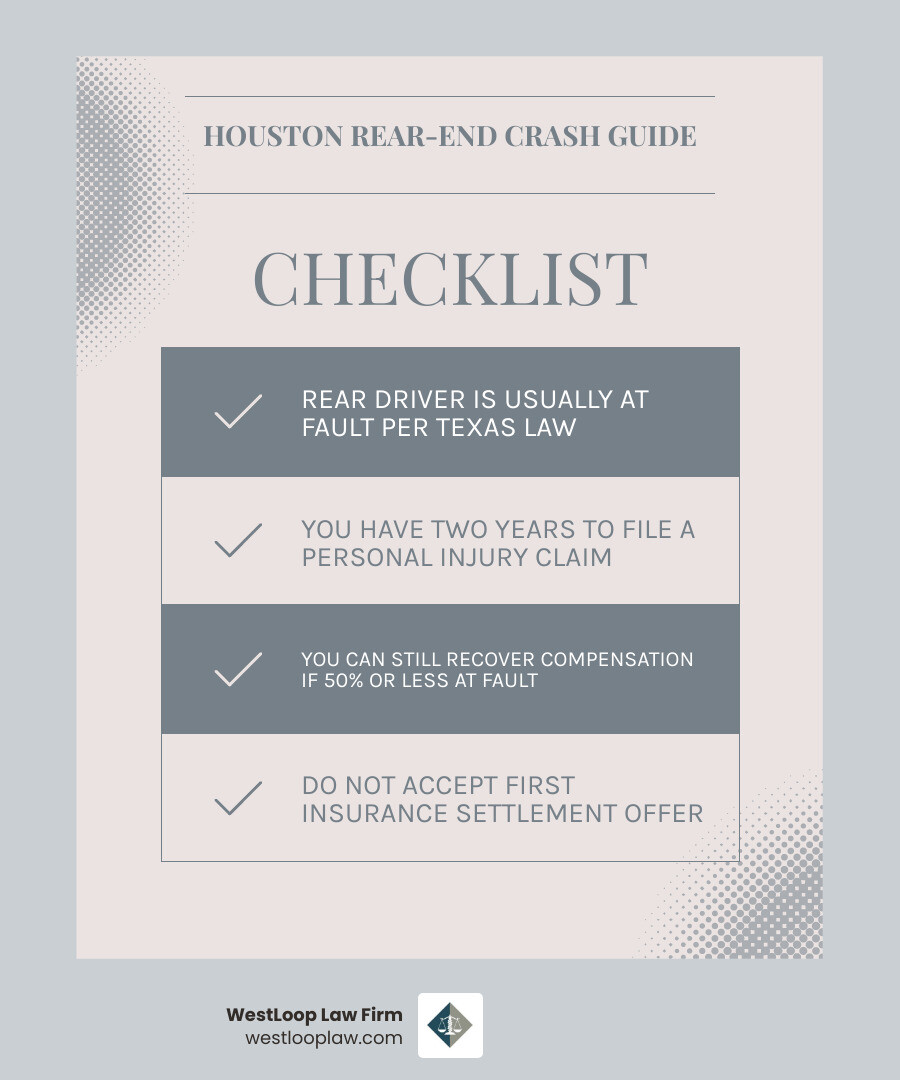
- The rear driver is usually at fault — Texas law presumes the trailing car caused the crash.
- You have two years to file a personal injury claim in Texas.
- You can still recover compensation even if you were partially at fault, as long as you are 50% or less responsible.
- Do not accept the first settlement offer — insurance companies routinely undervalue these claims.
- Get medical care immediately — even if you feel fine. Symptoms like whiplash can appear days later.
Rear-end crashes are far more common — and far more serious — than most people expect. According to the National Highway Traffic Safety Administration, rear-end collisions account for 28 percent of all automobile accidents in the United States. In 2020 alone, 2,428 fatal U.S. crashes involved one vehicle striking the back of another.
In Houston, the problem is amplified. High-traffic corridors like the I-10 Katy Freeway, the 610 Loop, and the Southwest Freeway see constant stop-and-go congestion — exactly the conditions that lead to rear-end impacts. As of 2026, Houston’s continued metro growth means more vehicles, more distracted drivers, and more crash risk for everyday commuters.
If you are dealing with mounting medical bills, missed work, and an injury that wasn’t your fault, you are not alone — and you have legal options.
Basic Rear end collision attorney vocab:
Determining Fault with a Houston Rear End Collision Attorney
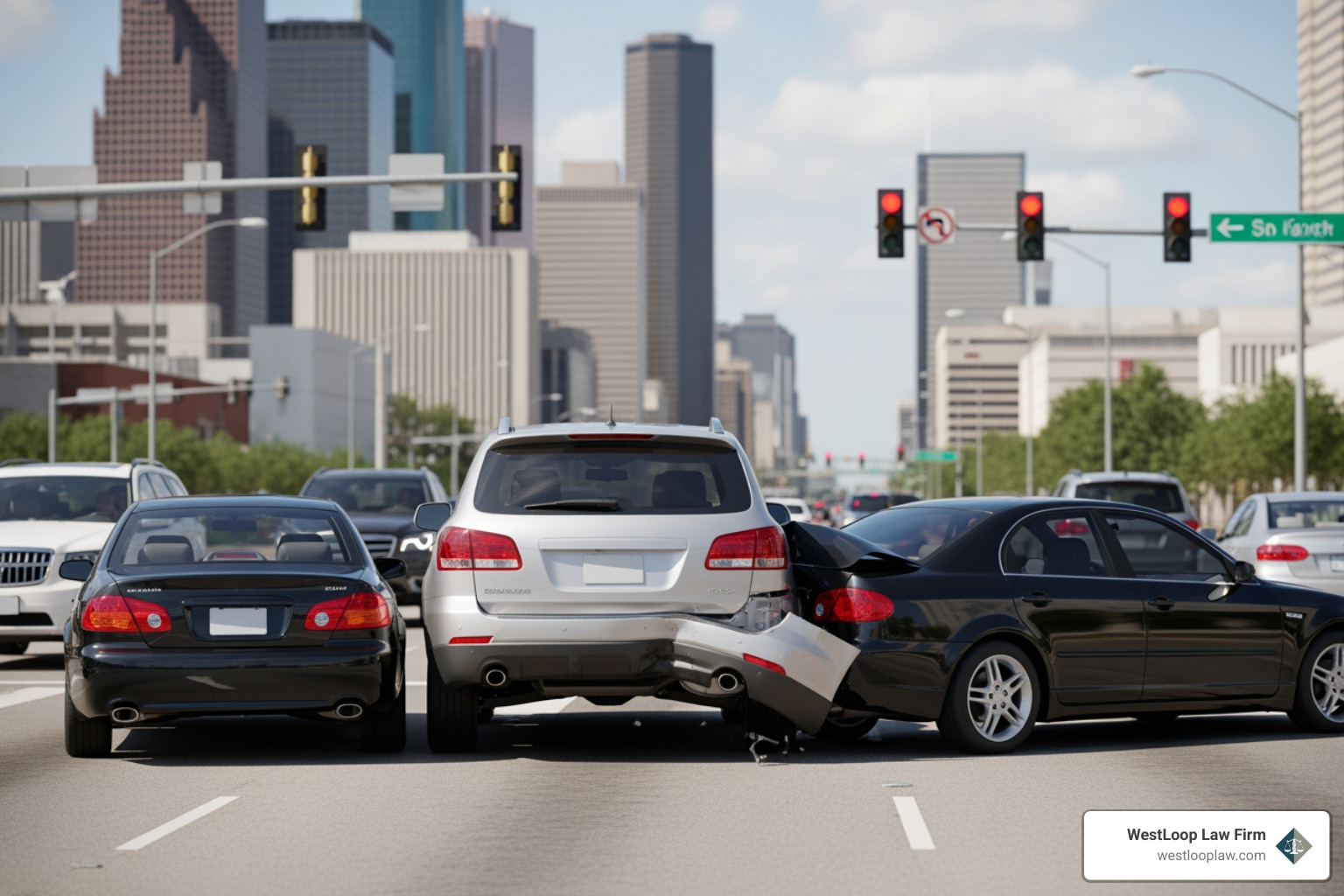
When you are sitting at a red light on Westheimer Road and suddenly feel a massive jolt from behind, you might assume the legal part of your case is a “slam dunk.” While there is a strong legal presumption that the trailing driver is at fault, proving it in a way that satisfies an insurance company or a Harris County jury requires a bit more legwork.
In Texas, every driver owes a “duty of care” to others on the road. This includes maintaining a safe following distance and staying alert. When a driver fails to do this, they have breached that duty. A rear end collision attorney works to show that this breach was the “proximate cause” of your injuries.
Common factors that determine Who’s At Fault After A Rear End Collision include:
- Tailgating Violations: The Texas Transportation Code requires drivers to leave enough space to stop safely.
- Sudden Stops on Feeders: If a driver is speeding on an I-10 feeder road and cannot react to traffic, they are typically liable.
- Faulty Equipment: If the rear driver had non-functioning brakes, their negligence began before they even hit the road.
Proving Negligence in Houston Traffic
Houston is famous for its traffic, but “I was in a rush on the 610 Loop” is not a valid legal defense. Stop-and-go accidents often occur because a driver was looking at their phone instead of the brake lights in front of them.
To build a winning case, we look at several pieces of evidence:
- Houston Police Department (HPD) Reports: These official documents often contain the officer’s initial assessment of who caused the wreck.
- Distracted Driving Data: We can sometimes subpoena cell phone records to prove the other driver was texting or scrolling.
- Commuter Witnesses: Statements from other Houstonians who saw the impact can provide an unbiased account of the lead-up to the crash.
If you’ve been hurt in a crash, consulting a Car Accident Lawyer Houston is the first step in ensuring these pieces of evidence are preserved before they disappear.
Exceptions to the Rear-Driver Liability Rule
Is the rear driver always at fault? Not necessarily. While it’s rare, there are “rebuttable presumptions” where the lead driver or a third party might share the blame.
- Chain Reaction Crashes: On the Southwest Freeway, a pileup might involve four or five cars. Car A hits Car B, which then hits you. In this case, Car A is likely responsible for the entire mess.
- Illegal Lane Changes: If someone “cuts you off” and slams on their brakes immediately, you may not be the negligent party.
- Reversing Accidents: We see this often in crowded parking garages near the Galleria or Downtown Houston—a driver accidentally puts their car in reverse instead of drive.
- Road Rage: If a driver intentionally “brake checks” another out of anger, they may be held liable for the resulting collision.
Common Injuries and Damages in Houston Crashes
Don’t let the term “fender bender” fool you. Even a low-speed impact at 10 mph can generate enough force to cause permanent physical damage. The human body isn’t designed to absorb the sudden transfer of kinetic energy that happens when several thousand pounds of steel hit you from behind.
Frequently reported injuries from Houston rear-end accidents include:
- Whiplash: This is the most common injury, caused by the head snapping forward and back. It can lead to chronic neck pain and headaches.
- Traumatic Brain Injuries (TBI): A concussion can occur even if your head doesn’t hit the steering wheel; the brain can “slosh” against the skull from the force of the impact.
- Spinal Cord Damage and Herniated Discs: The pressure on your lower back during a rear-end hit can cause discs to bulge or rupture, often requiring surgery.
If you experience pain, head straight to an emergency room like Memorial Hermann or Houston Methodist. Getting medical documentation on the same day as your accident is vital for your legal claim. For more on this, check our guide on How To Maximize Compensation For Your Car Accident Claim.
Role of a Houston Rear End Collision Attorney in Negotiations
Insurance adjusters are not your friends. Their job is to settle your claim for as little as possible. They might tell you that because there is “minor” damage to your bumper, you couldn’t possibly be “seriously” injured. This is a classic tactic.
We combat these lowball offers by:
- Documenting Medical Records: We work with your Houston healthcare providers to show the objective reality of your injuries.
- Calculating Future Care: If you need physical therapy for the next six months, that cost must be included in your settlement.
- Standing Our Ground: We know the “defense playbook” and don’t let adjusters bully our clients into accepting pennies on the dollar.
Recoverable Compensation for Houston Victims
When we file a claim, we seek both economic and non-economic damages to make you whole again.
| Damage Type | Examples |
|---|---|
| Economic Damages | Medical bills, car repairs, lost wages, future medical costs |
| Non-Economic Damages | Pain and suffering, mental anguish, loss of enjoyment of life |
| Punitive Damages | Awarded in Harris County courts to punish extreme recklessness (like Drunk Driving) |
Whether you are a shift worker at the Port of Houston or an office professional in the Energy Corridor, lost wages can devastate your family’s finances. We make sure every dollar of lost income is accounted for.
Navigating Texas Comparative Negligence Laws in Houston
Texas follows a “modified comparative fault” system. This is a fancy way of saying that you can still recover money even if you were partly to blame for the accident—up to a point.
In Houston, the “51 percent bar rule” applies. This means:
- If you are 0% at fault, you recover 100% of your damages.
- If you are 20% at fault (perhaps one of your brake lights was out), your total award is reduced by 20%.
- If you are 51% or more at fault, you cannot recover any money from the other driver.
Understanding how these rules play out in a local courtroom is essential. For a deeper dive, read about Understanding Comparative Negligence In Houston Tx.
Why You Need a Houston Rear End Collision Attorney Early
Time is not on your side after a car wreck. In Texas, the statute of limitations for personal injury is generally two years from the date of the accident. While that might sound like a long time, evidence has a habit of disappearing quickly.
A rear end collision attorney helps by:
- Preserving Evidence: We can act quickly to secure “black box” data from the other vehicle, which records speed and braking patterns.
- Securing Video: Many Houston intersections and businesses have surveillance cameras that overwrite footage every few days.
- Managing Paperwork: We handle the filing requirements for Harris County courts so you can focus on physical therapy and recovery.
Immediate Steps to Take After a Houston Car Wreck
What you do in the first 30 minutes after a crash can significantly impact your ability to get paid later. If you are physically able, follow these Steps To Take After A Houston Car Wreck:
- Call 911: Even for a “minor” crash, you want an official police report. If the accident happens on a busy highway like the 59, the dispatcher may send a freeway tow truck to clear the lanes.
- Exchange Info: Get the other driver’s name, phone number, and insurance details.
- Take Photos: Capture the damage to both cars, the position of the vehicles, and nearby street signs or landmarks (like the Williams Tower if you’re near the Galleria).
- See a Doctor: Do not skip this. Adrenaline can mask serious pain. A “gap in treatment” is the #1 reason insurance companies deny claims.
- Call Westloop Law Firm: Before you give a recorded statement to any insurance company, speak with us.
Frequently Asked Questions about Houston Rear-End Accidents
Is the rear driver always at fault in a Houston accident?
While there is a strong presumption that the trailing driver is at fault, it is not absolute. If the lead driver reversed into the rear driver, or if a third car pushed the middle car into the lead car, the rear driver might not be liable. Each case requires a specific investigation.
How long do I have to file a lawsuit in Houston, Texas?
You generally have two years from the date of the crash to file a personal injury lawsuit. However, for property damage or specific claims against government entities (like a METRO bus), the timelines and notice requirements can be much shorter.
Can I still recover compensation if I was partially at fault for a Houston crash?
Yes, thanks to Texas’s modified comparative negligence laws. As long as your percentage of responsibility is 50% or less, you can still recover damages, though your payout will be reduced by your share of the fault.
Conclusion
At Westloop Law Firm, we understand that a rear-end collision is more than just a headache—it’s a disruption to your life, your health, and your family’s future. Our team provides dedicated Houston legal advocacy, combining our deep knowledge of personal injury law with a unique perspective on probate matters to ensure our clients are protected on all fronts.
If you’ve been injured on Houston’s roads, don’t navigate the complex insurance and legal systems alone. We are here to help you hold negligent drivers accountable and secure the compensation you deserve.
Ready to take the next step? Contact us to schedule your free case evaluation.