 Skip to content
What You Need to Know About Houston 18 Wheeler Injury Claims
Houston 18 wheeler injury claims are among the most complex personal injury cases in Texas — and the stakes could not be higher.
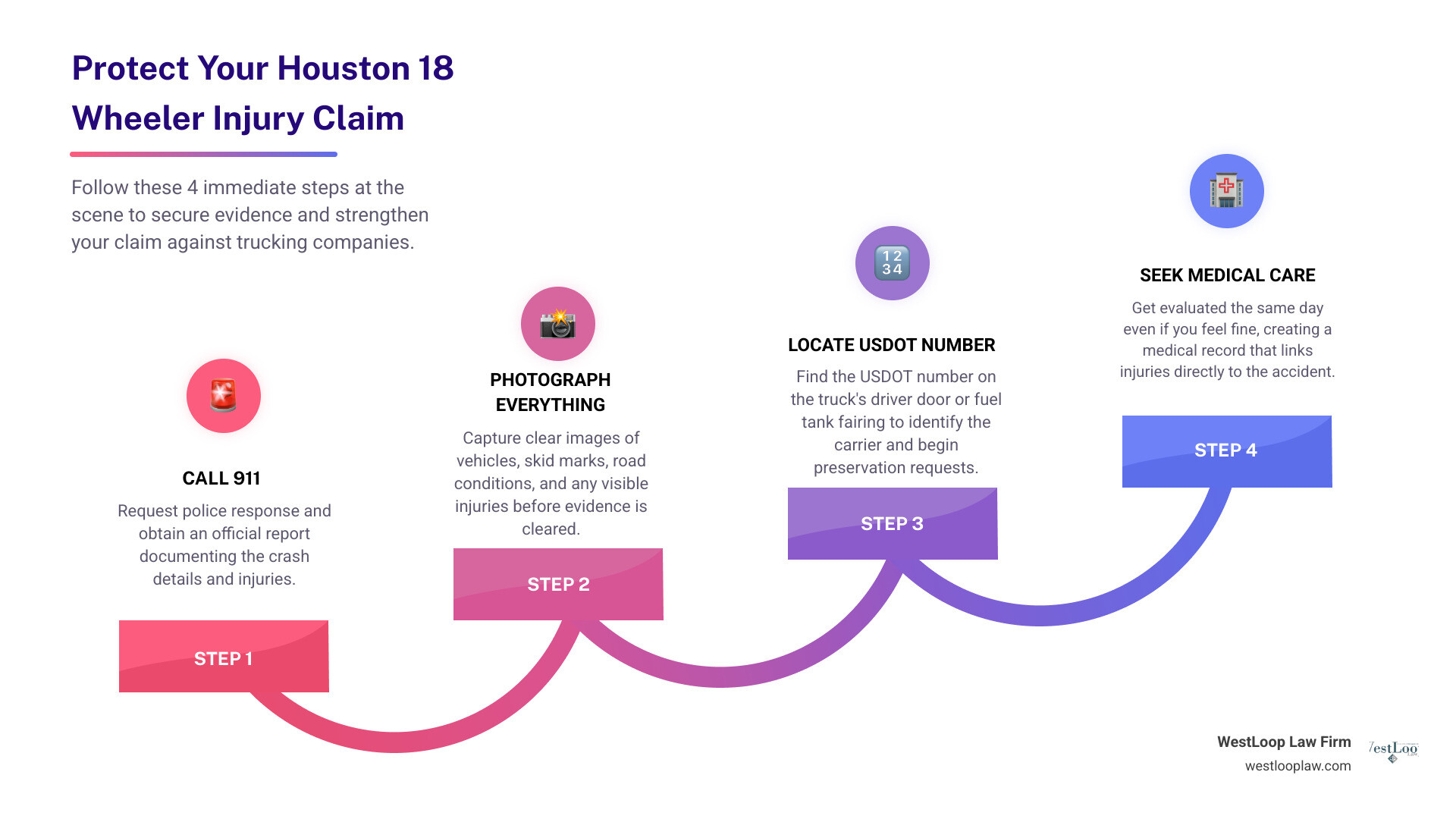
Here is a quick overview of the key steps to protect your claim:
- Call 911 and get a police report at the scene
- Photograph everything — vehicles, injuries, skid marks, road conditions
- Locate the USDOT number on the truck’s door or fuel tank panel
- Seek medical attention the same day, even if you feel fine
- Do not give a recorded statement to the trucking company’s insurance adjuster
- Contact a Houston truck accident attorney immediately to preserve critical evidence
- File your claim within two years under the Texas statute of limitations
Keep reading for a full breakdown of each strategy.
Texas leads the entire nation in large truck accident fatalities. In 2022 alone, 810 people died in serious truck accidents across the state — nearly double the number recorded in California that same year. Harris County, which includes Houston, recorded more than 6,200 commercial vehicle crashes in 2022, making it the most dangerous county in Texas for truck accident victims.
The reason is no mystery. Houston sits at the crossroads of Interstates 10, 45, and 69, plus the Beltway 8 loop. The Port of Houston handles over 247 million tons of cargo annually, pushing a constant stream of heavy commercial trucks through neighborhoods, industrial corridors, and busy freeways every single day.
When an 80,000-pound 18-wheeler collides with a passenger car, the results are rarely minor. Traumatic brain injuries, spinal cord damage, broken bones, and internal injuries are common. The financial toll — medical bills, lost income, long-term care — can be devastating for a middle-aged Texan already stretched thin.
What makes these cases even harder is that trucking companies move fast. Their insurers and defense teams often arrive at crash scenes before the wreckage is cleared. Evidence disappears. Records get deleted. And injured victims are left dealing with the aftermath alone.
That is exactly why knowing the right strategies matters from the moment the crash happens.
Houston 18 wheeler injury claims terms to know:
Key Factors in Houston 18 Wheeler Injury Claims
To navigate Houston 18 wheeler injury claims successfully, we must first understand the local landscape. Houston is a massive economic engine, but its heavy reliance on commercial transportation creates a perfect storm for highway accidents. Harris County consistently leads the state in commercial vehicle wrecks, and the sheer volume of truck traffic around the Port of Houston means our local roads are uniquely hazardous.
When you are involved in an accident with a large commercial vehicle, you are not just dealing with another driver. You are entering a complex legal and regulatory arena. Working with an experienced 18 Wheeler Accident Attorney Houston is critical to level the playing field against large transport carriers and their well-funded insurance teams.
The Unique Nature of Houston 18 wheeler injury claims
An ordinary car crash typically involves two drivers and their respective insurance companies. A commercial truck crash is entirely different.
First, the physical forces involved are catastrophic. A fully loaded semi-truck can weigh up to 80,000 pounds, whereas a standard passenger car weighs around 4,000 pounds. This massive weight discrepancy explains why truck occupants rarely suffer minor injuries, and why passenger vehicle occupants bear the brunt of the impact.
Second, liability is rarely straightforward. In a typical car accident, the negligent party is usually the person behind the wheel. In commercial truck crashes, multiple entities may share responsibility:
- The Truck Driver: For hours-of-service violations, distracted driving, or driving under the influence.
- The Trucking Company: For negligent hiring practices, poor training, or forcing drivers to meet unrealistic deadlines.
- The Maintenance Contractor: For failing to service brakes, tires, or steering systems properly.
- The Cargo Loading Company: For improperly balancing or overloading the trailer, which can cause jackknife or rollover accidents.
- The Parts Manufacturer: If a defective component like a tire blowout or brake failure caused the wreck.
Sorting through these layers of liability requires deep legal knowledge. For a comprehensive look at how these elements interact, you can read our 18 Wheeler Injury Attorney Complete Guide.
How Federal Motor Carrier Safety Regulations Impact Liability
Commercial trucking is heavily regulated by the Federal Motor Carrier Safety Administration (FMCSA). These Federal Motor Carrier Safety Regulations (FMCSR) establish strict standards for everything from driver qualifications to vehicle maintenance.
One of the most critical federal rules is the Hours of Service (HOS) regulation. To combat driver fatigue, the FMCSA limits commercial drivers to a maximum of 11 hours of driving after 10 consecutive hours off duty. Drivers are also barred from driving beyond the 14th consecutive hour after coming on duty.
When a truck driver or motor carrier violates these rules, it is not just a regulatory infraction — it is powerful evidence of negligence. Under Texas law, violating a safety regulation designed to protect the public can establish negligence per se, meaning the driver or company is considered negligent as a matter of law. Proving an HOS violation or a failure to perform required pre-trip inspections can completely transform the strength of Houston 18 wheeler injury claims.
Smart Strategies 1 to 4: Securing Evidence and Proving Fault
In the immediate aftermath of a commercial truck wreck, a quiet battle for evidence begins. Trucking companies employ rapid-response teams that deploy to the scene to gather evidence, interview witnesses, and build a defense to minimize their financial exposure. To protect your rights, we must act quickly to secure the facts. Our team of 18 Wheeler Wreck Lawyers uses these four smart strategies to build an unshakeable foundation for your claim.
1. Preserve Physical Evidence Immediately at the Scene
The moments directly following a crash are chaotic, but if you are physically able, the steps you take at the scene will directly shape your recovery.
First, ensure your physical safety. Move to a safe area away from traffic, call 911, and request both medical assistance and the Houston Police Department or Harris County Sheriff’s Office. An official police report is a vital piece of neutral evidence that insurance companies rely on during early negotiations.
Next, document the scene thoroughly using your smartphone:
- Photograph the Vehicles: Capture close-ups and wide shots of the damage to all vehicles involved from multiple angles.
- Document the Environment: Take photos of skid marks, shattered glass, displaced highway barriers, and road signs.
- Capture Road and Weather Conditions: Wet asphalt, heavy rain, or construction zones can all play a role in proving fault.
- Gather Witness Information: Ask bystanders for their names, phone numbers, and brief statements of what they saw. Do not rely solely on the police officer to collect this information, as witnesses sometimes leave before law enforcement arrives.
2. Locate the USDOT Number and Trucking Company Details
Every commercial truck operating in interstate commerce must display its unique United States Department of Transportation (USDOT) number. This number is a crucial key that unlocks the history of the trucking company and the vehicle itself.
You can typically find the USDOT number painted on or affixed to:
- The driver-side or passenger-side door of the tractor unit.
- The lower side panels near the fuel tanks.
- The side of the cab’s sleeper compartment.
The number will always be preceded by the letters “USDOT” followed by a series of digits. Write this number down or take a clear photograph of it. With this identifier, we can access public federal databases to review the carrier’s safety rating, past crash history, vehicle inspection violations, and insurance coverage limits. If you cannot locate the number because of the severity of the crash, do not panic — we can retrieve it through police reports and registration records.
3. Proving Liability in Houston 18 wheeler injury claims
Proving who is at fault in a commercial truck crash requires looking far beyond the truck driver’s actions in the seconds before impact. While driver-related factors like speeding, distracted driving, or tailgating are common, corporate negligence often lurks beneath the surface.
We investigate whether the motor carrier engaged in:
- Negligent Hiring: Employing a driver with a history of serious traffic violations, drug abuse, or a suspended commercial driver’s license (CDL).
- Negligent Retention: Keeping a driver on the payroll after they racked up multiple safety violations or failed random drug screenings.
- Negligent Training: Failing to instruct drivers on safe mountain driving, cargo securement, or adverse weather operations.
- Improper Maintenance: Allowing a truck with worn brake pads, bald tires, or broken lights to remain on Houston highways like the 610 Loop or Highway 225.
By identifying every negligent party, we can access multiple insurance policies, ensuring there is sufficient coverage to pay for catastrophic injuries.
4. Demand Black Box and Electronic Logging Device Records
Modern commercial trucks are rolling computers. They are equipped with sophisticated electronic systems that capture invaluable data before, during, and after a collision.
- The Electronic Control Module (ECM) / Black Box: This device records critical technical parameters, including vehicle speed, engine RPM, brake application, throttle position, and steering inputs. It can tell us exactly whether the truck driver attempted to brake before the collision or if they were speeding.
- Electronic Logging Devices (ELD): Gone are the days of easily falsified paper logbooks. ELDs automatically record driving time, engine hours, vehicle movement, and miles driven, providing a digital, near-indisputable record of whether the driver violated Hours of Service limits.
However, this data is highly vulnerable. Trucking companies routinely overwrite black box data during normal operations, and federal rules only require carriers to keep certain records like ELD logs for six months. To prevent this critical evidence from being lost or intentionally wiped, we immediately send a formal spoliation letter to the trucking company and their insurer. This legal notice obligates them to preserve all electronic data, dispatch records, and maintenance logs under threat of severe court sanctions.

Smart Strategies 5 to 7: Maximizing Compensation and Meeting Deadlines
Securing evidence is only half the battle. To turn that evidence into a fair financial recovery, you must navigate the insurance claim and legal processes with extreme care. Trucking insurance companies are notorious for using aggressive tactics to minimize payouts. To protect your future, we employ three key strategies designed to maximize your 18 Wheeler Accident Compensation Guide recovery.
5. Avoid Giving Recorded Statements to Insurance Adjusters
Shortly after the accident, you will likely receive a call from an insurance adjuster representing the trucking company. They may sound friendly, sympathetic, and eager to help you resolve your claim quickly.
Do not be fooled. Their primary goal is to protect their company’s bottom line. Adjusters are skilled at asking leading questions designed to get you to admit partial fault, downplay the severity of your injuries, or agree to a premature, lowball settlement.
A common tactic is asking you to provide a “recorded statement.” They will tell you it is standard procedure to process your claim. In reality, they are looking for inconsistencies they can use against you later in court. You are under no legal obligation to provide a recorded statement to the trucking company’s insurer. Simply tell them that you are represented by counsel and refer all their communications to us.
6. Account for All Economic and Non-Economic Damages
A serious 18-wheeler crash can disrupt every aspect of your life. When seeking compensation, we must ensure that every single loss — both present and future — is fully accounted for. We divide these losses into two primary categories:
Economic Damages
These are the tangible, quantifiable financial losses resulting from your injuries:
- Immediate Medical Bills: Emergency room care at local facilities like Memorial Hermann Hospital or Ben Taub Hospital, surgery costs, diagnostic imaging (MRIs, CT scans), and prescription medications.
- Future Medical Expenses: Physical therapy, chiropractic care, prosthetic devices, and long-term rehabilitation or home care.
- Lost Income: The wages you lost while recovering in the hospital or at home.
- Loss of Earning Capacity: If your injuries result in permanent disability or force you to transition to a lower-paying job, you are entitled to the difference in your lifetime earning potential.
Non-Economic Damages
These represent the intangible, human cost of the accident:
- Pain and Suffering: The physical pain and discomfort caused by your injuries and medical treatments.
- Emotional Distress: Anxiety, depression, post-traumatic stress disorder (PTSD), and sleep disturbances following the wreck.
- Loss of Enjoyment of Life: The inability to participate in hobbies, sports, or family activities that were once a central part of your daily routine.
- Loss of Consortium: The negative impact of your injuries on your relationship with your spouse.
We work closely with medical practitioners, life care planners, and economic analysts to calculate the true lifetime cost of your injuries, ensuring you do not accept a settlement that leaves you empty-handed down the road.
7. File Within the Texas Two-Year Statute of Limitations
Under the Texas Civil Practice and Remedies Code, the statute of limitations for personal injury claims is two years from the date of the accident. If you do not file a formal lawsuit before this window closes, you will permanently lose your right to seek compensation.
While two years may sound like a long time, it passes quickly when you are focused on surgeries, physical therapy, and rebuilding your life. Furthermore, building a strong case takes time. Investigating the crash, securing black box data, consulting with reconstructionists, and negotiating with stubborn insurance companies can take months.
Additionally, if the accident resulted in a tragic loss of life, a wrongful death claim must also be filed within this two-year window. Because our firm possesses deep knowledge of both personal injury and probate law, we are uniquely equipped to handle the complex intersection of probate administration and wrongful death claims, ensuring that estate representatives are properly appointed to pursue justice for grieving families.
Frequently Asked Questions About Houston Truck Wrecks
If you are trying to understand the truck injury claim process, you likely have several questions about how these cases work. Here are clear, straightforward answers to the most common questions we receive. For more detailed guidance, explore our Houston 18 Wheeler Accident Lawyer resource page.
How much does it cost to hire a Houston truck accident attorney?
We handle all our personal injury and truck accident cases on a contingency fee basis. This means:
- You pay absolutely zero upfront costs or hourly fees.
- We cover all case expenses, including hiring accident reconstructionists, obtaining medical records, and filing court documents.
- We only receive a fee if we successfully recover compensation for you through a settlement or jury verdict.
- If we do not win your case, you owe us nothing.
This structure ensures that high-quality legal representation is accessible to everyone, regardless of their financial situation.
What is the typical settlement value for a commercial truck crash?
There is no single “average” settlement value because every case depends on its unique facts. However, commercial truck settlements are typically much higher than standard car accident claims because:
- Severe Injuries: The sheer size of an 18-wheeler means injuries are more likely to be catastrophic or permanent, requiring extensive medical care.
- Higher Insurance Limits: Federal regulations require interstate commercial motor carriers to carry at least $750,000 in liability insurance, though many carry policies worth $1 million to $5 million or more.
The ultimate value of your claim will depend on the clarity of fault, the severity of your injuries, your total economic losses, and the amount of available insurance coverage.
Can I recover compensation if I was partially at fault for the accident?
Yes. Texas operates under a modified comparative negligence system, also known as the 51% bar rule.
| Your Percentage of Fault | Can You Recover Compensation? | How Your Compensation is Affected |
|---|---|---|
| 0% to 50% | Yes | Your total recovery is reduced by your exact percentage of fault. For example, if you are awarded $100,000 but found 20% at fault, you will receive $80,000. |
| 51% or More | No | You are barred from recovering any compensation from the other parties. |
Because trucking companies will aggressively try to shift the blame to you to reduce their payout, having a skilled legal team to defend your actions is essential.
Secure Your Future with Dedicated Houston Legal Advocacy
Recovering from an 18-wheeler accident is a long, difficult journey. You should not have to spend your recovery fighting stubborn insurance adjusters, chasing down trucking fleet managers, or decoding complex federal regulations.
At WestLoop Law Firm, we stand up to powerful transport corporations and insurance giants on behalf of everyday Houstonians. Our unique combined background in personal injury and probate law allows us to provide comprehensive, compassionate advocacy for injured victims and families who have lost loved ones in tragic highway accidents.
We will handle every detail of your Houston Trucking Accident Lawyer claim — from issuing spoliation letters and analyzing black box data to negotiating with insurers and preparing your case for trial.
If you or a loved one has been injured in a Houston commercial truck crash, contact WestLoop Law Firm today to schedule your free, confidential consultation. Let us handle the legal fight so you can focus entirely on your healing and your family.