 Skip to content
What You Need to Know About Truck Accident Medical Bills in Houston
Truck accident medical bills in Houston can pile up fast — sometimes reaching six figures before you even leave the hospital.
Here is a quick answer to what most people need to know right away:
Who pays truck accident medical bills in Texas?
- The at-fault driver or trucking company is ultimately responsible under Texas law
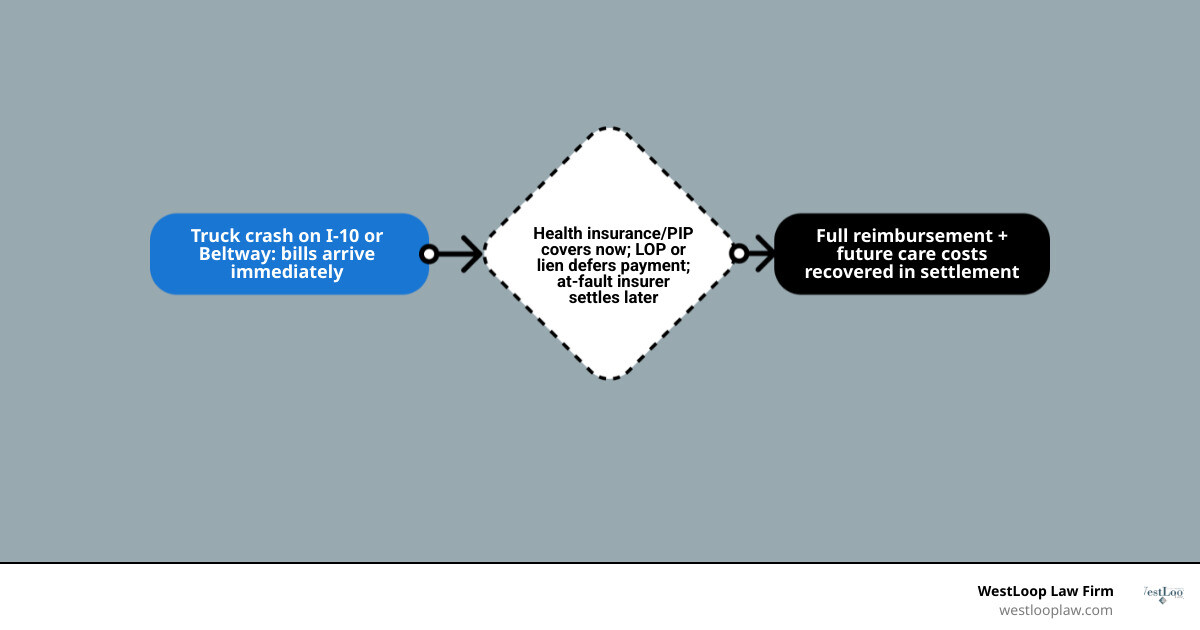
- Your own health insurance or PIP/MedPay can cover costs while you wait for a settlement
- Medical liens and Letters of Protection (LOPs) allow you to get treatment now and pay providers later from your settlement
- The trucking company’s commercial insurer typically pays a lump sum at the end of the claim — not upfront
- Multiple parties may share liability, including the driver, trucking company, cargo loaders, or maintenance contractors
The reality is that the at-fault party’s insurer rarely writes a check the day after the crash. In the meantime, you are responsible for your bills — and the clock is ticking.
According to national data, the average medical cost per injured person in a truck crash runs around $19,000, but serious injuries can push well past $100,000. In Houston, where crashes on I-10, I-45, and the Beltway regularly involve heavy commercial vehicles, those numbers are not uncommon.
This guide walks you through every step: who pays, how to bridge the gap, and how to protect the full value of your claim under Texas law.
Simple Truck accident medical bills word guide:
Who is Responsible for Truck Accident Medical Bills in Texas?
In Texas, the basic rule of personal injury law is simple: the party who caused the accident is legally responsible for the resulting damages, including your medical expenses. However, establishing who that party is can be surprisingly complex after a commercial vehicle collision.
Unlike standard passenger car wrecks, a collision with an 18-wheeler or semi-truck often involves multiple layers of liability. If you are rushed to the emergency room at Memorial Hermann Hospital or another Houston trauma center after a crash on the 610 Loop, several parties may ultimately share financial responsibility for your care:
- The Truck Driver: If the driver was speeding, distracted, fatigued, or driving under the influence, their personal negligence makes them a primary target for liability.
- The Trucking Company: Under the legal doctrine of respondeat superior (vicarious liability), employers are generally responsible for the actions of their employees while they are on the job. Furthermore, the motor carrier can be held directly liable for negligent hiring, training, or failing to maintain their fleet. You can read more about these legal dynamics in our guide to finding a Trucking Accident Lawyer Texas.
- Third-Party Maintenance Companies: Commercial trucks travel thousands of miles every week, requiring constant upkeep. If a third-party contractor failed to properly repair the truck’s brakes or steering system, leading to a mechanical failure, that company may be held responsible.
- Cargo Loaders and Shippers: If an unsecured or overloaded cargo bed caused the truck to jackknife or roll over on Interstate 10, the company responsible for loading the trailer can be held liable.
While these parties are legally responsible, their commercial insurance companies will not pay your medical bills as they arrive. They only pay in a single, lump-sum settlement or court judgment. This makes it critical to understand how to manage your immediate expenses and protect your financial stability while building your case.
How Texas At-Fault Laws Impact Your Medical Recovery
Texas operates under a modified comparative fault system, which is also known as the 51% bar rule or proportionate responsibility. Under this law, your financial recovery is directly tied to your level of fault for the accident.
If you are found to be 50% or less at fault for the crash, you can still recover compensation, though your final payout will be reduced by your percentage of responsibility. For example, if your total eligible medical damages are $100,000, but a jury determines you were 20% at fault for failing to avoid the truck, your recovery will be reduced to $80,000. However, if your share of the fault is found to be 51% or more, you are legally barred from recovering any compensation from the other parties.
Managing these rules requires a strategic approach to proving liability. You can learn more about how fault is established in our Houston Truck Accident Complete Guide.
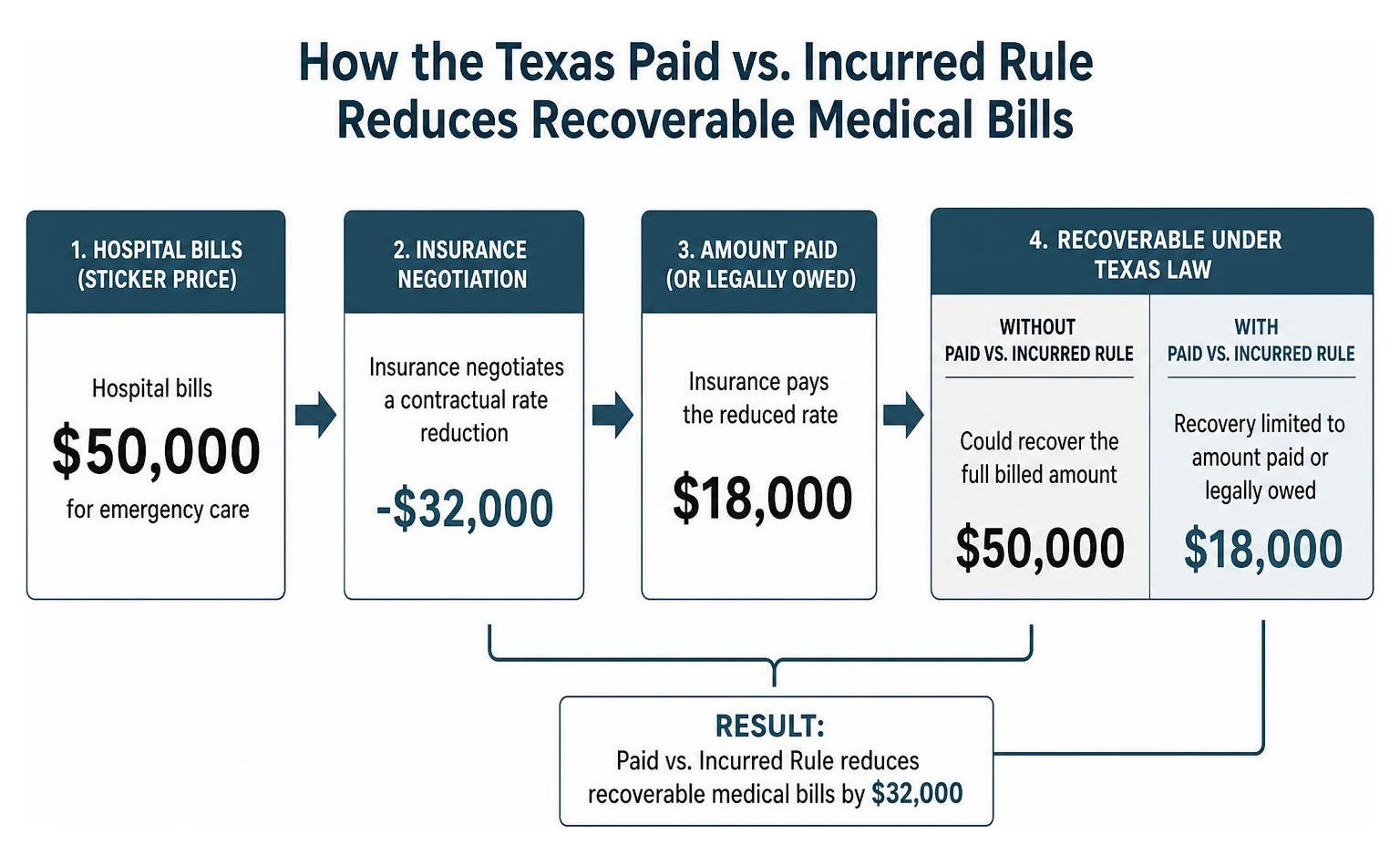
Additionally, Texas Civil Practice and Remedies Code Section 41.0105—frequently referred to as the “paid versus incurred” rule—significantly impacts how medical damages are calculated in Harris County courts. Under this statute, an injured victim can only recover the amount of medical expenses actually paid or legally owed, rather than the initial “sticker price” billed by the hospital.
For example, if a Houston hospital bills $50,000 for your emergency care, but your health insurance company negotiates a contractual rate reduction that settles the bill for $18,000, Texas law limits your past medical expense recovery to that $18,000. This rule prevents plaintiffs from recovering windfall damages based on inflated hospital billing rates that no one actually paid.
Using Health Insurance for Truck Accident Medical Bills
Many people hesitate to use their private health insurance after a truck crash because they believe the at-fault driver’s insurance should pay. However, using your own health insurance, Medicare, or Medicaid is often the smartest way to protect your physical and financial health while your legal claim is pending.
When you use your health insurance, you benefit from their contractual rate reductions. A major medical bill can be slashed by 60% or more, leaving you with much lower out-of-pocket costs. Under the collateral source rule, the fact that you have health insurance cannot be used by the defense to argue that your damages should be ignored.
By routing your bills through health insurance, you keep medical providers from sending your accounts to collections, protecting your credit score while we build your case. If you need local representation to help manage this process, you can explore your options through our guide on Truck Accident Lawyer In Harris County Legal Help.
Personal Injury Protection (PIP) and MedPay in Houston
In Texas, auto insurance companies are legally required to offer Personal Injury Protection (PIP) with every liability policy. PIP is a form of no-fault coverage, meaning it pays out regardless of who caused the truck wreck. The only way you do not have PIP on your Texas auto policy is if you rejected it in writing.
PIP typically covers:
- Reasonable and necessary medical treatments (ambulance rides, surgeries, physical therapy)
- 80% of lost wages resulting from your injuries
- The cost of hiring someone to perform household services you can no longer do
Medical Payments (MedPay) coverage is another optional add-on in Texas. While similar to PIP because it pays medical bills immediately regardless of fault, MedPay only covers direct medical expenses and does not pay for lost wages or non-medical costs.
Coordinating your auto PIP/MedPay with your private health insurance is an excellent way to cover deductibles and co-pays, ensuring you pay nothing out of pocket for your immediate recovery. If you were injured near the Fort Bend County line, you can find specific steps on managing these coverages in our guide on Truck Accident Lawyer In Sugar Land Tx What To Do.
Medical Liens and Letters of Protection in Harris County
If you do not have health insurance or cannot afford your high deductibles, you may feel like you have no way to get the medical care you need. Fortunately, two common legal tools can help you access treatment without paying upfront: Letters of Protection and hospital statutory liens.
A Letter of Protection (LOP) is a legally binding agreement sent by your attorney to a medical provider. The LOP guarantees that the provider will be paid for their services directly out of your final settlement or court judgment. In exchange, the medical provider agrees to treat you immediately and pause all billing collection efforts while your lawsuit is active. This allows you to see orthopedic surgeons, physical therapists, and neurologists in Houston without worrying about immediate out-of-pocket costs.
On the other hand, a hospital statutory lien is created by Texas law under Texas Property Code Chapter 55. If you receive emergency care at a hospital within 72 hours of your truck accident, the hospital has the right to file a lien against your future personal injury settlement. This lien is filed in the county property records (such as Harris County) and must be paid before any settlement funds can be distributed to you.
While a lien sounds intimidating, it is a routine part of personal injury cases that our legal team can negotiate down once your case resolves. For more detailed information, consult our Trucking Accident Attorney Houston Guide or read about handling claims in neighboring areas with our guide, Truck Accident Lawyer In Pearland Tx What To Do.
Calculating Future Medical Expenses and Lifetime Care Costs
When a commercial semi-truck collides with a passenger vehicle, the sheer physical force often causes catastrophic, life-altering injuries. While past medical bills are relatively easy to calculate by adding up your receipts, determining the cost of future medical care requires deep analysis.
Before settling any claim, you must reach Maximum Medical Improvement (MMI). MMI is the point at which your treating doctors believe your physical condition has stabilized and is unlikely to improve any further. Settling your case before reaching MMI is a critical mistake, as you cannot reopen a claim to ask for more money if you discover you need another surgery down the road.
For severe injuries, such as traumatic brain injuries (TBI) or spinal cord damage, future care costs can easily reach millions of dollars over a lifetime. To accurately calculate these damages, we work with professional life care planners and medical economists. These professionals create a comprehensive projection of your lifetime medical needs, including:
- Future surgeries, doctor visits, and diagnostic imaging
- Long-term rehabilitation and physical therapy
- Prescription medications and medical devices (such as wheelchairs or prosthetics)
- In-home nursing care or assisted living accommodations
- Home and vehicle modifications to accommodate physical limitations
To understand how these future costs impact your overall recovery, you can read our Houston Truck Accident Settlements Complete Guide.
Protecting Your Claim for Truck Accident Medical Bills
The steps you take in the hours, days, and weeks following a commercial truck wreck will directly impact your ability to recover full compensation for your medical bills. To protect your claim, we recommend taking the following actions:
- Seek an Immediate Medical Evaluation: Even if you think your injuries are minor, go to an emergency room, urgent care clinic, or your primary care physician immediately. Adrenaline can mask severe internal injuries, and a delay in seeking care will be used by the insurance company to argue that your injuries were not caused by the crash.
- Follow Your Treatment Plan to the Letter: Attend every physical therapy session, fill every prescription, and follow all of your doctor’s restrictions. Skipping appointments or ignoring medical advice creates gaps in care that insurance adjusters will use to claim you are exaggerating your pain.
- Document All Expenses: Keep an organized file of every medical bill, explanation of benefits (EOB), pharmacy receipt, and travel expense related to your medical care.
- Avoid Giving Recorded Statements: Do not speak to the trucking company’s insurance adjusters or give recorded statements without an attorney present. Their goal is to get you to admit fault or downplay your injuries.
For a deeper dive into protecting your rights, read our comprehensive Houston Truck Accident Injury Lawyer Guide.
Frequently Asked Questions About Houston Truck Wreck Bills
What happens if the trucking company’s insurance denies my claim?
It is common for commercial insurance companies to deny liability or delay payments after a major wreck. They may claim that you were the one who caused the crash, or that your injuries are related to a pre-existing medical condition.
If the insurer refuses to offer a fair settlement, your attorney can file a formal personal injury lawsuit in a Harris County civil court. Filing a lawsuit signals to the defense that you are serious, and it initiates the discovery process, allowing us to demand internal trucking company records, maintenance logs, and black box data. To understand why having legal representation is so critical during a denial, read about The Importance Of Hiring A Truck Accident Lawyer In Houston.
How does subrogation affect my final settlement?
Subrogation is the legal process by which an insurance company (like your health insurer or auto PIP provider) seeks reimbursement for the money they paid on your behalf. If your health insurance paid $20,000 for your medical care after a truck accident, and you later win a $100,000 settlement from the trucking company, your health insurer has a legal right to demand their $20,000 back from your settlement.
However, these subrogation claims are not set in stone. An experienced attorney can negotiate with your health insurance company to reduce their subrogation lien, leaving more money in your pocket at the end of the day. For more information on navigating these complex financial negotiations, see our Truck Accident Attorneys Ultimate Guide.
When should I contact a Houston truck accident lawyer?
You should contact a lawyer as soon as possible after a collision. Under Texas law, the statute of limitations for personal injury claims is generally two years from the date of the accident.
However, waiting to take action can be devastating to your case. Trucking companies are only required to preserve certain records, like driver logs and black box data, for a limited time. If you do not act quickly to send a formal spoliation letter, critical evidence that proves the truck driver’s negligence could be legally destroyed. Early legal intervention ensures all evidence is preserved and your medical bills are managed correctly from day one.
Secure Your Financial Recovery with WestLoop Law Firm
Managing a mountain of Truck accident medical bills while trying to heal from severe injuries is an overwhelming experience. You do not have to carry this financial and legal burden alone.
At WestLoop Law Firm, we offer experienced legal representation to injury victims across the greater Houston area. With our deep background in personal injury and probate law, we are uniquely positioned to handle complex commercial vehicle claims, protect your rights, and pursue the maximum compensation you deserve.
Whether you were injured on I-10, the loop, or in Sugar Land or Pearland, our team is ready to stand up to aggressive commercial insurance companies on your behalf. We work on a contingency-fee basis, meaning you pay us nothing upfront, and we only get paid if we win your case.
Take the first step toward securing your financial recovery in July 2026. For a complete look at how we fight for our clients, read our Houston Truck Accident Lawyers Ultimate Guide.
Contact WestLoop Law Firm today to schedule your free case evaluation, or visit our Houston office by finding us on Google Maps at WestLoop Law Firm. Let us handle the insurance companies so you can focus on your physical recovery.