 Skip to content
What You Need to Know Before Filing a Houston Accident Insurance Claim
Filing a Houston accident insurance claim can feel overwhelming — especially when you’re dealing with injuries, a damaged vehicle, and non-stop calls from insurance adjusters all at the same time.
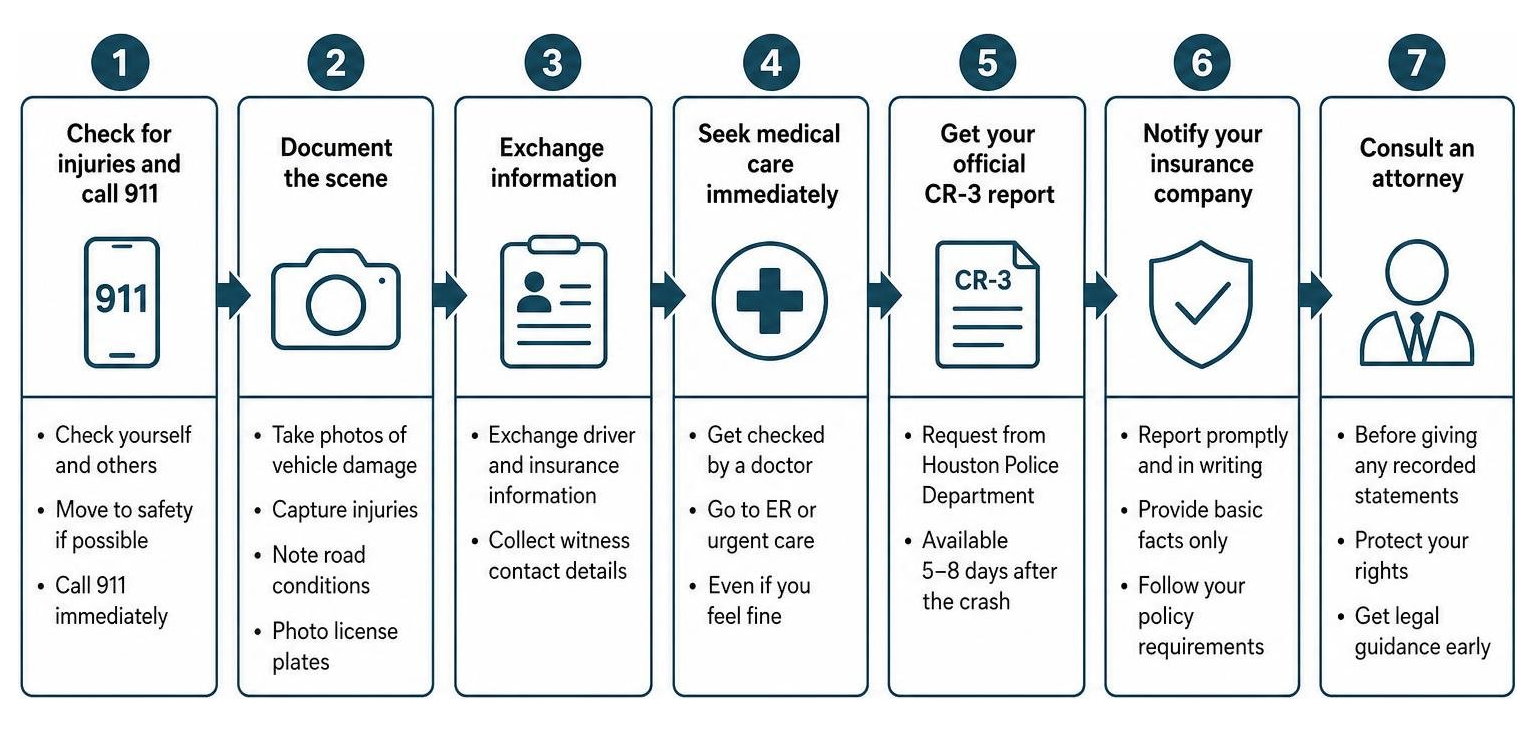
Here’s a quick overview of the key steps:
- Check for injuries and call 911 — especially on busy routes like I-10, the 610 Loop, I-45, or US-59
- Document the scene — take photos of all vehicle damage, injuries, road conditions, and license plates
- Exchange information with the other driver and collect witness contact details
- Seek medical care immediately — even if you feel fine — at facilities like Memorial Hermann or Ben Taub Hospital
- Get your official CR-3 crash report from the Houston Police Department (available 5–8 days after the crash)
- Notify your insurance company promptly and in writing
- Consult an attorney before giving any recorded statements to an insurance adjuster
The stakes are real. Texas sees one reportable crash every 56 seconds, and Harris County consistently ranks among the most crash-heavy counties in the state. With more than 2.3 million registered vehicles registered in Harris County alone, accidents on Houston roads happen every single day.
What many drivers don’t realize is that the decisions made in the first few days after a crash — what you say, what you sign, and who you talk to — can significantly affect how much compensation you ultimately receive.
This guide walks you through every step of the process, from the scene of the crash to settlement, including what to do if the City of Houston itself is responsible for your damages.
Houston accident insurance claim word roundup:
Immediate Steps to Take After a Crash on Houston Roads

The first sixty seconds after a collision are usually a blur of adrenaline and confusion. However, taking a deep breath and following a structured plan can protect both your physical well-being and your future financial recovery.
First, safety is the absolute priority. If you are on a busy Houston highway, move your vehicle to the shoulder or a safe area if possible to avoid secondary collisions. Turn on your hazard lights immediately. Once you are in a safe position, exchange contact, driver’s license, and insurance information with the other driver. Avoid discussing who caused the crash or apologizing, as insurance adjusters can later twist these polite statements into admissions of fault.
While you are exchanging information, look around for any witnesses who stopped. Ask for their names and phone numbers. Their unbiased accounts can be invaluable if the other driver’s story changes later. To understand more about your immediate protections and legal standing on local roads, you can read about what to do after a car crash in Houston — your rights, explained.
Securing the Scene and Seeking Medical Care
Major Houston corridors like I-10, the 610 Loop, I-45, and US-59 are notorious for high-speed, multi-vehicle pileups. If you are involved in a wreck on these routes, dispatch emergency services immediately. Even if you think your injuries are minor, you should undergo a thorough medical evaluation as soon as possible.
Adrenaline can mask severe pain and serious conditions, such as internal bleeding, concussions, or soft-tissue damage. Seeking prompt evaluation at local emergency centers like Memorial Hermann Hospital or Ben Taub Hospital ensures your injuries are diagnosed and treated early.
Furthermore, this prompt medical attention establishes a direct, official link between the collision and your injuries. If you delay medical care, the insurance company will almost certainly argue that your injuries were caused by something else or are not as severe as you claim. To better understand how medical documentation directly impacts your financial recovery, review our guide on What to Know About the Injury Claim Process in Houston, TX.
Gathering Evidence for Your Houston Accident Insurance Claim
When it comes to dealing with auto insurers, documentation is your strongest asset. If it is safe to do so, use your phone to take extensive photographs and videos of the scene. Be sure to capture:
- The positions of all vehicles involved
- Close-ups of the property damage on all cars
- License plates and insurance cards
- Skid marks, broken glass, or debris on the road
- Traffic signs, signals, and road construction markings
- Any visible physical injuries you or your passengers sustained
Additionally, check if your vehicle or any nearby vehicles have active dashcams, and ask business owners in the immediate area if their security cameras captured the incident. Backing up these physical details with witness statements will make it much harder for an insurance carrier to deny liability. For a detailed breakdown of how to compile this evidence to build a bulletproof case, check out our resource on How to Maximize Compensation for Your Car Accident Claim.
Understanding the Texas At-Fault Insurance System
Texas operates under an “at-fault” (or tort) insurance system. This means that the driver who causes a motor vehicle collision is legally and financially responsible for paying for the resulting damages, including medical bills, lost income, and vehicle repairs.
To legally operate a vehicle in Texas, drivers must carry minimum liability coverage. These statutory minimums are often referred to as “30/60/25” coverage:
- $30,000 for bodily injury per person in an accident
- $60,000 total bodily injury coverage per accident (if multiple people are hurt)
- $25,000 for property damage per accident
While these are the minimum legal requirements, severe crashes often result in medical bills and property damage that quickly exceed these limits. When an accident occurs, insurance adjusters from both sides will investigate to assign fault. They will review police reports, examine vehicle damage, and analyze statements to determine who violated Texas traffic laws.
First-Party vs. Third-Party Claims and UM/UIM Coverage
When you file a houston accident insurance claim, you can pursue compensation through two primary avenues: first-party claims and third-party claims.
- First-Party Claims: These are claims you file directly with your own insurance company under coverages you pay premiums for, such as Collision coverage, Personal Injury Protection (PIP), or Medical Payments (MedPay). PIP is especially valuable in Texas because it typically covers up to $2,500 (or more, depending on your policy) in medical bills and lost wages regardless of who caused the crash.
- Third-Party Claims: These are claims you file against the at-fault driver’s liability policy.
If the driver who hit you does not have insurance (which is the case for roughly 13.7% of Texas motorists) or does not have enough insurance to cover your bills, you must turn to Uninsured/Underinsured Motorist (UM/UIM) coverage. This coverage protects you in hit-and-run scenarios and crashes with underinsured drivers. If you want to dive deeper into how these coverages interact, read our detailed article on Car Accident Claim Insurance. You can also learn more about these policies by reviewing standard options with a legal professional who understands Texas insurance policies.
Texas Insurance Deadlines and Your Right to Choose a Repair Shop
Under the Texas Prompt Payment of Claims Act, insurance companies must adhere to strict, state-mandated timelines when handling first-party claims:
- Acknowledgment: The insurer has 15 days to acknowledge your claim, begin an investigation, and request all necessary documents.
- Decision: Once they receive all requested items, they must approve or deny your claim within 15 business days.
- Payment: If they approve your claim, they must issue payment within 5 business days.
When it comes to getting your vehicle fixed, Texas law grants you the absolute right to choose your own repair shop. An insurance company cannot force you to use their “preferred” or “network” shops. Additionally, you have the right to request Original Equipment Manufacturer (OEM) parts rather than cheaper, aftermarket parts to ensure your vehicle is restored to its pre-accident safety standards. To learn more about protecting your vehicle’s resale value and navigating repair disputes, check out our Houston Property Damage Claim Survival Guide.
How to Obtain Your Official Houston Police Accident Report (CR-3)
An official Texas Peace Officer Crash Report (Form CR-3) is one of the most critical pieces of evidence for your houston accident insurance claim. Under Texas Transportation Code Section 550.062, a law enforcement officer must file a CR-3 report within 10 days of an accident if the collision resulted in injury, death, or apparent property damage of $1,000 or more.
This report contains objective facts recorded by the responding officer, including:
- The date, time, and exact location of the crash
- Contact and insurance details for all drivers
- Weather, road, and lighting conditions
- A visual diagram of the collision and a narrative of what happened
- Citations issued or traffic laws violated
- The officer’s initial assessment of contributing factors and fault
Methods, Fees, and Timelines for Retrieving a CR-3 Report
Because CR-3 reports contain sensitive personal data, Texas law restricts access to involved parties, their legal representatives, and authorized insurers. It typically takes 5 to 8 business days (and sometimes up to two weeks) for a report to be processed and made available.
You can obtain your report through three primary methods:
- Online via the TxDOT Crash Report Purchase Portal: This is the fastest method. You can search for and purchase your report using the date of the crash, the county, and the names of the drivers involved.
- In-Person at the Houston Police Department Records Division: You can visit the HPD Records Division located at 1200 Travis Street, Houston, TX 77002. Be sure to bring a valid government-issued ID, your HPD incident number, and the required fee.
- By Mail: You can download and complete the HPD crash report request form (complying with H.B. 2633), enclose a check or money order, and mail it with a self-addressed, stamped envelope to the HPD Records Division.
Fees for Crash Reports:
- Standard Copy: $6.00
- Certified Copy: $8.00 (highly recommended if you anticipate filing a lawsuit, as certified copies are generally required for court proceedings)
Texas Laws That Impact Your Houston Accident Insurance Claim
Every insurance claim and personal injury lawsuit in Houston is governed by the Texas Civil Practice and Remedies Code. Understanding these statutory rules is essential because failing to follow them can completely bar you from recovering compensation. If you need representation to navigate these complex laws, consulting a qualified Auto Accident Claim Lawyer is a smart first step.
Statute of Limitations and Modified Comparative Negligence (51% Bar Rule)
Under Texas Civil Practice and Remedies Code Section 16.003, the statute of limitations for a personal injury claim is two years from the date of the accident. If you do not file a formal lawsuit within this two-year window, you lose your legal right to pursue compensation forever.
While there are rare tolling exceptions — such as when the victim is a minor, experiences temporary mental incapacity, or if the defendant flees the state — you should never rely on these exceptions without consulting a Car Accident Claim Attorney.
Texas also follows a modified comparative negligence rule (specifically, a 51% bar rule). This means you can recover damages as long as your percentage of responsibility is 50% or less. However, your final financial recovery will be reduced by your percentage of fault. For example, if a jury determines your total damages are $100,000 but finds you 20% at fault for failing to signal, your recovery is reduced by 20%, leaving you with $80,000. If you are found 51% or more at fault, you are completely barred from recovering any compensation. To learn more about how fault is negotiated, you can read about the legal strategies used to protect accident victims.
Recoverable Damages and Texas Statutory Caps
In a Texas auto accident claim, you have the right to pursue three main categories of damages: economic, non-economic, and punitive. Unlike medical malpractice cases, standard car accident claims in Texas do not have caps on economic or non-economic damages. However, punitive damages (exemplary damages meant to punish egregious behavior like drunk driving) are capped under Texas law at the greater of $200,000 or two times economic damages plus non-economic damages (not to exceed $750,000).
| Damage Category | Type of Loss | Examples |
|---|---|---|
| Economic Damages | Verifiable financial losses | Medical bills, future medical care, lost wages, loss of earning capacity, and property damage repairs |
| Non-Economic Damages | Subjective, non-monetary losses | Pain and suffering, mental anguish, physical impairment, disfigurement, and loss of enjoyment of life |
| Punitive Damages | Punishment for gross negligence | Awarded by a jury to punish drunk driving, street racing, or intentional misconduct |
Filing a Claim Against the City of Houston vs. a Private Driver
Filing a claim against a private driver and their insurance company is a relatively straightforward process. However, if your accident involved a municipal vehicle (such as a METRO bus, an HPD patrol car, or a City of Houston garbage truck), you face an entirely different legal landscape.
Under the legal doctrine of sovereign immunity, government entities are generally protected from lawsuits. However, the Texas Tort Claims Act carves out specific exceptions, allowing citizens to hold the government liable for personal injury or property damage caused by the negligent operation of motor-driven vehicles or equipment by a city employee acting within their scope of employment.
Strict 90-Day Notice Requirements Under the City Charter
When you file a claim against a private driver, you have up to two years to act. But when you are filing a claim against the City of Houston, you must act immediately. Under Article IX, Section 11 of the Houston City Charter, you must file a formal, written “Notice of Claim” within 90 days of the date of the incident. If you miss this strict 90-day deadline, your claim will be permanently barred, and you will receive zero compensation.
To file a valid municipal claim, your written notice must include:
- The date, time, and exact location of the incident
- A detailed description of how the accident occurred
- The specific damage to your property and the nature of your physical injuries
- The amount of monetary compensation you are seeking
- The names and contact details of any witnesses
This written statement must be signed in the presence of a Notary Public. You must mail the notarized document, along with three independent repair estimates, scene photographs, the police report, and copies of your medical bills, to the City Secretary’s Office (P.O. Box 1562, Houston, TX 77251) and send a duplicate copy to the City Attorney’s Office Claims/Subrogation Section.
Municipal Liability Exemptions for Potholes and Sewer Lines
Many Houstonians assume the City of Houston is liable for vehicle damage caused by the city’s notoriously bad potholes or home damage caused by backed-up city sewer lines. Unfortunately, Texas state law heavily protects municipalities from these types of claims.
- Potholes and Road Debris: Under Texas law, road maintenance is classified as a governmental function. The City of Houston is generally exempt from liability for property damage caused by potholes, road wear, or loose objects on city streets. Unless you can prove the city had actual, written notice of a specific pothole and failed to repair it within a reasonable timeframe (which is incredibly difficult to prove), your property damage claim will be denied.
- Sewer Backups: Similarly, the city is not legally liable for property damage resulting from clogged, defective, or backed-up municipal sewer lines. Homeowners are expected to rely on their own private homeowners’ insurance policies to cover these repairs.
Overcoming Common Insurance Company Tactics
It is vital to remember that insurance companies are businesses. Their primary goal is to protect their financial bottom line, which means keeping payouts as low as possible. Within days of your accident, an insurance adjuster will likely call you, acting friendly and offering a quick settlement.
Do not fall for this. Early settlement offers are almost always “lowball” offers designed to resolve your claim before you know the full extent of your injuries or the cost of your future medical care. Once you sign a settlement release, you waive your right to ask for more money later, even if you discover you need surgery. To protect yourself from these early traps, read our survival guide on How to Insurance Companies After a Car Accident.
Protecting Your Rights During a Houston Accident Insurance Claim Investigation
Insurance adjusters use several common tactics to devalue or deny valid claims:
- Recorded Statements: Adjusters will ask you to provide a recorded statement, claiming it is standard procedure to “get your side of the story.” In reality, they are looking for any minor inconsistency, hesitation, or casual phrase (like “I’m doing okay”) to argue that you are exaggerating your injuries or admitting fault.
- Broad Medical Authorizations: They may ask you to sign a blanket medical release to verify your injuries. However, these forms often allow them to dig through your entire medical history from years before the crash, searching for pre-existing conditions they can blame for your current pain.
To protect your claim, politely decline to give a recorded statement and refuse to sign broad medical releases without legal counsel. Instead, keep a detailed daily journal documenting your physical pain levels, emotional struggles, and missed activities. Keep a rigorous log of all communications with the insurance company, and let a qualified attorney handle the negotiations on a contingency fee basis. This means you pay nothing upfront, and your legal team only gets paid if they successfully recover compensation for you. For more information on how a dedicated legal advocate can shield you from these corporate tactics, check out our resource on the role of a Houston Insurance Claim Attorney.
Frequently Asked Questions About Houston Accident Claims
What happens if I miss the 90-day deadline to file a claim against the City of Houston?
If you fail to submit a notarized, written Notice of Claim to the City Secretary’s Office within 90 days of the incident, your claim will be permanently barred under Article IX, Section 11 of the Houston City Charter. The city will refuse to pay any compensation, and you will lose your legal right to file a lawsuit.
Can I still recover compensation if I was partially at fault for a Houston car crash?
Yes, under Texas’s modified comparative negligence law, you can recover compensation as long as your share of the blame is 50% or less. Your final financial recovery will simply be reduced by your percentage of fault. If you are found 51% or more at fault, you cannot recover any damages.
Is the City of Houston liable for vehicle damage caused by potholes?
No. Under Texas state law, the City of Houston is generally immune from liability for property damage caused by the condition of its streets, including potholes and road debris. Drivers must rely on their own collision insurance coverage to pay for these repairs.
Let Us Handle the Insurance Fight While You Heal
Dealing with a houston accident insurance claim while recovering from serious injuries can be exhausting. Insurance adjusters are trained to use confusing legal jargon, tight deadlines, and high-pressure tactics to get you to settle for less than you deserve. You do not have to fight this battle alone.
At WestLoop Law Firm, we offer a unique and powerful combination of personal injury advocacy and probate litigation support. This dual capability is incredibly beneficial for families navigating complex injury claims or handling wrongful death claims that require establishing estates through probate court. We handle every aspect of your claim — from gathering police records and medical bills to negotiating with stubborn insurance carriers — so you can focus entirely on your physical recovery.
We work on a contingency fee basis, meaning we charge no upfront fees, and you only pay us if we win your case. If you are ready to stand up to the insurance companies and secure the maximum compensation for your medical bills, lost wages, and pain and suffering, schedule a free consultation with us today at WestLoop Law Firm.