 Skip to content
Common Causes and High-Risk Corridors for Houston Rear-End Crashes
Navigating Houston traffic can feel like an Olympic sport where nobody asked to participate. Between heavy gridlock, sudden lane changes, and erratic weather, driver reaction times are tested every single day.
According to statistics from the National Highway Traffic Safety Administration (NHTSA), rear-end crashes make up nearly 29% of all motor vehicle accidents across the nation. In urban hubs like Houston, over 50,000 rear-end collisions happen every year, placing Houston among the top 10 U.S. cities for these types of injury claims.
Understanding why these crashes happen—and where they happen most often—is critical when building a personal injury claim.
Primary Causes of Rear-End Accidents in Houston
- Distracted Driving: The Houston Police Department reports that distracted driving causes 38% of all rear-end crashes in the city. Drivers checking text messages, setting GPS routes, or eating while commuting down Katy Freeway (I-10) often fail to notice traffic slowing ahead.
- Tailgating (Following Too Closely): Leaving less than three to four seconds of space behind another vehicle leaves zero room for error when a sudden stop occurs.
- Speeding and Aggressive Driving: Drivers flying down the 610 Loop at high speeds cannot stop in time when traffic abruptly grinds to a halt.
- Severe Weather and Slick Roads: Heavy downpours in Houston create slick conditions, especially on major thoroughfares like Southwest Freeway (US-59). Wet pavement dramatically increases braking distance.
- Drunk or Impaired Driving: Impaired drivers experience delayed reaction times, preventing them from applying brakes before impact.
Houston’s Most Dangerous Corridors for Rear-End Crashes
Stop-and-go congestion creates ideal conditions for rear-end impacts. Some of the most notorious spots in the Houston metropolitan area include:
- Interstate 45 (I-45): Known for heavy commuter congestion and frequent construction zone slowdowns.
- The 610 Loop: Constant lane changing and rapid speed transitions around West Loop North and South make this ring road a hot spot for bumper-to-bumper pileups.
- Interstate 10 (Katy Freeway): Wide lanes and high traffic volume lead to sudden, unexpected traffic stops.
- Sam Houston Tollway (Beltway 8): Sudden slowdowns near toll plazas and exit ramps frequently result in tailgating collisions.
If you were involved in a collision on one of these roadways, review our step-by-step guide on What to Do After a Car Accident in Houston to make sure you protect your rights from day one.
Why You Need a Houston Rear End Collision Attorney to Prove Liability and Maximize Compensation

Many accident victims assume that proving fault in a rear-end collision is automatic. While the driver who hits you from behind is usually presumed responsible, insurance companies work hard to challenge that presumption or minimize your payout.
An experienced Houston rear end collision attorney protects your claim against lowball settlement offers and unfair tactics. Roughly 70% of rear-end crash victims in Houston choose to retain legal representation, and data shows that victims who work with an attorney secure settlements that average 3.5 times higher than those who handle claims on their own.
What Compensation Can You Recover?
Typical settlements for a Houston rear-end crash range from $10,000 to $50,000 for moderate soft-tissue injuries like whiplash. However, when injuries involve severe spinal cord damage, traumatic brain injuries, or require surgery, compensation can easily exceed $100,000 or more.
At WestLoop Law Firm, we aggressively seek recovery for all available economic and non-economic damages:
- Medical Expenses: Emergency room bills from facilities like Memorial Hermann Hospital or Ben Taub Hospital, ongoing physical therapy, prescription medication, surgeries, and future medical care.
- Lost Income: Unpaid time away from work while recovering, as well as reduced earning capacity if your injuries cause long-term disability.
- Property Damage: Complete vehicle repair costs or fair market cash value if your car is declared a total loss.
- Pain and Suffering: Physical distress, emotional trauma, reduced quality of life, and loss of enjoyment.
To learn how an attorney builds the true value of your claim, read our guide on How to Maximize Compensation for Your Car Accident Claim. You can also visit our dedicated Rear-End Collision Attorney Houston page for specific case information.
How a Houston Rear End Collision Attorney Counteracts Sudden Emergency Claims
Insurance adjusters often try to dodge liability by asserting legal defenses such as the “sudden emergency doctrine” or mechanical failure. They may claim their policyholder hit you because:
- A mechanical glitch caused their brakes to fail without warning.
- Another driver abruptly cut into their lane, creating an unforeseen emergency.
- You stopped abruptly without reason or had non-functioning brake lights.
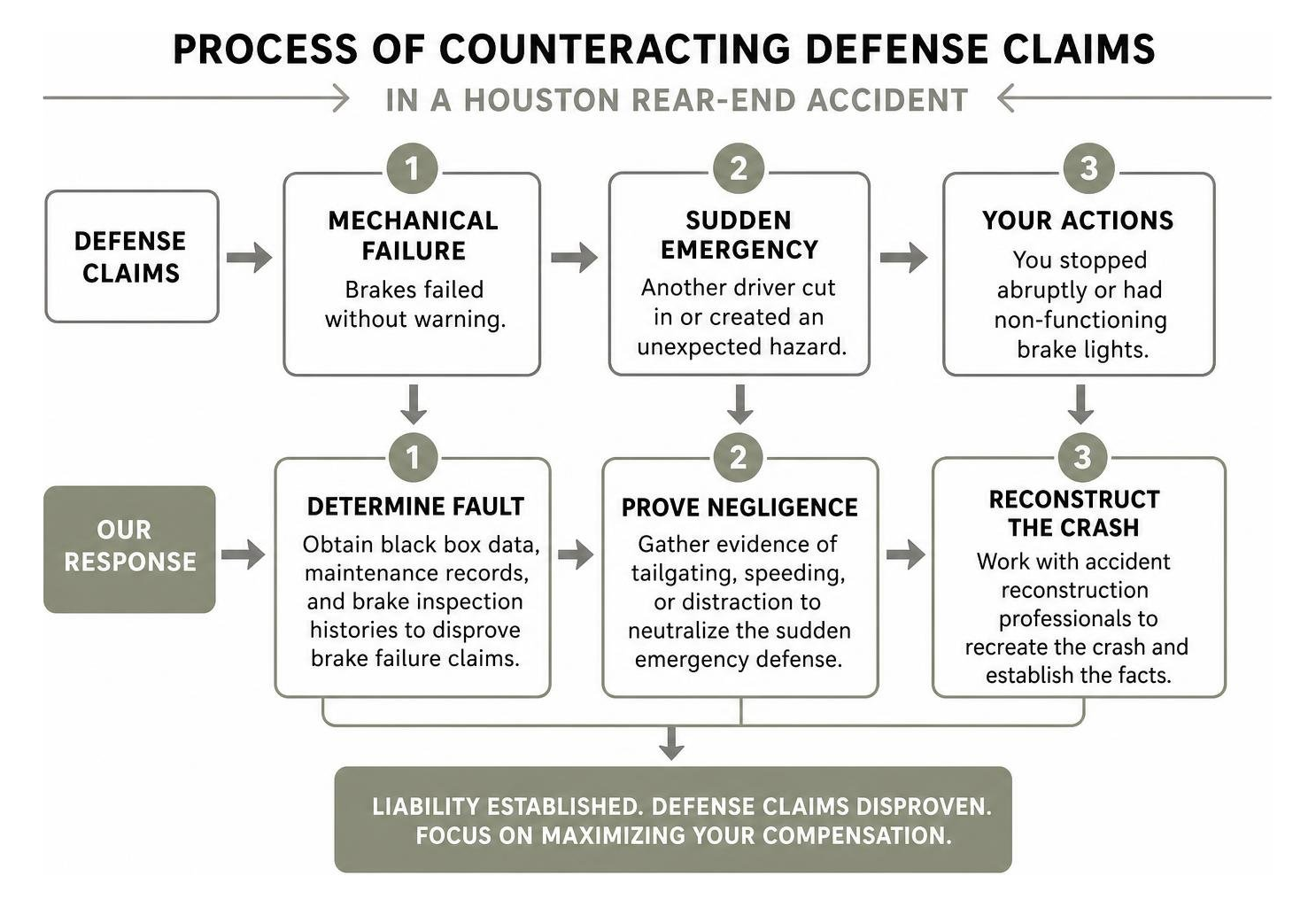
When insurance companies raise these defenses, we push back immediately by conducting a deep investigation:
- Determining Fault: We examine black box data, vehicle maintenance records, and brake inspection histories to disprove fake brake failure claims. Read more about Whos at Fault After a Rear-End Collision and how courts evaluate liability.
- Proving Negligence: We gather evidence showing the rear driver was tailgating or distracted, which neutralizes their sudden emergency defense. Explore our detailed guide on Determining Fault Prove Negligent Driving Houston TX.
- Working with Accident Reconstruction Practitioners: We recreate the crash scene using physics, skid mark measurements, and impact angles to establish exactly how the collision occurred.
Key Evidence Your Houston Rear End Collision Attorney Uses to Secure Damages
Building a winning compensation claim requires bulletproof evidence. Key elements we compile to hold the negligent driver accountable include:
- Dashcam and Traffic Camera Footage: Clear video evidence showing the sequence of events before impact.
- Police Crash Reports: Official law enforcement reports from the Houston Police Department or Harris County Sheriff’s Office detailing officer observations and citations issued at the scene.
- Event Data Recorders (Black Boxes): Vehicle data detailing exact speed, braking application, and throttle pressure prior to the collision.
- Medical Documentation: Direct medical evaluation linking your whiplash, neck pain, or spinal trauma to the force of the crash.
- Spoliation Notices: Formal legal letters sent to trucking firms or insurance carriers ordering them not to alter or delete crucial electronic evidence.
For a comprehensive walkthrough on gathering evidence, review our Houston Car Crash Lawyers Guide.
Understanding Texas Fault Laws, Comparative Negligence, and Deadlines
Texas operates under a modified comparative fault rule (often called the 51 percent bar rule). This rule allows you to recover compensation as long as you are 50% or less at fault for the crash. However, your total financial payout will be reduced by your percentage of fault.
If the court determines you were 51% or more responsible for the rear-end accident, you are legally barred from recovering any damages from the other party.
Comparative Fault Calculation Examples
| Scenario | Total Damages Assessed | Your Fault Percentage | Payout Received |
|---|---|---|---|
| 0% At Fault (Stopped legally at red light on Westheimer Rd) | $50,000 | 0% | $50,000 (Full Recovery) |
| 20% At Fault (Brake light was out, but driver was tailgating) | $50,000 | 20% | $40,000 ($50k reduced by 20%) |
| 51% At Fault (Sudden illegal stop on freeway without reason) | $50,000 | 51% | $0 (Barred from recovery) |
Understanding how fault percentages impact your final settlement is essential. You can dive deeper into these rules in our article on Understanding Comparative Negligence in Houston TX.
Texas Statute of Limitations for Rear-End Collision Claims
Under Texas Civil Practice and Remedies Code Section 16.003, you have two (2) years from the exact date of your rear-end collision to file a personal injury lawsuit.
If you miss this legal deadline, you forfeit your right to bring your claim to court, and insurance companies will refuse to offer any settlement. Rare exceptions exist—such as claims involving minors or government entities—but acting quickly is vital to protect your right to compensation.
Handling Uninsured and Underinsured Motorist Claims
Despite Texas law requiring all drivers to maintain minimum auto liability insurance, thousands of motorists drive across Harris County completely uninsured or carry minimum coverage limits that fail to pay for serious injuries.
When an uninsured or hit-and-run driver rear-ends your car:
- We turn to your own Uninsured Motorist (UM) policy to cover your medical costs, lost pay, and vehicle repairs.
- If the at-fault driver’s policy limit is too low to cover extensive medical treatments, we file an Underinsured Motorist (UIM) claim under your policy.
- We manage all communications with your insurance company to make sure they process your claim fairly and without bad-faith delays.
Learn more about dealing with policy issues in our comprehensive guide to Car Accident Claim Insurance.
Frequently Asked Questions About Houston Rear-End Collisions
What is the average settlement for a rear-end collision in Houston?
The average settlement for a minor to moderate rear-end crash in Houston ranges between $10,000 and $50,000. However, claims involving severe injuries—such as herniated discs, whiplash requiring surgery, or traumatic brain injuries—frequently result in settlements exceeding $100,000. The total settlement amount depends on medical expense costs, lost wages, and long-term physical impacts. Read our detailed analysis on What is the Average Car Accident Settlement in Houston for more information.
Can I receive compensation if I was partially at fault for the rear-end crash?
Yes. Under Texas modified comparative fault laws, you can recover financial compensation as long as your share of responsibility is 50% or less. Your total recovery payout will simply be reduced proportionally by your percentage of fault. If you are found 51% or more at fault, you cannot collect compensation from the other driver. Check out our Car Accident Compensation Houston Guide to see how fault affects your payout.
How long do I have to file a rear-end collision claim in Texas?
In Texas, the statute of limitations for personal injury claims is two years from the date of the accident. Failing to file your claim or lawsuit within this timeframe typically bars you from pursuing compensation permanently. Contacting a dedicated Houston Personal Injury Lawyer promptly helps preserve critical evidence like video footage and witness memories.
Taking Action After a Houston Rear-End Crash: Protect Your Rights with WestLoop Law Firm
A sudden rear-end accident can throw your personal and financial life into chaos. Between managing doctor visits, missing work, and answering aggressive calls from insurance adjusters, the recovery process can quickly feel overwhelming.
Making simple mistakes after a crash—such as giving recorded statements to insurance adjusters, delaying medical care, or accepting an initial lowball offer—can severely hurt your final payout.
At WestLoop Law Firm, we handle the heavy legal lifting so you can focus entirely on getting better. We investigate your crash, negotiate aggressively with insurance providers, and demand full compensation for your injuries and losses.
If you or a loved one was hurt in a rear-end collision in Harris County or anywhere in the greater Houston area, don’t face the insurance companies alone.
- Explore our guidance on hiring a Car Accident Lawyer in Houston.
- Visit our local profile on Google Maps at WestLoop Law Firm to view our location and get directions.
- Contact our team today for a free, no-obligation case review to see how we can help you get the justice and financial recovery you deserve.