 Skip to content
Why Commercial Truck Text Driving Can Cause Life-Changing Crashes
Commercial truck text driving is illegal under federal safety rules when a driver is operating a commercial motor vehicle. If a truck driver is reading, typing, emailing, browsing, or responding to dispatch messages, they should pull over and park safely before using the device.
For someone hurt in a Houston truck crash, the practical steps are:
- Get medical care and report the crash.
- Save photos, witness details, and any information about the truck and carrier.
- Act quickly to preserve cell phone, dispatch, dashcam, ELD, and truck data.
- Find out whether the driver was using a device while the truck was moving or stopped in traffic.
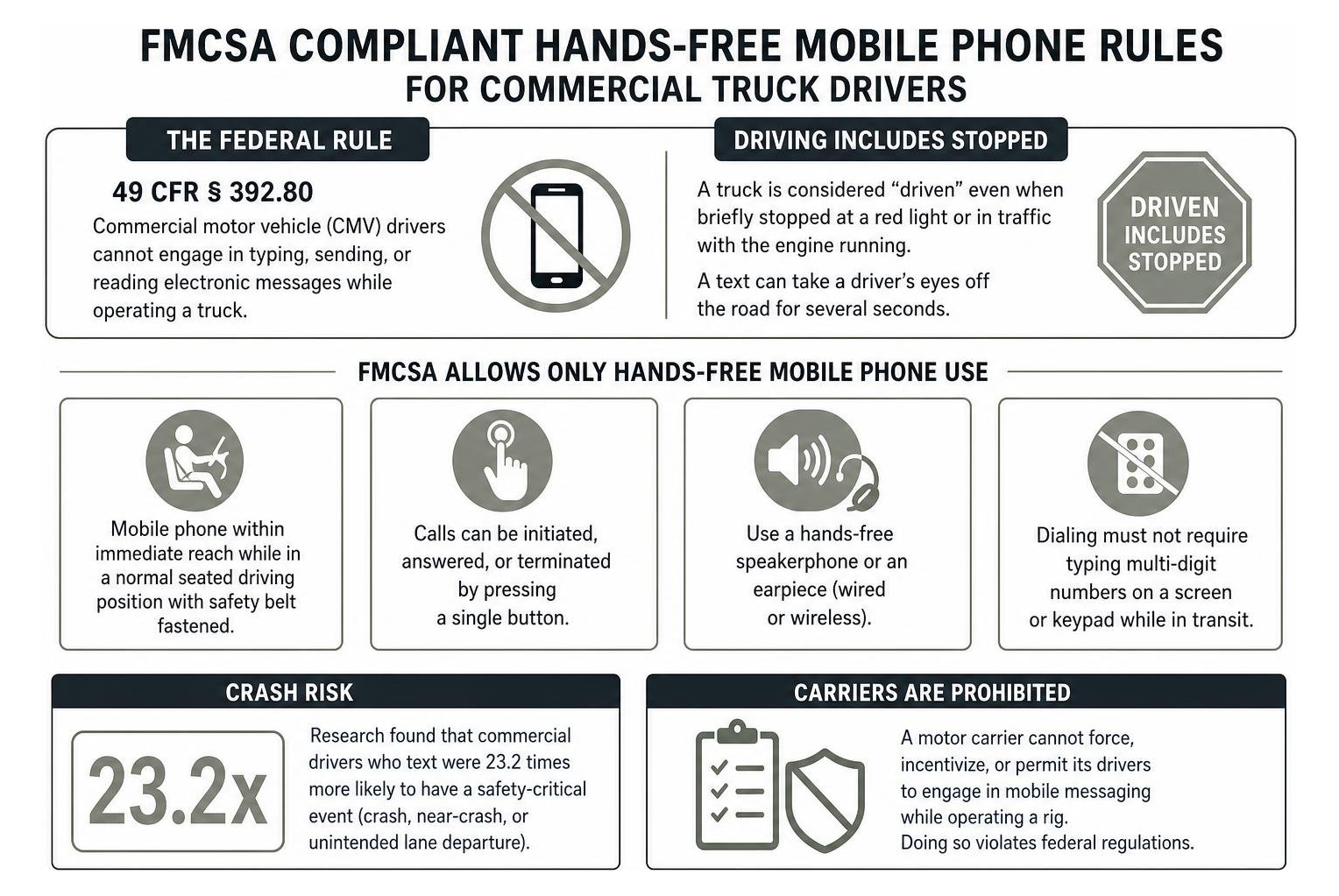
Federal rules treat a truck as being “driven” even when it is briefly stopped at a red light or in a traffic backup with the engine running. A text message can take a driver’s eyes off the road for several seconds. At highway speed, that can mean hundreds of feet traveled without watching traffic ahead.
The risk is not small. Research found that commercial drivers who text were 23.2 times more likely to have a safety-critical event, such as a crash, near-crash, or unintended lane departure. For an 80,000-pound truck on Houston freight corridors, a few distracted seconds can cause devastating harm.

Key Commercial truck text driving vocabulary:
Understanding Federal Regulations on Commercial Truck Text Driving
Operating an 80,000-pound tractor-trailer requires constant focus, split-second reflexes, and absolute awareness of traffic conditions. Recognizing the severe hazards posed by electronic distractions behind the wheel, the Federal Motor Carrier Safety Administration (FMCSA) established strict nationwide rules under 49 CFR § 392.80. These safety standards make it clear that commercial motor vehicle (CMV) operators cannot engage in typing, sending, or reading electronic messages while behind the wheel.
Federal safety guidelines also regulate how motor carriers conduct business. Under these regulations, a trucking company cannot force, incentivize, or permit its drivers to engage in mobile messaging while operating a rig.
When a driver or motor carrier cuts corners and breaks these clear federal safety rules, working with a trucking regulations violation lawyer helps hold both the driver and the motor carrier accountable for any harm caused on our shared roadways.
To stay compliant with federal law, commercial drivers are limited to strictly hands-free mobile phone configurations. Under these rules, drivers may only use mobile communication if:
- The mobile phone is located within immediate reach while the driver is in a normal seated driving position with their safety belt fastened.
- The call can be initiated, answered, or terminated by pressing a single button.
- The device utilizes a hands-free speakerphone or an earpiece (wired or wireless).
- Dialing does not require typing multi-digit numbers manually on a screen or keypad while in transit.
What FMCSA Rules Define as Driving and Texting
The FMCSA applies broad definitions to what constitutes illegal mobile use. Under FMCSA commercial texting definitions, texting is defined as manually entering text into, or reading text from, an electronic device.
This includes:
- Short Message Service (SMS) text messages
- Composing, sending, or reading emails
- Instant messaging through apps
- Accessing web pages or browsing internet feeds
- Pressing more than one single button to initiate or terminate a phone call
- Interacting with fleet dispatching and electronic logging tablets while in transit
Crucially, the federal definition of “driving” catches many commercial drivers off guard. Under federal law, driving does not simply mean rolling down Interstate 10 at 65 miles per hour. It includes operating a commercial motor vehicle on a highway with the engine running, which encompasses moments when the truck is temporarily stationary due to traffic jams, red lights, stop signs, or other momentary road delays. A commercial driver idling in heavy traffic on the 610 Loop in Houston is still legally driving.
Furthermore, reaching for a device in a manner that requires the driver to unbuckle their seatbelt or shift out of their normal seated position is an explicit safety violation under federal motor carrier regulations.
Emergency Exceptions to Prohibited Mobile Use
The federal prohibition on electronic device usage is broad, but narrow exceptions do exist. Commercial truck drivers may manually interact with a communication device only under limited circumstances:
- Emergency Service Communications: A driver is legally permitted to use a mobile phone or enter text when necessary to communicate with law enforcement, 911 dispatchers, emergency medical personnel, or fire departments during an active emergency.
- Safely Parked Vehicles: Commercial drivers may freely use mobile devices once the vehicle has been brought to a complete stop off the travel lanes of the highway, parked in a safe location where it can remain stationary without impeding traffic.
Outside of communicating with emergency services or operating a vehicle pulled completely out of moving traffic, there are no exceptions for checking traffic updates, answering dispatch messages, or reviewing route alterations.
How Texting While Driving Elevates Severe Crash Risks on Houston Roadways
Distracted driving regularly ranks among the top 5 common causes of truck accidents. While a driver in a compact passenger car who looks away from the road creates danger, a distracted semi-truck driver creates an immediate life-threatening hazard. Commercial trucks require substantial braking distances, have wide blind spots, and carry enormous kinetic force.
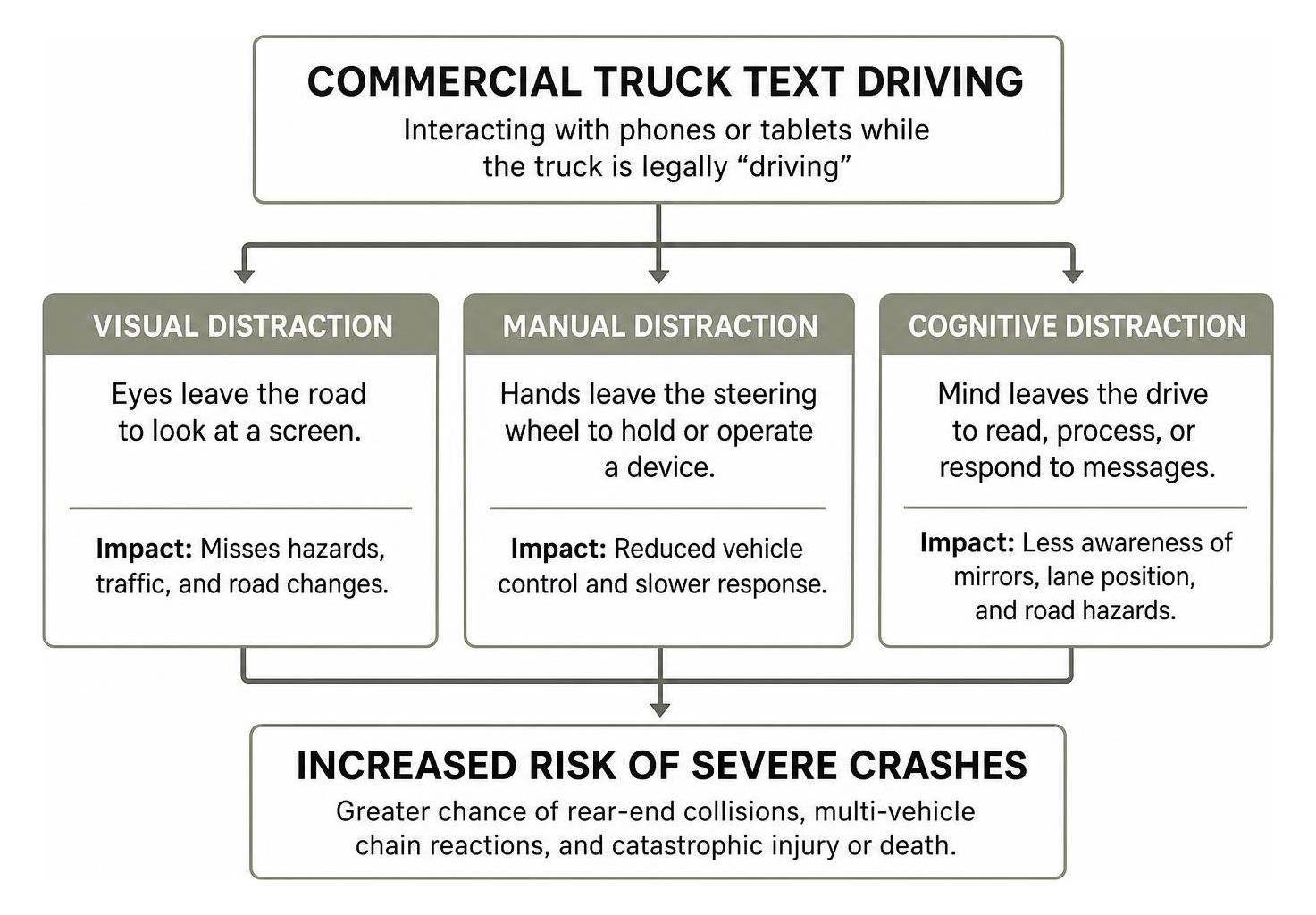
When a trucker engages with a mobile device, they experience three distinct forms of distraction simultaneously:
- Visual Distraction: Taking their eyes off forward traffic to look down at a screen.
- Manual Distraction: Removing one or both hands from the steering wheel to grip a phone or tablet.
- Cognitive Distraction: Diverting mental focus from scanning mirrors, monitoring lane positions, and anticipating road hazards to process an incoming message.
On congested freight corridors like Interstate 45, Highway 290, and the Sam Houston Tollway, sudden traffic backups are common. When commercial driver inattention meets sudden highway deceleration, catastrophic rear-end collisions and multi-vehicle chain reactions frequently follow.
The 23.2x Collision Multiplier in Commercial Truck Text Driving
The extreme danger of mobile phone use in commercial trucking is supported by extensive real-world research. A landmark commercial driver texting study conducted by the Virginia Tech Transportation Institute (VTTI) evaluated long-haul truck drivers over an 18-month period using continuous in-cab video monitoring and telematics.
The naturalistic driving study produced striking findings:
- Commercial drivers who text while driving are 23.2 times more likely to experience a safety-critical event (such as a collision, near-crash, or unintentional lane deviation) compared to non-distracted drivers.
- Texting elevated collision hazards far above any other in-cab distraction measured, including eating, adjusting the radio, or talking on a hands-free device.
- Unintentional lane deviations spiked dramatically while drivers were looking down at digital screens, leading directly to sideswipe collisions and rollovers.
Blind Distance Traveled at Highway Speeds
The physics of moving an 80,000-pound truck explain why texting leads to severe trauma. Research shows that commercial drivers take their eyes off the forward roadway for an average of 4.6 seconds when reading, typing, or sending a text message.
At a standard highway cruising speed of 55 miles per hour, a truck travels approximately 80.7 feet per second. In 4.6 seconds, the vehicle travels 371 feet—longer than an entire football field, including both end zones—without the driver looking at the road ahead.
| Vehicle Speed | Distance Per Second | Blind Distance Traveled in 4.6 Seconds | Real-World Equivalent |
|---|---|---|---|
| 45 MPH | ~66.0 feet | 303.6 feet | 1 full football field (goal line to goal line) |
| 55 MPH | ~80.7 feet | 371.2 feet | 1 football field plus both end zones |
| 65 MPH | ~95.3 feet | 438.4 feet | Nearly 1.5 football fields |
| 75 MPH | ~110.0 feet | 506.0 feet | Over 1.5 football fields |
When a commercial driver travels over 370 feet without looking forward, they lose all ability to react to slowing traffic ahead. Reviewing our commercial truck accident attorney Houston guide helps explain how braking physics and impact forces combine to cause severe vehicle damage and catastrophic injuries.
Legal Penalties, CSA Scores, and Employer Liability for Texting Violations
Because the safety hazards are so pronounced, both individual commercial drivers and the motor carriers employing them face stiff financial and administrative penalties for mobile device violations under federal law.
Federal regulations assign severe consequences to texting violations to ensure both drivers and motor carriers treat mobile communication seriously.
| Penalty Category | Individual Commercial Driver | Motor Carrier / Employer |
|---|---|---|
| Maximum Federal Civil Fine | Up to $2,750 per violation | Up to $11,000 per violation |
| License Disqualification | 60 days (2nd offense) / 120 days (3rd offense) | Suspension of operating authority for severe fleet-wide non-compliance |
| CSA Severity Weight | Impact on driver qualification profile | 10 out of 10 (Maximum baseline penalty in Unsafe Driving BASIC) |
| Civil Lawsuit Impact | Personal negligence per se | Vicarious liability, negligent supervision, and punitive damage exposure |
Individual Driver Fines and CDL Disqualification
For a commercial truck driver, texting behind the wheel brings immediate career-altering consequences. Beyond individual civil fines of up to $2,750 per occurrence, the FMCSA categorizes texting while operating a commercial vehicle as a “serious traffic violation” under 49 CFR Part 383.
If a driver holding a Commercial Driver’s License (CDL) receives multiple citations, mandatory disqualifications follow:
- Second Serious Violation Within 3 Years: Mandatory minimum 60-day CDL disqualification.
- Third Serious Violation Within 3 Years: Mandatory minimum 120-day CDL disqualification.
These suspensions remove the driver from commercial service, preventing them from operating any commercial vehicle nationwide during the disqualification window.
Motor Carrier Penalties for Mandating Commercial Truck Text Driving
Trucking companies cannot simply blame their drivers when texting violations occur. Under 49 CFR § 392.80(b), motor carriers are strictly prohibited from requiring or permitting their drivers to engage in texting while driving. Employers who push drivers with tight delivery schedules or pressure them into answering dispatch alerts while on the road face civil penalties of up to $11,000 per violation.
From a regulatory standpoint, texting citations carry a massive safety penalty. Roadside citation code 390.17DT violation severity carries a baseline severity weight of 10 out of 10—the maximum possible weight in the FMCSA Safety Measurement System (SMS) under the Unsafe Driving BASIC category.
When safety points accumulate, a motor carrier faces:
- Increased roadside inspection frequency
- Comprehensive federal safety audits
- Downgraded carrier safety fitness ratings
- Elevated commercial insurance premiums
In civil court, a trucking company’s practice of texting drivers while their wheels are turning serves as powerful evidence of institutional recklessness. Victims injured by distracted truckers can review our in-depth guide to Houston trucking firm negligence to see how corporate safety violations demonstrate direct carrier liability.
How to Prove Truck Driver Distraction and Secure Evidence After a Crash
Proving that a truck driver was texting or using a phone at the exact moment of a collision requires prompt legal action. Truck drivers rarely admit to looking down at their phones when a crash occurs. Securing objective digital evidence before it is overwritten, lost, or deleted is critical to proving liability.
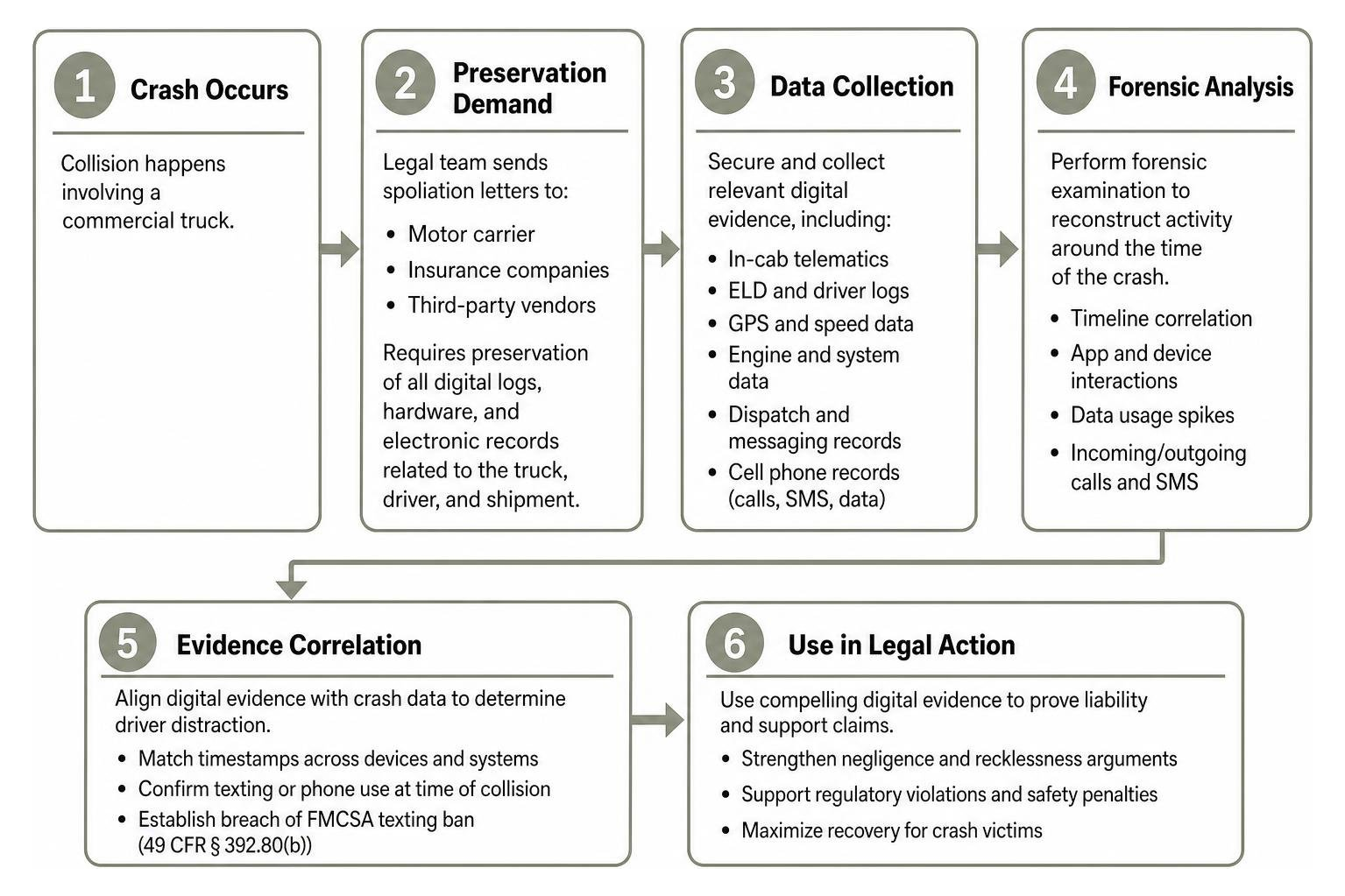
When our team at Westloop Law Firm investigates a commercial vehicle collision in Houston, we send formal spoliation letters to the motor carrier, insurance companies, and third-party vendors. These legal notices require the preservation of all digital logs, hardware, and electronic records associated with the truck, driver, and shipment.
Subpoenaing Cell Phone Records and In-Cab Telematics
Cellular carrier logs provide concrete timestamps of incoming and outgoing calls, data usage spikes, and SMS transmissions. However, basic billing statements do not always tell the entire story. In-depth forensic investigations help uncover app-specific interactions, social media feeds, and cloud-based push notifications.
As highlighted in NTSB crash investigation standards, incoming smartphone notifications create substantial cognitive distraction and performance drops even when a driver does not actively open or respond to the alert.
In addition to cellular data, our investigations examine the heavy vehicle’s onboard computer systems. Gathering all about trucking black box data from the engine control module (ECM) provides precise information regarding:
- Vehicle travel speed leading up to impact
- Throttle percentage and engine RPM
- Exact timing of brake application (or complete lack of braking)
- Steering angle inputs and sudden steering corrections
- Forward-facing and in-cab driver-facing video recordings
When telematics show no brake application prior to impact, paired with cellular data showing active data transmission, the evidence clearly demonstrates driver inattention.
Analyzing Electronic Logging Device (ELD) Duty Status and Dispatch Software
Federal rules mandate that interstate commercial motor vehicles maintain an Electronic Logging Device (ELD) to track Hours of Service (HOS). These systems log whether a driver is “Off Duty,” “Sleeper Berth,” “On Duty Not Driving,” or “Driving.”
When handling trucking log book disputes, matching the ELD “Driving” duty status against dispatch time logs reveals whether dispatchers sent messages to the truck while the vehicle was moving.
Modern fleet management tools should adhere to proper logistics software notification compliance by holding non-critical alerts until a driver is safely parked. If a freight broker or fleet dispatcher sends interactive messages like “tap to accept load” while a truck is traveling at highway speeds, they directly contribute to driver distraction and share liability for resulting collisions.
Frequently Asked Questions About Commercial Truck Texting
Is a truck driver allowed to text while stopped at a red light in Houston?
No. Under 49 CFR § 392.80(c), the federal definition of “driving” includes operating a commercial motor vehicle on a public roadway with the engine running, including temporary stops at traffic lights, stop signs, or traffic jams. A truck driver may only send or read text messages if the commercial motor vehicle is safely parked off the travel lanes in a location where it can remain stationary.
What financial penalties do trucking companies face if their driver texts?
Motor carriers that require or permit drivers to engage in commercial truck text driving face federal civil penalties of up to $11,000 per violation. In addition, the citation carries the maximum CSA severity score of 10/10 in the FMCSA Safety Measurement System, which can trigger safety rating downgrades, audits, and higher insurance costs.
How do ELD duty records help prove distracted driving after an accident?
Electronic Logging Device (ELD) records show the truck’s operational status minute by minute. By cross-referencing the exact window when the ELD logged the driver as “Driving” against mobile carrier call records, SMS logs, and fleet dispatch messages, an attorney can prove that the driver was interacting with an electronic device while the truck was moving.
Securing Accountability for Distracted Truck Driving in Houston
When a commercial truck driver prioritizes a smartphone notification over the safety of surrounding motorists, innocent people face severe, life-altering consequences. The combination of high highway speeds, heavy commercial vehicle weight, and cognitive distraction leads to catastrophic injuries across Houston roadways every year.
Holding negligent truck drivers and reckless motor carriers accountable requires decisive legal action, prompt evidence preservation, and thorough knowledge of federal safety regulations. At Westloop Law Firm, our attorneys fight tirelessly for victims of severe 18-wheeler crashes throughout Houston and Harris County, pursuing the full compensation and justice our clients deserve.
If you or a loved one suffered injuries in a collision involving a commercial truck, reach out to our legal team today for a free, comprehensive consultation to discuss your case and protect your rights.