 Skip to content
Probate disputes can move quickly from paperwork to litigation when heirs, beneficiaries, creditors, or fiduciaries disagree about how an estate should be handled. A contested probate Houston hearing is the court setting where those disagreements begin to take shape through pleadings, sworn testimony, exhibits, and judicial rulings. For Houston families, the process is often stressful because it combines grief, financial pressure, and strict Texas procedural rules. Understanding the difference between a routine prove-up and an adversarial hearing helps you prepare realistic expectations before appearing in court. It also helps you avoid missed deadlines that can delay distributions, increase estate costs, or weaken your position in a will contest, executor dispute, or heirship challenge.
Understanding the Contested Probate Houston Hearing vs. Uncontested Matters
When family members or named beneficiaries disagree over an estate, standard administrative filings quickly shift into active courtroom litigation. Navigating probate disputes in the greater Houston area requires understanding how local judges separate straightforward matters from complex conflicts.
An uncontested probate hearing generally involves routine matters, such as proving a valid, self-proved will where all interested parties agree, or establishing heirship without controversy. In nearby Fort Bend County Court at Law No. 1, uncontested matters are typically handled during morning dockets at 9:00 a.m., where parties may often use remote appearance platforms if scheduled appropriately.
By contrast, a contested probate matter arises when someone challenges the validity of a will, petitions to remove an executor, disputes an accounting, or questions heirship. For deep insights on procedural differences in regional courts, you can review our probate court houston texas complete guide or consult statutory guidelines published on Probate | Fort Bend County.
| Feature | Uncontested Probate Hearing | Contested Probate Hearing |
|---|---|---|
| Typical Issues | Routine will probate, agreed heirship, muniment of title | Will contests, breach of fiduciary duty, executor removal, disputed claims |
| Docket Timing | Monday mornings (e.g., 9:00 a.m.) | Designated Monday afternoons at 1:30 p.m. or special settings |
| Appearance Format | In-person or Zoom (court dependent) | Strictly In-Person Only (No Zoom option available) |
| Evidence & Witnesses | Standard prove-up testimony, pre-filed oaths | Live cross-examination, formal exhibit lists, depositions, ad litem reports |
| Time Limits | Typically under 15 minutes | Under 1.5 hours on general docket; special setting required if longer |
When a dispute escalates, having a dedicated probate litigation attorney ensures that statutory rules under the Texas Estates Code are properly followed. Understanding local differences across courts, including harris county probate venues, prevents common procedural missteps before you ever set foot in the courtroom.

Court Scheduling and In-Person Appearance Requirements
Local court rules strictly control how contested estate dockets operate. In Fort Bend County Court at Law No. 1, contested matters are set specifically on designated Monday afternoons starting promptly at 1:30 p.m. Unlike routine administrative hearings, the court maintains a mandatory in-person appearance requirement for all contested probate dockets. There is no Zoom option for these adversarial proceedings in Houston-area jurisdictions.
Arriving prepared means factoring in security lines, traffic across the Houston metro area, and potential docket call delays. Because judges have full discretion over their dockets, tardiness can cause your case to be dismissed or pushed to the very end of the call.
Key Deadlines for a Contested Probate Houston Hearing
Meeting filing windows is mandatory to ensure the judge has time to review disputed issues before taking the bench.
- 3-Business-Day E-Filing Deadline: Any document, evidence binder, or motion you wish the court to evaluate during a contested hearing must be e-filed at least three (3) business days prior to the hearing date. This cushion accounts for County Clerk processing buffers.
- 7-Day Ancillary Document Window: Proposed orders, judgments, and court-appointed ad litem reports must be submitted at least seven (7) days before the scheduled hearing.
- 14-Day Deposition Rule: Responses and materials tied to written deposition questions or evidentiary matters must be coordinated fourteen (14) days prior to the hearing.
- Ad Litem Deposit: If an attorney ad litem has been appointed to represent unknown heirs or incapacitated individuals, the required deposit must be paid into the Registry of the Court well ahead of the hearing.
Managing Extended Hearings and Docket Control Orders
Standard contested hearing settings on the Monday afternoon 1:30 p.m. docket are intended for focused legal arguments and brief evidentiary presentations. If your dispute requires detailed financial accountings, extensive witness testimony, or substantial cross-examination that is anticipated to last more than 1.5 hours, the court cannot accommodate it on a standard docket.
In these circumstances, counsel must request a special setting from the court coordinator. The court will evaluate calendar availability and may enter a formal Docket Control Order. This order dictates exact discovery cutoff dates, deadlines for designated technical witnesses, and time limits for each side’s arguments. When facing prolonged challenges, working with a probate challenge lawyer houston tx ensures your timeline complies fully with judicial orders.
Step-by-Step Preparation for Trial and Pre-Trial Conferences
Preparing for a contested probate trial requires a methodical approach to gather admissible evidence and meet pre-trial obligations. When you partner with Westloop Law Firm in Houston, we guide clients through each critical phase of litigation and hearing readiness.
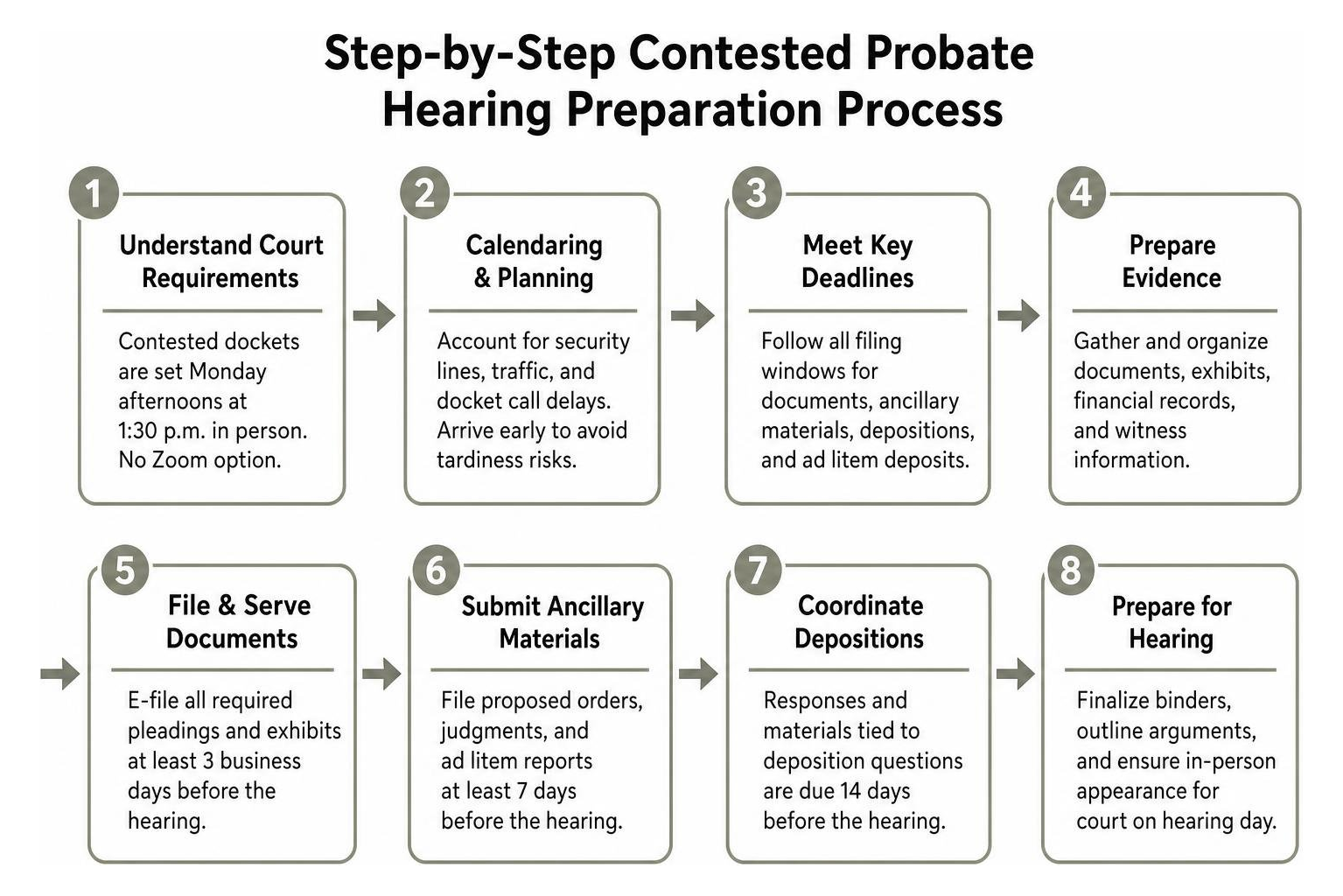
Step 1: E-Filing Essential Documents and Exhibits
Before stepping into the courtroom, every piece of documentary evidence must be properly filed and served in accordance with procedural guidelines:
- Original Will Lodgment: Ensure the original testamentary instrument is physically lodged with the County Clerk’s office if will validity, undue influence, or testamentary capacity is at issue.
- Registry Deposits: Verify that required statutory security deposits, cost bonds, and ad litem fees have been posted to avoid hearing cancellations.
- Proposed Orders: Draft clear, concise proposed orders reflecting the exact relief sought and provide courtesy copies in advance to opposing counsel and the court.
- Exhibit and Witness Lists: Organize your trial binders, pre-mark exhibits, serve mandatory witness disclosures, and ensure compliance with our probate filing houston complete guide.
Step 2: Preparing for Pre-Trial Conferences and Jury Trials
If a party requests a jury trial to resolve factual controversies, distinct scheduling rules apply under local administrative procedures:
- Tuesday Morning Jury Dockets: In Fort Bend County Court at Law No. 1, probate jury trials are heard on designated Tuesdays starting at 10:00 a.m.
- Mandatory In-Person Pre-Trial Conference: An in-person pre-trial conference is required at least one (1) week prior to the trial date. Remote appearances are not permitted.
- Jury Charges and Motions in Limine: Attorneys must exchange proposed jury questions, instructions, and evidentiary motions prior to the pre-trial conference to resolve objections ahead of trial.
Retaining an experienced estate litigation lawyer in texas helps you manage the demanding pace of trial practice and protect your inheritance rights under Texas law.
Procedural Rules and Compliance Guidelines
Texas probate courts maintain rigorous standards of procedural compliance to ensure fair proceedings for all beneficiaries, heirs, and creditors. Litigants must follow local court administrative rules alongside the Texas Rules of Civil Procedure, local county rules, and the Texas Estates Code.
Avoiding Penalties in a Contested Probate Houston Hearing
Failing to follow court rules can critically harm your case and delay the administration of the estate. Judges manage busy Houston dockets and expect strict compliance with established protocols:
- Hearing Postponements: Missing the three-day e-filing deadline frequently results in the judge refusing to consider late-filed documents, leading to automatic hearing resets.
- Docket Displacement: If parties arrive unprepared or fail to meet preliminary ad litem deposit mandates, the court may strike the setting, pushing the hearing out by weeks or months.
- Judicial Sanctions: Repeated non-compliance with Docket Control Orders or failure to appear at mandatory in-person pre-trial conferences can result in monetary sanctions, cost assessments, or the striking of pleadings.
To understand how procedural readiness keeps your case on track, review the ultimate guide to the houston probate process steps.
Frequently Asked Questions About Houston Contested Probate Hearings
Can a contested probate hearing be held over Zoom in Greater Houston courts?
No. In Fort Bend County Court at Law No. 1, all contested probate matters must be conducted in person on designated Monday afternoons at 1:30 p.m. Virtual appearances over Zoom are reserved solely for specific uncontested matters.
What happens if I miss the document e-filing deadline before my hearing?
Due to processing buffers with the County Clerk, documents must be e-filed at least three business days prior to the hearing. If you miss this deadline, the court may refuse to review your documents, dismiss the motion without prejudice, or reset the hearing to a future date.
How are jury trials scheduled for contested estate disputes?
Probate jury trials are set on designated Tuesday mornings at 10:00 a.m. The court requires a mandatory, in-person pre-trial conference at least one week before the trial date to finalize exhibit lists, motions, and jury charge issues.
Secure Your Legacy with Confident Courtroom Advocacy
Resolving a contested estate dispute demands strategic preparation, thorough knowledge of local court rules, and steadfast courtroom presentation. Whether you are defending the final wishes of a loved one or challenging an invalid document, our team at Westloop Law Firm is committed to guiding Houston families through complex litigation. Explore comprehensive solutions for protecting your estate on our estate planning law houston page or contact our office today to discuss your contested probate matter.