 Skip to content
What Determines Legal Fault in a Houston 610 Loop Chain-Reaction Crash?
What to do first after a 610 Loop pileup:
- Move to a safe area, such as a shoulder or median, if your vehicle is drivable and you can do so safely.
- Call 911 to request Houston Police Department or Harris County Sheriff’s Office response and emergency medical help.
- Photograph vehicle positions, license plates, damage, skid marks, and nearby highway signs before vehicles are moved.
- Exchange insurance and contact information with all involved drivers and collect witness contact details.
- Seek medical evaluation promptly, even if injuries do not feel severe.
In a Houston 610 Loop chain-reaction crash, legal fault is shared among all drivers whose negligent actions contributed to the pileup under Texas proportionate responsibility law. A driver who tailgates, speeds, texts, or makes an unsafe lane change can bear partial responsibility, and commercial vehicles can also share liability when their drivers fail to maintain safe stopping distance. Texas law does not require a single at-fault driver; instead, each negligent party pays according to their assigned percentage of fault.
In everyday conversation, people use the word “fault” loosely to mean general blame or an accidental mistake. In Texas courtrooms, however, legal fault is a strictly defined concept under tort law. Legal liability requires proving four fundamental elements:
- Duty of Care: Every motorist operating a vehicle on Texas roadways owes a legal duty to exercise reasonable care to avoid injuring others.
- Breach of Duty: A driver breaches that duty by acting negligently—such as speeding, tailgating, texting, or failing to maintain vehicle brakes.
- Causation: That specific breach directly caused the collision and resulting injuries (both cause-in-fact and proximate cause).
- Damages: The crash resulted in quantifiable financial, physical, or emotional harm.
On high-traffic thoroughfares like Interstate 610—whether you are navigating the dense commercial stretch near the Galleria on the West Loop, merging through the Ship Channel bridge area on the East Loop, or transitioning near the North Loop bottlenecks—legal fault is rarely confined to one driver. A commercial 18-wheeler, a distracted commuter, a rideshare driver making an erratic lane change, and even a trailing vehicle following too closely can all share legal liability for the overall pileup.
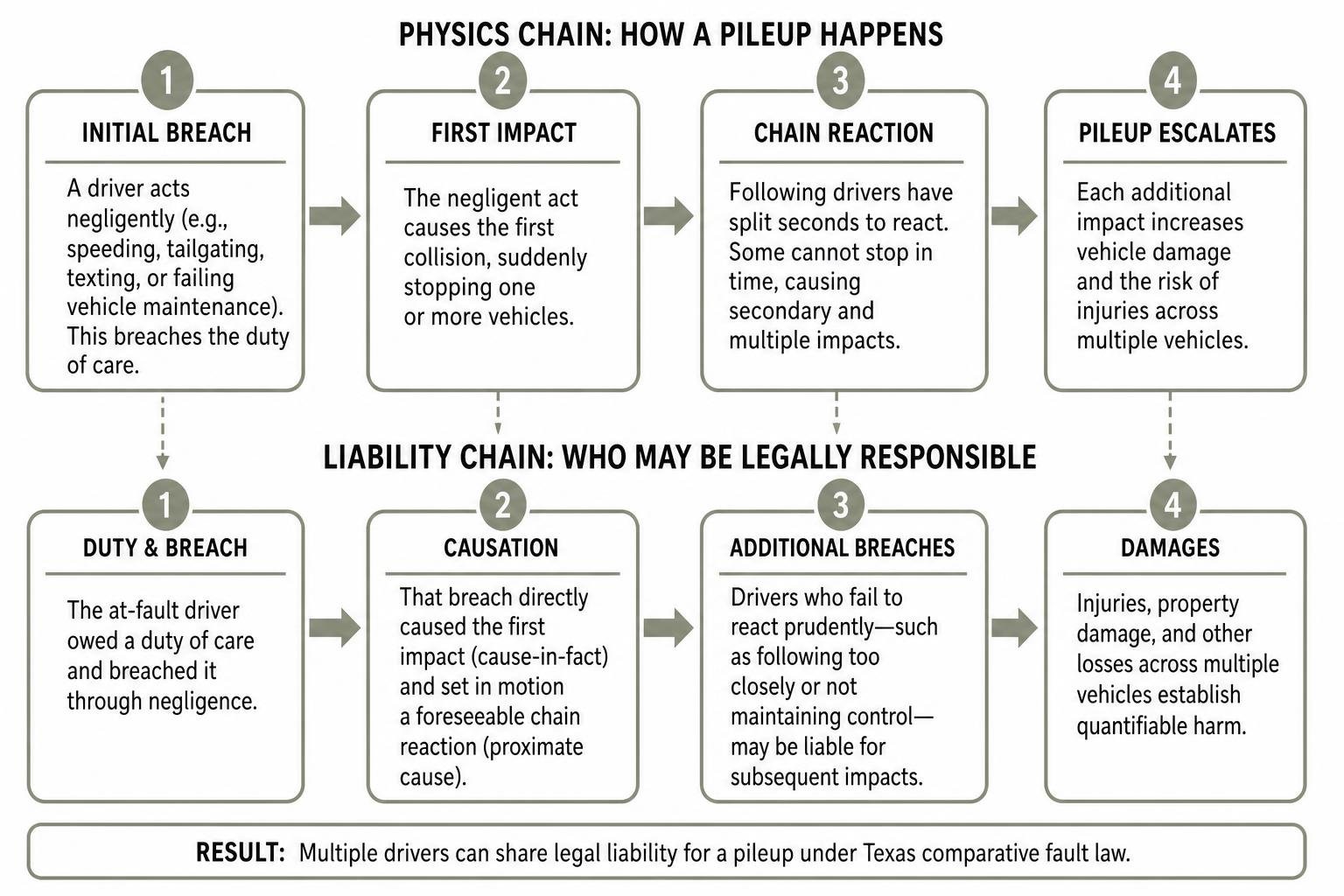
Chain-reaction crashes obscure liability because collisions happen in microsecond intervals. The driver who triggered the initial impact may start the domino effect, but trailing motorists who fail to react prudently can compound the crash severity, creating separate and distinct legal liabilities for subsequent impacts.
How Does Texas Comparative Fault Law Apply When Multiple Drivers Share Blame?
Texas handles multi-party roadway liability under the doctrine of proportionate responsibility, codified in Texas Civil Practice and Remedies Code Chapter 33. Under this framework, commonly referred to as the 51% modified comparative fault rule, an injured person can recover financial compensation from other negligent parties as long as their own share of fault does not exceed 50%.
If a judge or jury determines that your responsibility for the crash is 51% or greater, you are completely barred from recovering any compensation from the other drivers involved.
If you are found partially at fault but your liability is 50% or less, your total monetary award is reduced by your exact percentage of responsibility. For example, if your total damages equal $100,000 and the court determines you were 20% at fault because you had an inoperable brake light, your net compensation is reduced by 20% to $80,000.
| Driver Role | Assessed Fault % | Proven Gross Damages | Net Financial Recovery | Legal Outcome Under Texas Law |
|---|---|---|---|---|
| Driver A (Texting, caused initial rear-end impact) | 60% | $50,000 | $0 | Barred (Fault exceeds 50% threshold) |
| Driver B (Stopped safely, pushed from behind) | 0% | $150,000 | $150,000 | Full Recovery (100% compensable) |
| Driver C (Followed too closely, hit Driver B) | 25% | $80,000 | $60,000 | Reduced Recovery (Damages reduced by 25%) |
| Driver D (Speeding in rain, compounded final impact) | 15% | $40,000 | $34,000 | Reduced Recovery (Damages reduced by 15%) |
Understanding how damages adjust based on your actions is essential. If you want to see how these calculations operate in real-world scenarios, review our guide on how to get a settlement if you were 20 percent at fault for a car accident in Texas.
Because of this statutory threshold, insurance adjusters representing at-fault drivers on the 610 Loop routinely attempt to shift blame onto other motorists. If an insurance carrier can convince an investigator, judge, or jury that you were 51% responsible rather than 49%, they eliminate their financial obligation entirely. For a broader analysis of how local courts apply these standards, explore our breakdown of comparative negligence in Houston.
How Do Pure Comparative Fault and No-Fault Systems Differ from Texas Law?
Unlike pure comparative fault jurisdictions—where a driver who is 90% at fault can still theoretically collect 10% of their damages—Texas strictly bars recovery once a claimant passes the 51% threshold.
Furthermore, Texas is an at-fault tort state, which distinguishes it fundamentally from traditional “no-fault” auto insurance states like New York, Florida, or Michigan. In a true no-fault system, every injured driver files initial medical and wage-loss claims through their own mandatory Personal Injury Protection (PIP) policy regardless of who caused the wreck, and personal injury lawsuits are restricted unless injuries meet a statutory “serious injury” threshold.
In Texas, the negligent parties who cause a crash remain directly liable for medical bills, lost earnings, physical pain, mental anguish, and vehicle damage. However, Texas auto policies must include optional Personal Injury Protection (PIP) coverage unless the policyholder explicitly rejects it in writing. PIP provides prompt financial reimbursement for medical care and 80% of lost income following a 610 Loop wreck, regardless of who caused the collision, without affecting your right to pursue a fault-based liability claim against negligent third parties.
Under Texas Civil Practice and Remedies Code § 16.003, Texas establishes a strict two-year statute of limitations for personal injury and property damage lawsuits arising from motor vehicle crashes. This clock starts ticking on the exact date the collision occurs on Loop 610. If you do not file a formal lawsuit in an appropriate court, such as the Harris County Civil Courts at Law, within that two-year window, your claim will almost certainly be dismissed permanently.
Which Driving Behaviors and Road Conditions Typically Trigger 610 Loop Pileups?
Houston’s Interstate 610 Loop carries hundreds of thousands of passenger cars, commercial delivery vans, and heavy semi-trucks every day. Certain driver errors and environmental hazards frequently converge to create catastrophic chain-reaction wrecks.
1. Sudden Braking and Failure to Control Speed
Stop-and-go congestion frequently forms near major interchanges where the 610 Loop connects with Interstate 10 (Katy Freeway/East Freeway), Interstate 45 (North Freeway/Gulf Freeway), US-59/I-69 (Southwest Freeway/Eastex Freeway), Hwy 290, and Beltway 8. When a lead driver slams on their brakes without warning, trailing drivers who fail to control their speed inevitably trigger rear impacts. Evaluating fault after a rear-end collision requires assessing whether trailing motorists had adequate stopping distance.
2. Tailgating and Following Too Closely
Under Texas Transportation Code § 545.062, motorists must maintain an assured clear distance behind preceding vehicles so they can safely stop without colliding. Tailgating removes the reaction buffer necessary to avoid a crash when traffic suddenly halts on Loop 610 overpasses.
3. Dangerous Merging and Unsafe Lane Changes
Drivers trying to cross four lanes of traffic at the last minute to catch an exit ramp for the Galleria, Uptown, or NRG Stadium frequently cut off other motorists, forcing emergency evasive maneuvers that trigger secondary pileups.
4. Distracted Driving
Checking a smartphone, adjusting GPS systems, or reading text messages while traveling at highway speeds creates blind driving windows. Taking your eyes off the road for five seconds at 65 mph means traveling the entire length of a football field without looking.
5. Heavy Commercial Truck Braking Limitations
A fully loaded tractor-trailer traveling on Loop 610 requires substantially more distance to come to a complete stop than a standard passenger vehicle. When commercial truck drivers follow too closely or speed through Houston traffic, their impact can crush several vehicles forward into one another.
6. Adverse Houston Weather Conditions
Torrential Gulf Coast downpours cause rapid flash flooding and standing water on Loop 610 lanes. Hydroplaning, reduced tire traction, and diminished visibility dramatically heighten the risk of massive chain-reaction accidents when drivers fail to adjust their speed for slick roads.
Even if you were positioned in the middle of a pileup and did not initiate the very first impact, you can still face partial fault allegations if you struck the vehicle in front of you prior to being hit from behind.
What Critical Evidence Is Needed to Prove Liability in a Multi-Car Crash?
Untangling liability across four, six, or ten vehicles requires comprehensive physical and electronic documentation. We evaluate multiple streams of evidence to prove how each impact occurred:
- Electronic Data Recorders (EDR / “Black Box”): Modern passenger cars and commercial semi-trucks store vital pre-crash telemetry data. Black boxes record precise vehicle speed, throttle position, braking activation, steering angles, and seatbelt usage in the critical five to ten seconds before impact.
- Accident Reconstruction Analysis: Forensic engineers and accident reconstruction professionals evaluate vehicle crush patterns, vehicle weights, impact angles, and momentum physics to model the sequence of multiple collisions chronologically.
- Dashcam and Surveillance Footage: In-car dashboard cameras, private business security cameras along 610 feeder roads, and Texas Department of Transportation (TxDOT) traffic cameras provide invaluable visual evidence of the initial collision trigger.
- Physical Roadway Markings: Skid marks, yaw marks, gouges in the asphalt, fluid trails, and debris scatter patterns establish the exact points of impact and illustrate whether drivers attempted emergency braking.
- Official Law Enforcement Reports: Crash reports drafted by responding Houston Police Department (HPD) officers or Harris County Sheriff’s Office (HCSO) deputies document initial officer observations, citations issued, and driver statements.
Police reports completed in the chaotic aftermath of a major highway pileup sometimes contain inaccuracies or assign preliminary fault based on incomplete driver statements. If you face an inaccurate officer assessment, learn what steps to take if the police report says you were partially at fault for an accident to understand how evidence can correct the record.
Building an ironclad liability claim requires structured methodologies for determining fault and proving negligent driving before key evidence degrades or gets cleared by highway cleanup crews.
What Immediate Steps Should You Take After a 610 Loop Pileup to Protect Your Rights?
A multi-vehicle crash on a high-speed Houston loop creates an immediate danger of secondary collisions. Taking deliberate steps protects your physical safety and legal rights:
- Prioritize Immediate Safety and Comply with Steer It, Clear It: If your vehicle is drivable and you are on a live highway lane, Texas law requires you to move to the nearest shoulder, median, or emergency ramp to avoid secondary impacts. If the car is disabled, remain inside with your seatbelt buckled and hazard lights flashing until emergency personnel arrive.
- Call 911 Immediately: Ensure that Houston Police, Harris County Sheriff deputies, or Houston Fire Department emergency medical services dispatch units to the scene. An official crash report is vital.
- Photograph the Entire Scene: Before tow trucks move vehicles, take wide-angle and close-up photographs of all vehicle positions, license plates, visible damage on every car, road conditions, skid marks, debris, and relevant highway signs or exit markers.
- Exchange Complete Information: Gather names, phone numbers, driver’s license numbers, insurance policy details, and vehicle make/models from all drivers involved. Also obtain contact information from independent eyewitnesses who stopped to help.
- Seek Immediate Medical Care: Go directly to a nearby emergency facility—such as Memorial Hermann-Texas Medical Center, Ben Taub Hospital, or Houston Methodist—or visit an urgent care center. High-adrenaline collisions mask severe injuries such as concussions, internal bleeding, herniated discs, and soft tissue tears.
- Avoid Giving Recorded Statements to Insurance Adjusters: Insurance adjusters representing other drivers will call quickly to lock you into a recorded narrative that can be used to shift blame onto you. Do not provide recorded statements or discuss fault before speaking with an attorney.
- Contact an Attorney Early: Connecting quickly with legal counsel ensures vital black box data and traffic camera video are preserved through formal spoliation letters.
Knowing who to call after a 610 Loop multi-car pileup helps you avoid common traps set by multi-party insurance defense teams. Early representation shields you from complex cross-claims detailed in our multi-vehicle accident guide.
Why Do You Need an Experienced Houston Attorney for a Multi-Vehicle Pileup Claim?
Multi-vehicle pileups present legal complexities that single-car or standard two-car wrecks do not. When ten different drivers and insurance carriers are involved, the claims process quickly becomes contentious:
- Policy Limit Exhaustion: Texas minimum auto liability coverage is only $30,000 per injured person and $60,000 per accident for bodily injury, alongside $25,000 for property damage. In a pileup with multiple severely injured victims, the at-fault driver’s policy limits can be exhausted almost immediately.
- Multiple Blame-Shifting Insurers: Every insurance carrier involved will deploy adjusters and defense lawyers whose primary objective is to push liability percentages onto other drivers to minimize their own payout.
- Commercial Fleet and Trucking Liability: If a commercial carrier or corporate fleet vehicle is involved, navigating federal motor carrier safety regulations, employer liability, and corporate insurance layers requires rigorous discovery.
At WestLoop Law Firm, we combine deep background in personal injury, catastrophic injury, and probate law. When multi-car crashes lead to fatal injuries, our estate and probate capabilities allow us to seamlessly handle wrongful death claims and survivor actions for grieving Houston families without having to retain separate outside estate counsel.
We conduct exhaustive investigations into crash telemetry, coordinate with leading accident reconstruction professionals, and challenge insurance blame-shifting tactics to protect you from unfair fault assignments.
If you or a loved one suffered injuries in a pileup, consulting a Loop 610 car accident lawyer is the most effective way to protect your financial recovery. You can also consult our dedicated Houston car accident lawyer team and read through our comprehensive Houston car crash guide to learn more about pursuing maximum compensation.
Frequently Asked Questions About Houston 610 Loop Multi-Car Pileups
Can multiple drivers be held liable for the same multi-car pileup?
Yes. Under Texas proportionate responsibility law, a jury or insurance settlement agreement can distribute percentages of fault across multiple drivers. For example, Driver 1 may be found 50% responsible for initiating a sudden crash while texting, Driver 2 may be assigned 30% fault for following too closely and compounding the impact, and Driver 3 may bear 20% fault for speeding on wet pavement. Each liable driver’s insurer pays compensation proportional to their assigned percentage of blame.
What happens if the driver who caused the 610 Loop pileup does not have enough insurance?
When an at-fault driver carries only basic state-minimum insurance or no insurance at all, their coverage is rapidly drained across multiple claimants. In this situation, we look to several alternative recovery avenues:
- Your own Uninsured/Underinsured Motorist (UM/UIM) coverage.
- Your Personal Injury Protection (PIP) or Medical Payments (MedPay) coverage.
- Secondary liable parties, such as commercial trucking employers, vehicle maintenance facilities, or parts manufacturers.
Can I still receive compensation if I was pushed into the car ahead of me?
Yes. If you came to a safe, complete stop behind the vehicle ahead of you and a trailing motorist slammed into your rear bumper—forcing your car forward into the lead vehicle—you are not legally at fault. This is known as an involuntary impact. To defeat claims by the lead driver’s insurer alleging you were following too closely, we use skid mark evidence, dashcam video, and vehicle damage profiles to prove you maintained a safe distance prior to the rear impact.
Protecting Your Future After a Complex Highway 610 Pileup
Navigating the aftermath of a multi-vehicle pileup on Houston’s 610 Loop can feel overwhelming. While you focus on physical healing and medical treatment, multiple insurance carriers are already working behind the scenes to minimize payouts and shift blame.
You do not have to untangle the web of comparative fault, policy limits, and conflicting crash reports on your own. At WestLoop Law Firm, our legal team is dedicated to standing between you and aggressive insurance adjusters, fighting to ensure your rights are protected and that you receive the full financial compensation you deserve under Texas law.
If you or a family member was injured on the 610 Loop, I-10, I-45, or anywhere in the greater Houston area, reach out to our team today for a comprehensive, confidential case evaluation. Contact our Houston car wreck attorneys to take the first step toward securing your recovery.