 Skip to content

What to Do After an 18-Wheeler Winter Crash in Houston
What to do first:
- Move out of traffic if you can do so safely, and call 911.
- Get medical care, even if your injuries seem minor.
- Photograph the vehicles, road conditions, and visible ice or standing water. Get witness contact details.
- Report the crash to your insurer. Keep your records, and ask that the truck’s electronic data, driver logs, and inspection records be preserved.
An 18-wheeler winter crash can happen fast when freezing rain or black ice cuts tire grip. A heavy truck needs more room to stop, and ice makes braking and steering less reliable. Bad weather does not settle who is at fault. The driver’s actions, the trucking company’s decisions, and the evidence all matter.
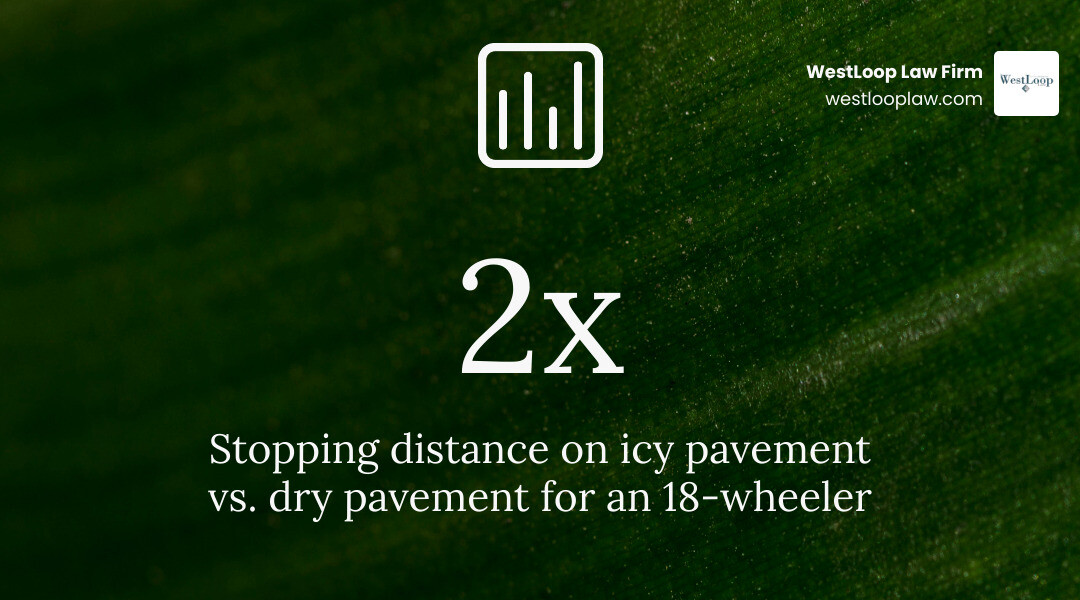
Easy 18 wheeler winter crash glossary:
Primary Factors That Trigger an 18 Wheeler Winter Crash
When winter storms sweep across Southeast Texas, commercial freight corridors such as I-10, I-45, Loop 610, and Beltway 8 become hazardous zones. Commercial tractor-trailers operate under immense physical forces. A fully loaded commercial big rig can weigh up to 80,000 pounds, making it 20 to 30 times heavier than a standard passenger vehicle. When freezing precipitation coats the asphalt, this staggering gross weight transforms a standard haul into an uncontrollable hazard.

Federal Motor Carrier Safety Administration (FMCSA) regulations hold commercial drivers to higher safety thresholds than everyday motorists. Under federal safety standards, commercial drivers must exercise extreme caution when hazardous conditions like ice or snow adversely affect traction. Despite these rules, corporate pressures often push drivers to meet tight delivery windows, resulting in severe wrecks. Understanding the underlying dynamics of these wrecks—including understanding rollover mechanics—helps injured motorists recognize when carrier misconduct caused their injuries.
How Ice and Braking Physics Cause an 18 Wheeler Winter Crash
The primary physical trigger of a winter commercial vehicle wreck is the loss of coefficient of friction between commercial tires and the road surface. In Houston, sudden cold snaps create thermal lag on elevated structures. Bridges, flyovers, and direct connectors along interchanges like the I-10 and Loop 610 interchange freeze well before surface streets. Moisture transforms into a nearly invisible sheet of black ice, catching truck drivers off guard.
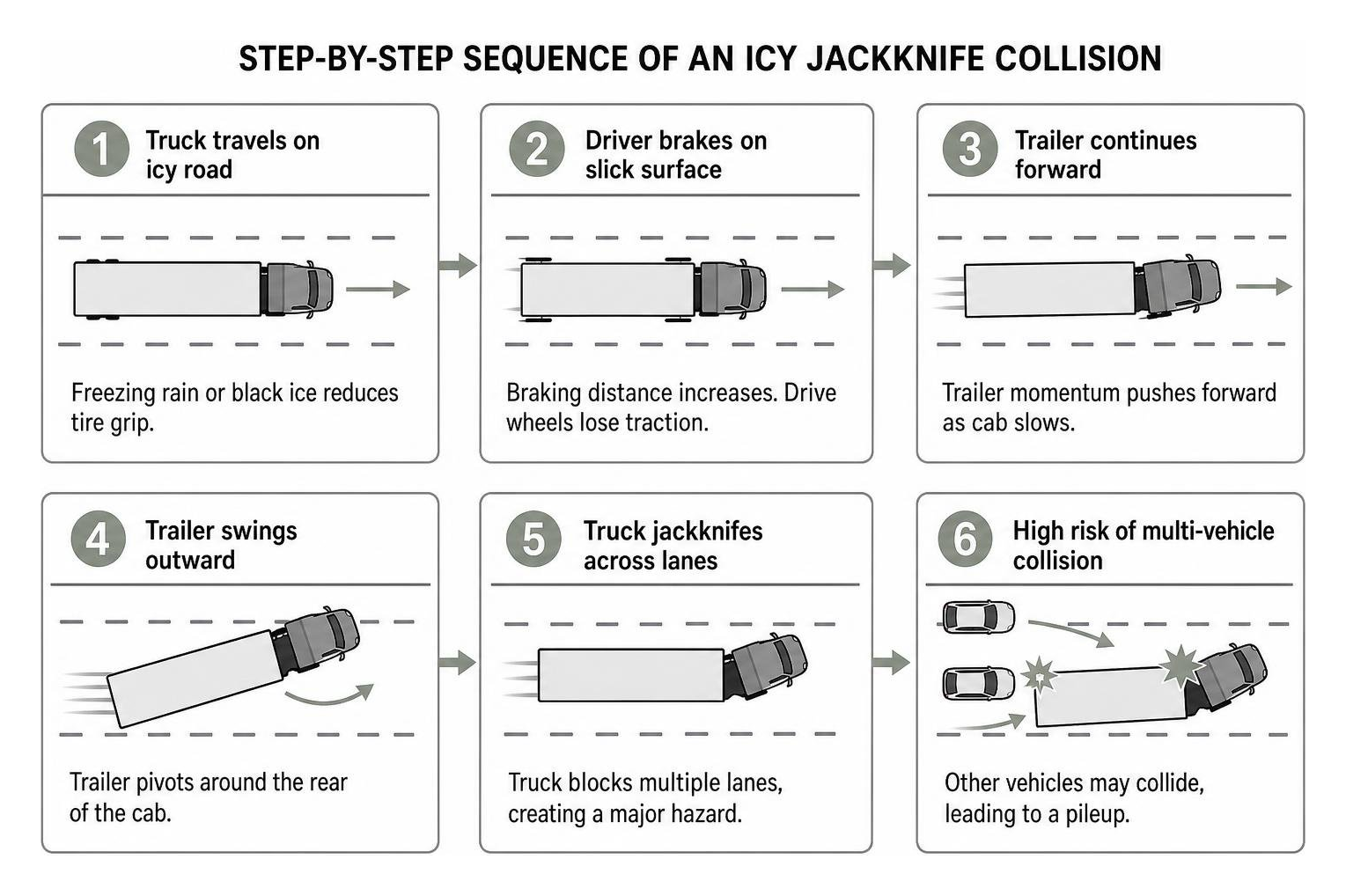
When an 80,000-pound truck encounters black ice, braking distance expands dramatically. On dry pavement, a tractor-trailer traveling at highway speed requires nearly the length of two football fields to come to a complete stop. On an icy roadway, stopping distances can multiply by up to ten times. When a commercial driver locks the service brakes or engages the engine retarder on a slick bridge deck, the drive axles lose lateral traction.
The heavy trailer continues moving forward due to its kinetic momentum, swinging perpendicular to the cab. This jackknife motion sweeps across multiple highway lanes, turning an isolated loss of control into a multi-vehicle disaster. When multiple vehicles become trapped behind an uncontrolled semi-truck, investigating highway pileup collisions requires examining brake timing and initial following distances.
Driver Inexperience and Corporate Fleet Negligence
Freezing weather alone does not cause collisions; human decisions and fleet oversight failures do. Motor carriers have a legal duty to vet, train, and supervise their workforce. When severe winter advisories are issued across Harris County, fleet managers must evaluate whether putting heavy trucks on the road creates an unreasonable hazard.
Common corporate failures that contribute to winter commercial wrecks include:
- Inadequate Driver Training: Placing newly licensed or trainee drivers on icy highway routes without direct cab supervision.
- Hours of Service Violations: Pressuring exhausted drivers to continue driving through freezing rain instead of pulling off at a safe truck stop.
- Improper Pre-Trip Vehicle Inspections: Failing to check tire tread depth, tire pressure, brake shoe adjustments, and windshield defrosting equipment prior to departure.
- Improper Cargo Loading: Distributing weight unevenly inside the dry van or flatbed trailer, which shifts the center of gravity and causes sudden rollovers during evasive maneuvers.
To uncover these operational oversights, accident reconstructionists examine the truck’s onboard computer systems through ECM and EDR technical reconstruction. These electronic control modules record operational parameters such as throttle percentage, engine RPM, steering input, and brake switch status in the seconds preceding an impact.
Real-World Case Studies: Winter Trucking Disasters and Liability Precedents
Analyzing real-world winter commercial wrecks reveals how courts evaluate liability when weather, speed, and driver decisions intersect.
Winter highway incidents across the Gulf Coast region, as tracked in news coverage of Houston commercial vehicle collisions, consistently show that corporate negligence and improper following distances turn minor weather events into severe multi-lane closures.
The I-20 Werner Winter Collision and Substantial-Factor Causation
A prominent legal case study regarding commercial vehicles and icy roads arose from a December 2014 crash on I-20 in Texas. During a winter storm involving black ice, a passenger pickup truck lost control, traversed a 42-foot-wide grassy median, and entered oncoming traffic, colliding with a commercial tractor-trailer. The collision resulted in one fatality and catastrophic injuries to three passengers.
In the initial trial, the jury returned an $89,687,994 verdict against the motor carrier. The plaintiffs argued that the motor carrier acted negligently by dispatching an unsupervised trainee driver who was traveling at approximately 50 to 60 miles per hour on icy roads while the lead driver slept in the sleeper berth.
However, as detailed in the Texas Supreme Court ruling on Werner liability, the state supreme court overturned the nuclear verdict. The court determined that while operating at that speed under freezing conditions was hazardous, there was insufficient evidence proving the commercial truck’s speed was a substantial factor in causing the crash. The court found that the immediate, uncontrolled crossover of the pickup truck into oncoming lanes served as the sole proximate cause of the collision.
This ruling underscores the necessity of establishing clear, proximate causation between a commercial driver’s winter driving choices and the resulting damages.
The I-10 Jackknife Shutdown and Highway Bridge Incidents
Another notable case illustrating the cascading dangers of winter truck handling occurred during the I-10 Baton Rouge interstate closure. An 18-wheeler jackknifed across Interstate 10 after a passenger vehicle abruptly slowed in front of it. The truck launched over the median barrier, paralyzing highway transit for ten hours and requiring heavy-duty recovery cranes to clear the wreckage.
Similar winter freight incidents occur across elevated spans and overpasses throughout the country. On I-94 in Wisconsin, an Amazon tractor-trailer lost traction on an icy bridge deck, breaching the bridge barrier and sliding down an embankment. Although bridge structural inspections cleared the roadway for travel and the driver walked away uninjured, these cases show how quickly a heavy commercial rig can lose stability on slick road surfaces.
Step-by-Step Guide: How to Respond After a Winter Semi-Truck Collision
Navigating the aftermath of a heavy truck wreck on an icy Houston highway requires quick, methodical action to protect your health and legal rights. Review our comprehensive semi-truck litigation guide to understand how commercial claims progress from the accident scene to the courtroom.
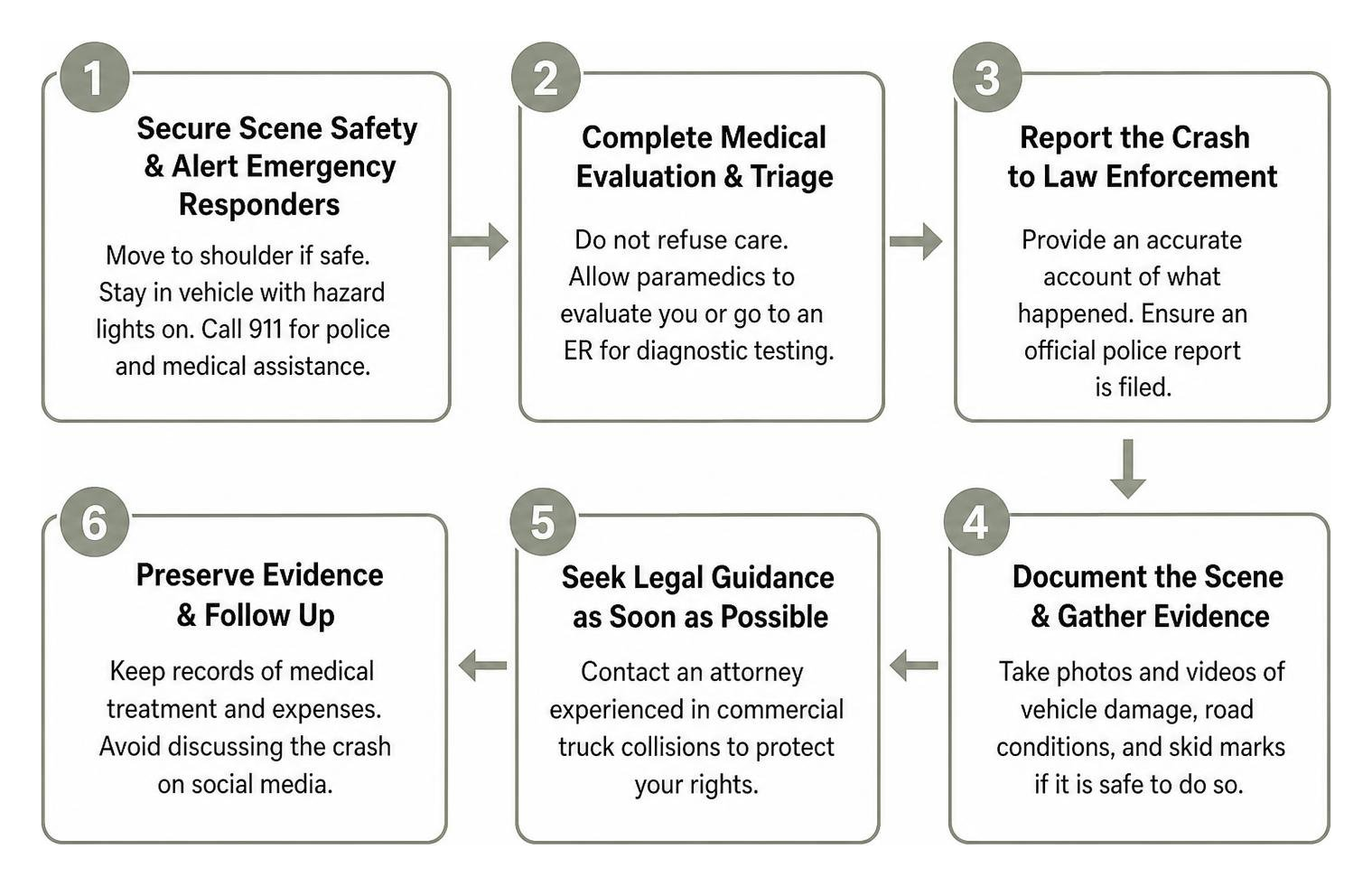
1. Secure Scene Safety and Alert Emergency Responders
If your vehicle is operational and you are stranded on a live lane along I-45, Loop 610, or Beltway 8, guide your vehicle onto the shoulder if it is safe to do so. Remain inside with your hazard lights activated to avoid being struck by oncoming traffic sliding on black ice. Dial 911 immediately to dispatch the Houston Police Department or Harris County Sheriff’s Office alongside local emergency medical teams.
2. Complete Medical Evaluation and Triage
Never refuse medical care at the scene. Low temperatures and adrenaline can mask severe injuries such as whiplash, herniated discs, internal bleeding, or traumatic brain injuries. Allow Houston Fire Department paramedics to evaluate you, or travel directly to an emergency facility such as Memorial Hermann Hospital or Ben Taub Hospital for diagnostic testing.
3. Document Physical Evidence at the Scene
If you can move safely without risking exposure to sliding traffic, capture extensive photographic and video evidence. Document:
- The resting positions of all involved commercial and passenger vehicles.
- Ice accumulation on the asphalt, bridge expansion joints, and highway guardrails.
- The commercial truck’s DOT number, motor carrier name, and license plate.
- Tire skid marks, yaw marks, and gouges in the pavement.
- Names, telephone numbers, and initial statements of all independent eyewitnesses.
4. Direct Formal Communications Properly
Report the crash to your auto insurance carrier to initiate your claim. Under Texas law, your policy may include Personal Injury Protection (PIP), which provides immediate no-fault coverage for medical expenses and lost wages regardless of who caused the crash. Avoid providing recorded statements to the commercial trucking company’s insurance adjusters or investigators until you have consulted legal representation.
Critical Evidence to Preserve Immediately
Commercial transportation companies maintain dedicated response teams that arrive at crash scenes within hours to mitigate corporate liability. Critical evidence can be lost, overwritten, or destroyed if legal preservation demands are not issued immediately. Retaining experienced 18-wheeler legal counsel ensures that a comprehensive formal spoliation letter is sent to the trucking company, its insurer, and its maintenance vendors.
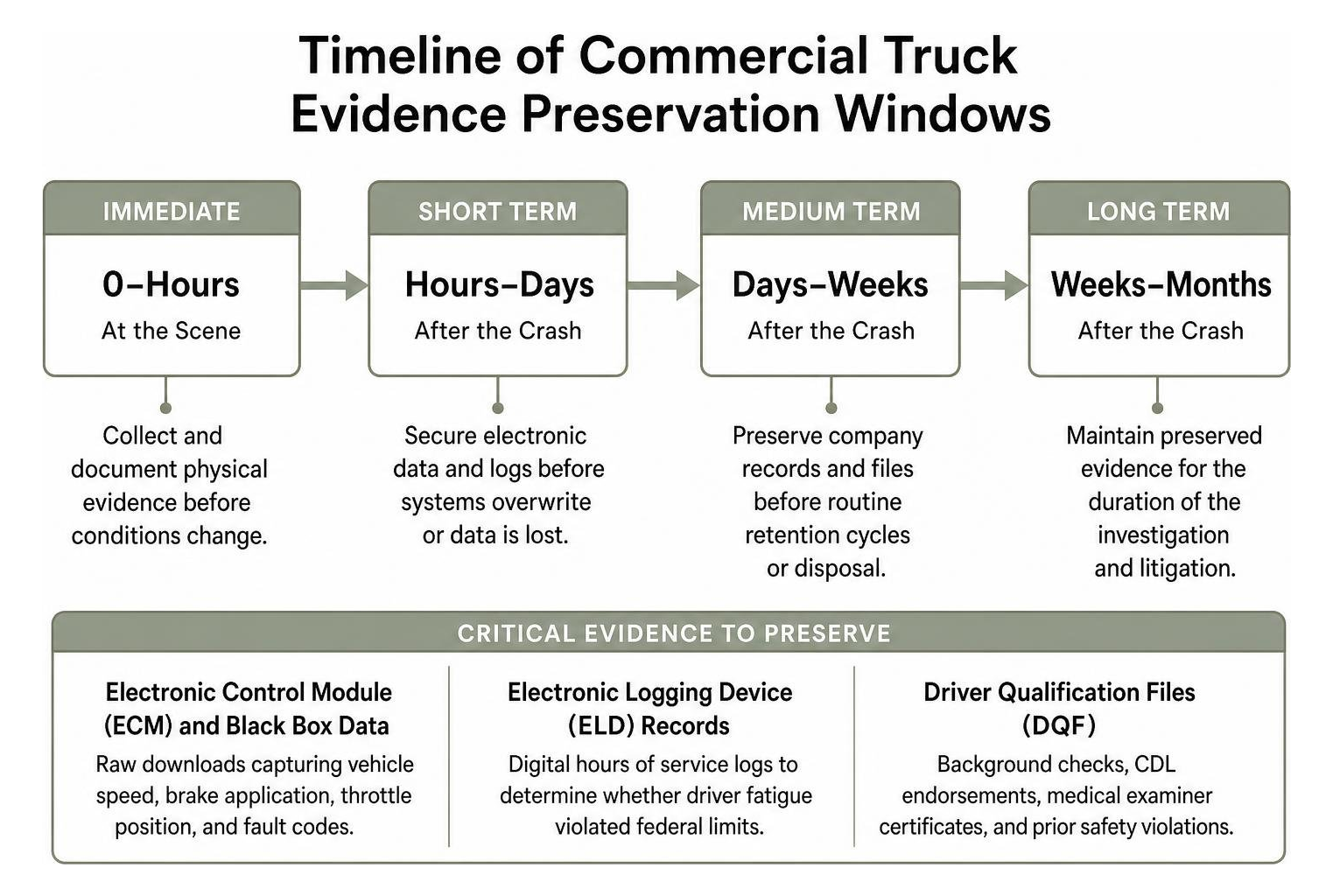
Key evidentiary items that must be secured include:
- Electronic Control Module (ECM) and Black Box Data: Raw downloads capturing vehicle speed, brake application, throttle position, and fault codes.
- Electronic Logging Device (ELD) Records: Digital hours of service logs to determine whether driver fatigue violated federal limits.
- Driver Qualification Files (DQF): Background checks, commercial driver’s license (CDL) endorsements, medical examiner certificates, and prior safety violations.
- Fleet Telematics and Dashcam Footage: Forward-facing, cab-facing, and side-view camera recordings showing road conditions and driver behavior.
- Pre-Trip and Post-Trip Inspection Reports: Records documenting brake adjustments, tire wear, and unresolved mechanical issues prior to the winter trip.
How to Legally Handle an 18 Wheeler Winter Crash
Filing a personal injury or wrongful death claim following an 18-wheeler winter crash requires navigating specific Texas procedural rules and liability standards. Working with dedicated Houston truck wreck representation helps protect your interests against well-funded corporate legal teams.
When handling your legal claim in Harris County Civil Courts at Law or Texas District Courts, key legal principles include:
- Texas Modified Comparative Fault (51% Bar Rule): Under the Texas Civil Practice and Remedies Code Chapter 33, an injured party can recover financial compensation as long as their share of responsibility does not exceed 50%. If you are found to be 20% responsible for sliding on ice while the commercial truck driver was 80% responsible for driving at an unsafe speed, your final recovery will be reduced by your 20% proportion of fault. If your fault is determined to be 51% or higher, you are barred from recovery.
- Texas Statute of Limitations: In Texas, personal injury and wrongful death lawsuits must be filed within two years from the date of the crash. Failing to file within this strict statutory deadline permanently forfeits your right to seek financial recovery.
- Third-Party Liability Identification: Liability in a commercial wreck often extends beyond the individual truck driver. Responsible entities can include the motor carrier that dispatched the vehicle into hazardous weather, the freight shipper that overloaded the trailer, third-party logistics brokers, and maintenance contractors who neglected brake systems.
Frequently Asked Questions About Winter Commercial Truck Crashes
Who is liable if a semi-truck crashes into my car on black ice?
The presence of black ice does not excuse a commercial driver from liability. Federal safety rules and Texas traffic laws require commercial drivers to adjust their speed, increase following distances, or pull off the highway when winter weather impairs traction. If the truck driver operated at an unsafe speed for the road conditions, failed to brake properly, or the trucking company dispatched an unqualified driver, the driver and motor carrier can be held financially liable for the resulting harm.
How does freezing weather impact a commercial truck’s stopping distance?
Freezing weather reduces the friction coefficient between heavy commercial tires and the road surface. While an 80,000-pound truck traveling at 65 mph on dry pavement requires roughly 525 feet to stop, that distance can increase to over 1,500 feet on wet, slushy, or icy pavement. Cold temperatures can also cause moisture inside commercial air brake lines to freeze, creating dangerous delays or complete brake line failures.
Why is electronic data recorder evidence critical after an icy truck collision?
The truck’s onboard Electronic Control Module (ECM) and black box record objective vehicle data in the moments before an impact. This data includes vehicle travel speed, engine braking status, cruise control engagement, and exact steering inputs. This objective digital record helps verify whether the commercial driver exercised proper care or acted negligently in hazardous winter conditions.
Protecting Your Recovery After a Winter Freight Collision
A winter crash involving an 80,000-pound commercial tractor-trailer can lead to life-altering physical, emotional, and financial burdens. When freezing rain, sleet, or black ice strikes the Houston metropolitan area, commercial transportation companies must prioritize public safety over delivery deadlines. Failing to adjust vehicle speed or properly train drivers in winter conditions constitutes actionable negligence under Texas law.
At WestLoop Law Firm, our team provides dedicated advocacy for injured individuals and grieving families across Greater Houston. If you or a loved one suffered injuries in a commercial vehicle collision, consult our comprehensive guide on Houston truck accidents or contact our local legal team directly through our WestLoop Law Firm office to schedule a free case evaluation.