 Skip to content
How Fault Works in a Houston Multi-Vehicle Collision
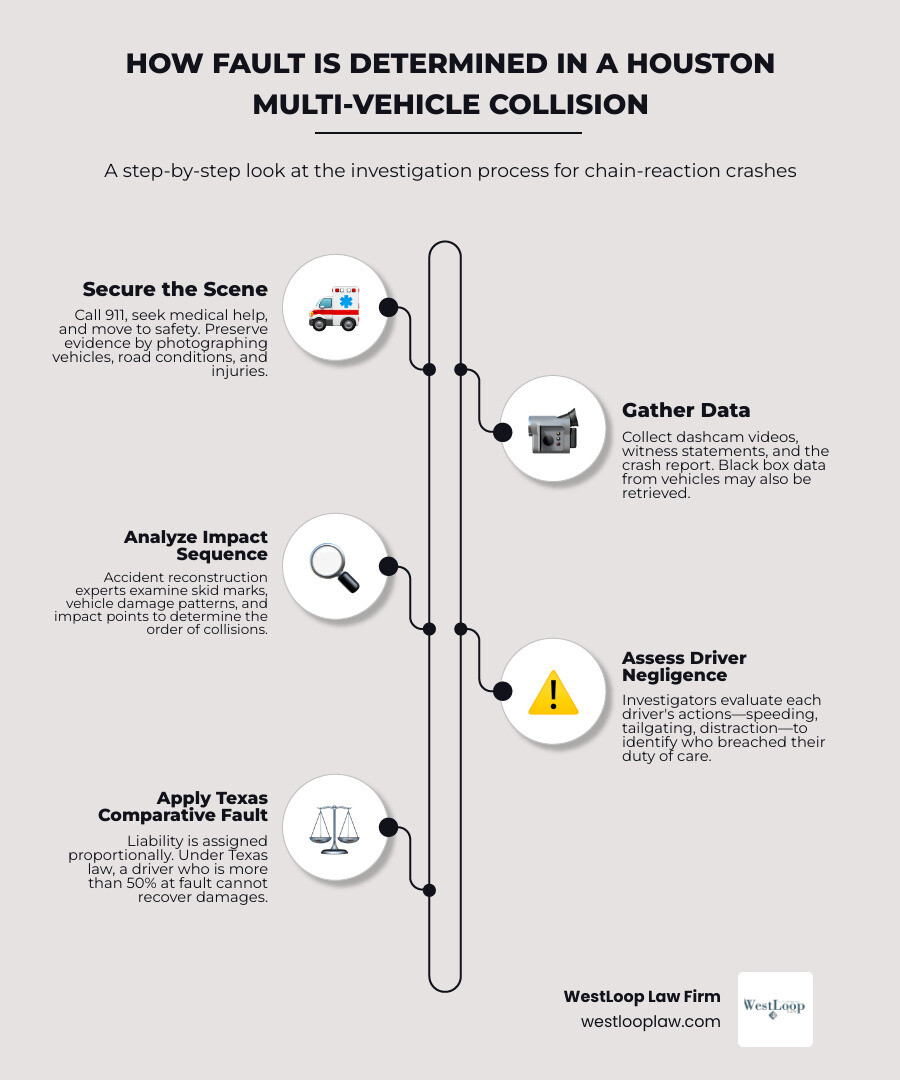
What to do first
- Get medical help and call 911. Move to a safe place if you can.
- Save evidence. Photograph the vehicles, road, and visible injuries. Get witness contact details and the crash report number.
- Do not assume one driver caused every impact. Fault depends on the order of the crashes and what each driver did. More than one driver may share responsibility.
A serious pileup can leave you facing injuries, missed work, and calls from several insurers. In Texas, fault is divided among all motorists whose negligence contributed to the chain reaction, meaning injured drivers can still recover compensation as long as they are not 51% or more responsible. Depending on where and how the crash occurred, victims often consult a Houston intersection accident attorney, a Houston rear end collision attorney, or a Houston accident settlement attorney to protect their rights across multiple insurance claims.
Understanding What Causes a Houston Multi Vehicle Collision
Houston drivers face some of the most demanding traffic conditions in the country. Between soaring population growth and massive ongoing highway expansions, major arteries like Interstate 10, Interstate 45, Interstate 69, Loop 610, and Beltway 8 frequently become sites of catastrophic chain reactions. When traffic flows at 65 miles per hour and abruptly stops near an interchange, even a minor mistake by one driver can cascade into a wreck involving three, four, or more automobiles.
In a typical chain-reaction wreck, the physics involved are violent and unpredictable. An initial impact propels vehicles into surrounding lanes, triggering secondary and tertiary collisions with adjacent commuter cars, commercial trucks, or stationary concrete barriers. Understanding how these wrecks start is the first step toward assigning accountability.
Primary Driver Errors Leading to a Houston Multi Vehicle Collision
Most multi-car wrecks begin with preventable driver errors. When motorists fail to respect basic road rules in dense traffic, the margin for error disappears completely. Common contributing behaviors include:
- Distracted Driving: Checking a text message or navigation app for just three seconds at highway speeds means traveling nearly the length of a football field blindfolded. In heavy traffic along the Southwest Freeway or Loop 610, that inattention leads directly into the back bumper of stopping traffic.
- Running Red Lights and Intersection Violations: High-speed surface streets frequently see devastating chain reactions. For example, a severe wreck at South Sam Houston Parkway occurred when a speeding motorist blew through a red light, striking a vehicle and triggering a four-car pileup that left one dead and five injured. Similar incidents happen across busy corridors like Harwin Drive and Hillcroft Avenue, where sudden intersection impacts send vehicles spinning into nearby traffic and even emergency patrol units.
- Tailgating and Unsafe Following Distances: Tailgating is perhaps the leading catalyst for multi-vehicle crashes. When a lead vehicle brakes suddenly, a following motorist without adequate stopping distance slams into them, causing trailing cars to pile on from behind.
- Excessive Speed for Conditions: Driving faster than surrounding traffic or driving too fast during poor visibility prevents drivers from reacting when highway lanes come to a sudden halt.
Knowing what should I do after a car accident in Houston? is critical for preserving evidence right from the start, especially when multiple vehicles and conflicting driver statements complicate the scene.
External Hazards: Construction Zones, Highway Bottlenecks, and Weather
While driver errors trigger many wrecks, Houston’s unique road infrastructure and environment create conditions ripe for pileups.
- Construction Zone Hazards: Road widening and maintenance projects on corridors like the I-10 East Freeway create narrow lanes, sudden lane shifts, and unexpected closures. A tragic incident on the East Freeway involved three passenger cars colliding and forcing a vehicle into a heavy tractor-trailer parked for construction, causing a fatal outcome and multiple critical injuries.
- Driver Fatigue and Shift Work: Houston is home to the world’s largest medical center and extensive industrial shipping ports, meaning thousands of commuters work overnight shifts. An in-depth NTSB driver fatigue investigation highlighted how non-commercial driver exhaustion can cause motorists to drift across medians on major roadways, triggering multi-vehicle fatal wrecks.
- Sudden Texas Downpours: Houston weather can shift from clear skies to blinding rainstorms in minutes, creating standing water and oil-slicked surfaces that drastically increase braking distances along Beltway 8 and US-290.
How Investigators Determine Fault in Multi-Car Pileups
Unraveling what happened in a pileup requires detailed forensic work. When four or five cars collide, every driver often claims someone else hit them first.
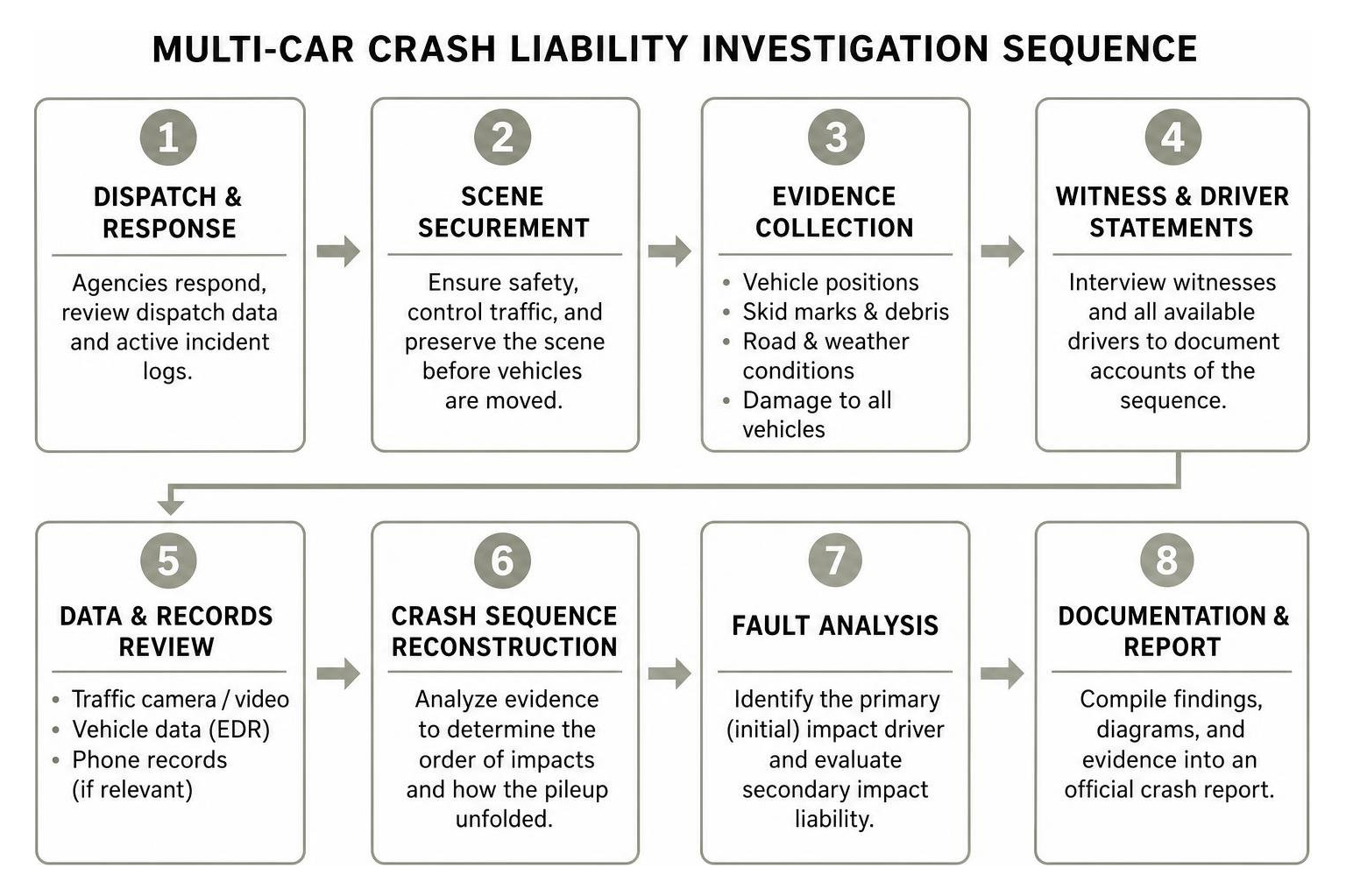
Investigating agencies, including the Houston Police Department and the Harris County Sheriff’s Office Vehicular Crimes Division, respond to document the scene. They review dispatch data, track active incident logs, and gather physical clues before vehicles are cleared from the roadway.
Key Factors in Determining Initial vs. Secondary Impact Liability
| Investigation Component | Initial Impact Analysis | Secondary Impact Analysis |
|---|---|---|
| Primary Focus | What triggered the first collision | How subsequent drivers reacted to the hazard |
| Physical Evidence | Event Data Recorders (black boxes), initial skid marks | Crush depth, paint transfer between vehicles, secondary debris fields |
| Common At-Fault Parties | Driver running red light, speeding, or distracted | Tailgating drivers, motorists failing to brake in time |
| Typical Liability Allocation | Carries primary fault for creating the road hazard | Carries proportionate fault for additional damages and injuries |
Proving Negligence and Sequence of Impacts
Proving liability requires reconstructing the exact timeline of the crash. Physical evidence tells a story that human memory often misremembers under stress:
- Event Data Recorder (EDR) Downloads: Modern passenger cars and commercial vehicles record speed, throttle position, braking application, and steering angles in the seconds leading up to an airbag deployment.
- Dashcam and Traffic Camera Footage: Video footage from city surveillance, TxDOT highway cameras, and private dashcams provides objective records of impact sequences.
- Physical Damage and Paint Transfer: Examining crush angles and paint transfer allows accident reconstructionists to determine which car struck which, and at what approximate velocity.
- Skid Marks and Yaw Marks: Roadway markings demonstrate when and how hard each driver attempted to stop or steer away from danger.
Determining how these factors establish responsibility is essential, especially when assessing who is at fault in a multi-car pileup on the Houston 610 Loop?
The Legal Impact of Texas Modified Comparative Fault
Texas handles liability under a system called proportionate responsibility, codified in Chapter 33 of the Texas Civil Practice and Remedies Code. Under Texas’s 51% modified comparative fault rule:
- You can recover damages as long as your share of responsibility is 50% or less.
- Your total recovery is reduced by your specific percentage of fault. If a jury awards you $100,000 for your medical bills and pain, but finds you were 10% responsible because you were following slightly too closely, your recovery is reduced by 10% to $90,000.
- If you are found 51% or more at fault, you are completely barred from recovering compensation from any other driver.
In a pileup, multiple drivers may share varying percentages of fault. One driver might be assigned 60% fault for initiating the wreck, a second driver 30% for tailgating, and a third driver 10% for driving with worn tires that lengthened their stopping distance. Navigating these percentages requires understanding comparative negligence in Houston TX and how insurance adjusters attempt to shift blame.
Insurance Claims and Legal Recourse for Injured Victims
Recovering financial compensation after a multi-car crash in Harris County is significantly more complex than handling a simple two-car fender bender.
Navigating Insurance Coverage in a Houston Multi Vehicle Collision
In Texas, drivers are legally required to carry minimum liability coverage of $30,000 per injured person, up to $60,000 per accident for bodily injury, and $25,000 for property damage (often called 30/60/25 coverage).
In a multi-vehicle wreck with multiple injured people, these minimum limits are quickly exhausted. If an at-fault driver has only $60,000 in total bodily injury coverage, and four different motorists suffer severe injuries requiring transport to Memorial Hermann or Ben Taub Hospital, that $60,000 policy will not begin to cover everyone’s emergency room bills.
To recover full compensation, injured motorists must explore several avenues:
- Personal Injury Protection (PIP): Texas auto insurance policies automatically include PIP coverage unless you explicitly rejected it in writing. PIP pays for your immediate medical treatment and a portion of lost income regardless of who caused the wreck.
- Uninsured/Underinsured Motorist (UM/UIM) Coverage: When the at-fault drivers lack adequate insurance limits to pay your full damages, your own UM/UIM policy can step in to bridge the gap.
- Third-Party Commercial Coverage: If a commercial vehicle, construction hauler, or delivery driver contributed to the pileup, their higher commercial insurance policy limits may be accessible.
Successfully resolving these claims requires filing a Houston accident insurance claim with proper documentation from the earliest stages.
Seeking Compensation for Catastrophic Injuries and Wrongful Death
Because multi-vehicle crashes involve secondary impacts, side-impact T-bones, and rollover risks, the injuries are often severe. Victims commonly sustain traumatic brain injuries, spinal cord trauma, crushed limbs, internal bleeding, and severe fractures.
When commercial vehicles are involved in highway pileups, specific federal and state trucking safety regulations come into play. Exploring legal options for injured motorists in a truck highway pileup Houston wreck allows victims to hold commercial carriers accountable when poor fleet maintenance, overloaded cargo, or driver fatigue contributed to the collision.
In tragic cases where a family member loses their life, surviving spouses, children, and parents may pursue a wrongful death claim in Harris County Civil Courts at Law or Harris County District Courts to recover funeral costs, lost financial support, and compensation for their loss.
Frequently Asked Questions About Houston Multi-Car Accidents
Who is usually held liable in a chain-reaction rear-end crash in Houston?
Liability depends on the sequence of events. While the rear driver who triggers the first impact is typically assigned primary fault, intermediate drivers can also share liability if they were tailgating, speeding, or failing to maintain an alert lookout, preventing them from stopping safely before striking the car ahead.
What happens if multiple drivers share fault in a Texas pileup?
Under Texas proportionate responsibility laws, a judge or jury determines the percentage of fault for every party involved. As long as your assigned responsibility is 50% or less, you can collect compensation from the other at-fault drivers, reduced proportionately by your fault percentage.
How long do I have to file an injury claim after a multi-car collision in Houston?
Under Texas Civil Practice and Remedies Code Section 16.003, the statute of limitations for personal injury and wrongful death lawsuits is two years from the date of the wreck. Failing to file your claim within this two-year window permanently eliminates your right to seek financial recovery in court.
Securing Fair Compensation After a Harris County Pileup
Multi-vehicle crashes present difficult legal challenges. Insurance companies move quickly to protect their own financial interests, often pointing fingers at other drivers or attempting to shift undue blame onto you to bar your recovery under the Texas 51% rule.
At Westloop Law Firm, we stand up for injured individuals and grieving families across the Greater Houston area. Our dual legal background in personal injury litigation and Texas probate law allows us to represent severely injured victims as well as families handling complex estate and wrongful death claims after a fatal crash.
If you or a loved one has suffered harm in a highway pileup, we are here to investigate the crash, hold negligent motorists accountable, and demand the full compensation you need to rebuild your life. Contact our team today for a free case evaluation with a dedicated Houston car accident attorney.