 Skip to content
Who Is at Fault After a Houston Weather-Related Accident?
What to do first:
- Get to safety and call for help. Do not enter floodwater or stand near downed power lines.
- Document what happened. If it is safe, photograph the vehicles, road conditions, and any signs or debris. Save witness contact details.
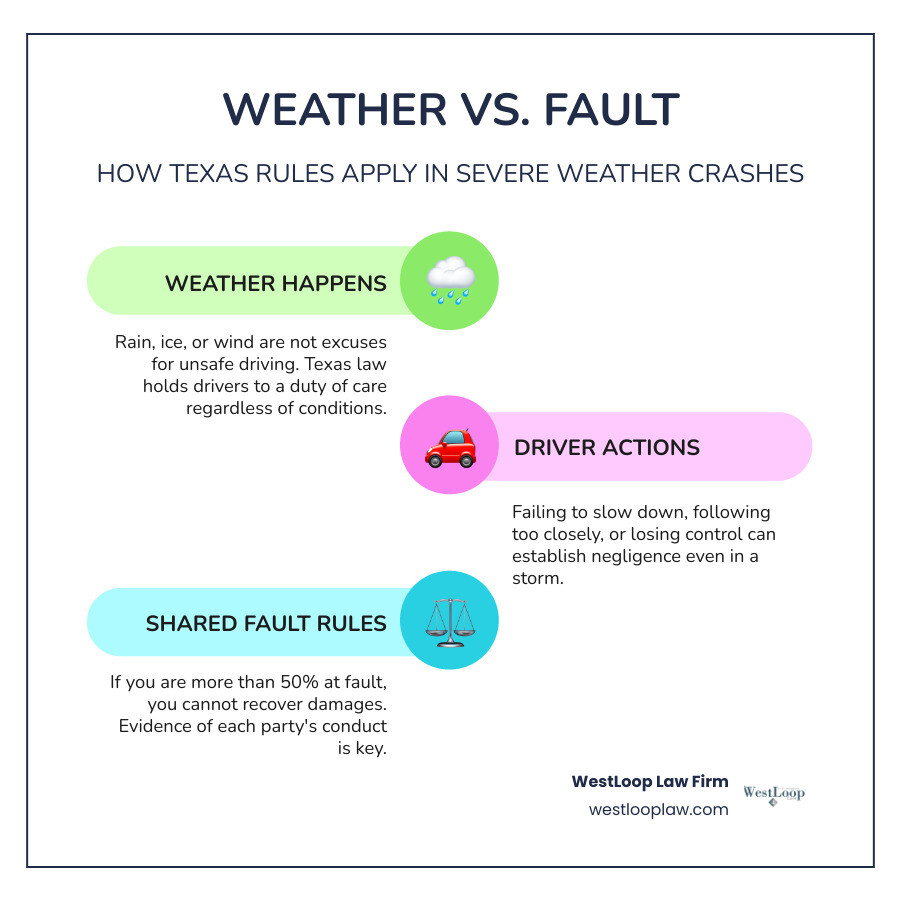
- Look beyond the weather. In a Houston weather-related accident, rain, ice, or wind does not automatically excuse a driver who failed to slow down or take reasonable care.
Texas fault rules can also reduce an injury claim if you share responsibility. If you are found more than 50% at fault, you cannot recover damages from another party under Texas proportionate responsibility rules. That makes evidence of both the weather and each person’s actions important.
Basic houston weather related accident glossary:
- Houston distracted driving accident lawyer
- Houston intersection accident attorney
- Houston rollover accident lawyer
Common Hazards Behind a Houston Weather Related Accident
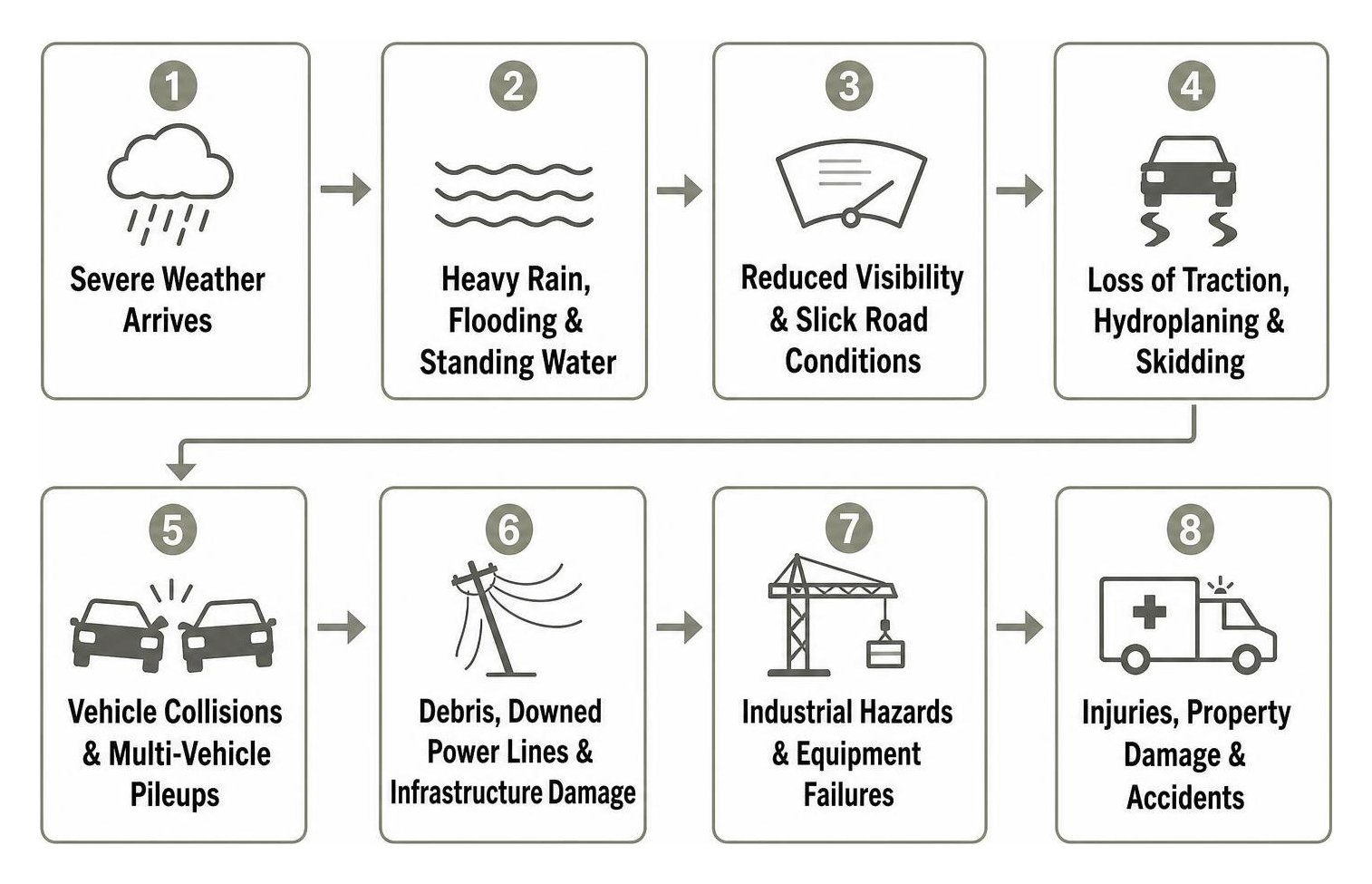
Driving in Houston often feels like an unpredictable journey through rapid microclimates. One minute the sun is beating down on the asphalt, and the next, a wall of tropical moisture reduces visibility to zero across the Galleria area. Our region’s flat geography and unique infrastructure present distinct challenges whenever storms sweep through Harris County.

Sudden, intense downpours can deposit multiple inches of rain across the city in less than an hour. Because Houston relies heavily on non-porous concrete road surfaces rather than permeable pavement, rainwater gathers quickly on highway lanes rather than draining away immediately. This rapid accumulation produces heavy roadway ponding, deep standing water, and sudden flash flooding along major transit corridors.
When regional bayous reach capacity, the surrounding freeway systems often serve as secondary detention basins. Commuters regularly face dangerous conditions when Buffalo Bayou overflows near downtown Houston and Rusk Street, quickly submerging access roads and ramps. As ABC13 reported on I-45 and Highway 288 storm disruptions, severe weather regularly stalls vehicles, brings down massive trees, and contributes to dangerous multi-vehicle collisions on our busiest routes.
Freezing Temperatures, Black Ice, and Overpasses
While Houston averages only a handful of freezing days per year, Arctic blasts present acute danger when sub-freezing temperatures arrive. Bridge decks and elevated highway structures—such as the elevated ramps connecting Interstate 10, Interstate 45, Loop 610, and Beltway 8—freeze long before ground-level lanes do.
When polar air masses move into the region, moisture trapped on concrete roadways quickly transitions into invisible black ice. Even when the Texas Department of Transportation (TxDOT) applies salt-brine treatments before a storm, sustained sub-freezing weather can cause ice to reform on concrete overpasses. The sudden loss of tire friction can send passenger vehicles into spinouts and create complex, multi-vehicle pileups. Commercial haulers face distinct braking challenges under these conditions, making it crucial to understand how an 18-wheeler winter crash happens across Houston roads when tractor-trailers fail to adjust their speed for slick bridges.
Hurricane Winds and Industrial Hazards
Tropical systems and severe coastal storms introduce destructive gale-force winds that compromise driving safety and urban infrastructure. When Hurricane Beryl struck the Houston area as a Category 1 storm, it brought wind gusts and intense downpours that left more than 2.2 million homes and businesses without power, uprooted large trees, and caused multiple fatalities across Harris County.
High winds turn loose debris into airborne projectiles, rip traffic signals from intersections, and knock live power lines directly into traffic lanes. Beyond residential risks, commercial and industrial zones face severe hazards when high winds strike heavy machinery. Wind speeds exceeding safe operating limits can lead to catastrophic equipment failures, as seen in recent lawsuits involving storm-related crane collapses where industrial cranes collapsed onto vehicles during intense storm gusts. Companies that fail to halt high-risk operations during severe weather warnings create massive hazards for nearby workers and motorists.
Determining Fault and Legal Liability Under Texas Law
A common misconception among drivers is that severe weather acts as an automatic legal shield. Insurance adjusters frequently attempt to label storm-related collisions as unavoidable “Acts of God.” Under Texas law, however, an Act of God defense applies only to violent, catastrophic events produced entirely by nature that could not have been anticipated or prevented by human foresight and care.
Section 545.351 of the Texas Transportation Code states that a driver cannot operate a vehicle at a speed greater than is reasonable and prudent under the conditions existing at the time. This means that posted speed limits apply only to ideal, clear weather. When torrential rain hits Loop 610 or black ice glazes over Beltway 8, driving at the posted speed limit may constitute clear negligence. Drivers have an ongoing legal duty to:
- Reduce their speed to match reduced tire traction.
- Increase following distance to allow adequate stopping room.
- Turn on headlights to maintain visibility for surrounding traffic.
- Avoid sudden braking or abrupt steering maneuvers on flooded or icy pavement.
| Driver Action | Adverse Weather Condition | Potential Legal Fault Determination |
|---|---|---|
| Driving at posted speed limit (65 mph) | Torrential downpour with standing water on freeway | Negligent: Failure to control speed for existing roadway conditions |
| Following 2 car lengths behind | Slick roads and black ice on overpass | Negligent: Inadequate following distance for reduced tire traction |
| Hydroplaning on worn, bald tires | Moderate rain shower on standard city street | Negligent: Failure to properly maintain vehicle equipment |
| Pulling safely onto shoulder with hazard lights | Zero-visibility whiteout storm | Non-Negligent: Prudent emergency action taken to avoid hazards |
Proving Negligence After a Houston Weather Related Accident
Establishing liability requires demonstrating that another motorist or entity breached their legal duty of care under the specific conditions present during the collision. In Texas personal injury claims, proving fault involves demonstrating how an ordinarily prudent driver would have behaved under identical circumstances.
Careless behaviors during severe storms often mirror the most common types of car accidents in Houston, including rear-end crashes, T-bone impacts at unlit intersections, and lane-departure collisions. When establishing liability, determining fault and proving negligent driving requires examining concrete driver errors such as:
- Operating with bald, worn tires that cannot channel water away from the tread.
- Driving with defective windshield wipers that obstruct the driver’s view.
- Unsafe lane changes or aggressive passing in standing water.
- Failing to yield at intersections where traffic signals are dark due to local power outages.
Police crash reports, citations issued by Houston Police or the Harris County Sheriff’s Office for failure to control speed, and witness statements play a vital role in demonstrating that driver error—not the storm alone—caused the wreck.
Key Evidence to Preserve in a Houston Weather Related Accident
Inclement weather changes quickly, which means crucial roadway evidence can wash away within hours. Preserving clear documentation immediately after an incident is vital to building a solid legal claim:
- Real-Time Traffic and Road Condition Data: Historical roadway reports, incident logs, and flood sensor maps from Houston TranStar help prove what alerts were active at the time of the crash.
- National Weather Service Records: Official meteorological archives verify rain totals, wind speeds, and freeze warnings present in the specific ZIP code where the crash occurred.
- Vehicle Black Box (ECM) Data: Electronic Control Module downloads from commercial trucks and passenger vehicles record vehicle speed, throttle position, and steering input immediately before impact.
- Dashcam and Surveillance Footage: Video recorded by traffic cameras, nearby business security systems, or onboard dashcams provides direct visual proof of driver behavior on wet pavement.
- Physical Scene Evidence: Photographs of tire tread depth, standing puddle depth, skid marks, vehicle rest positions, and downed highway signs establish the environment at the moment of the crash.
Understanding Texas Comparative Fault and Weather Claims
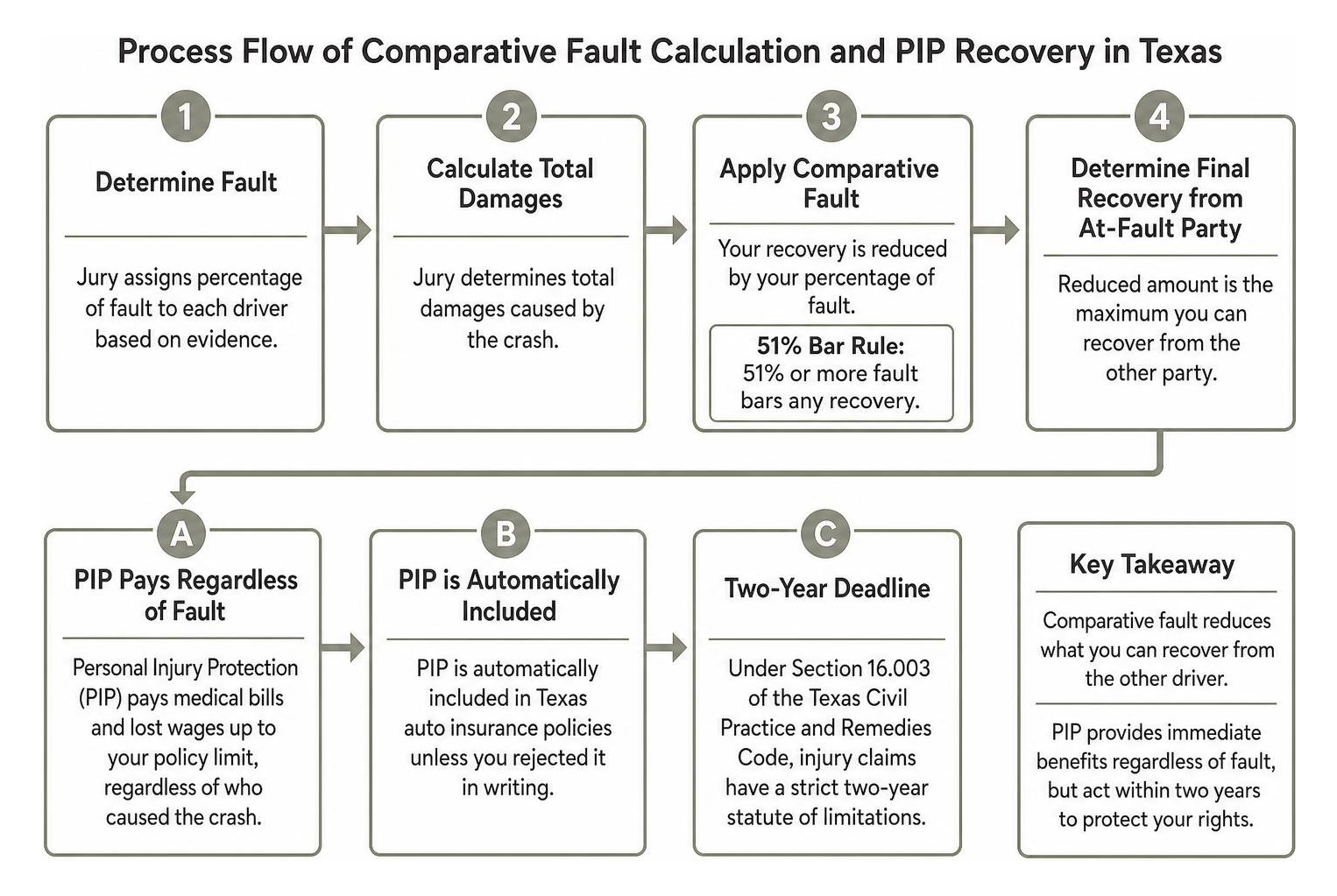
When an insurer evaluates a weather crash, they often claim the injured driver contributed to their own damages. Texas follows a modified comparative fault system, officially known as proportionate responsibility under Chapter 33 of the Texas Civil Practice and Remedies Code.
Under this rule, an injured person’s financial recovery is directly reduced by their percentage of fault. If a jury determines your damages total $100,000 but assigns you 20% of the blame for traveling slightly too fast for the rain, your final recovery is reduced to $80,000. Crucially, Texas enforces a 51% bar rule: if you are determined to be 51% or more at fault, you are completely barred from recovering any compensation from the other party. Understanding comparative negligence in Houston is vital because insurance carriers routinely inflate an injured driver’s degree of fault to escape paying claims.
If you carry Personal Injury Protection (PIP) on your auto policy, this coverage pays medical bills and lost wages up to your policy limit regardless of who caused the crash. Under Texas law, PIP is automatically included in auto insurance policies unless you rejected it in writing. Furthermore, under Section 16.003 of the Texas Civil Practice and Remedies Code, injury claims in Texas carry a strict two-year statute of limitations, meaning you must resolve your claim or file a formal lawsuit in court before this window closes.
Third-Party and Municipal Liability Considerations
Not every weather-related wreck is solely the fault of an individual motorist. In some instances, dangerous roadway defects or corporate negligence create unavoidable hazards for the public:
- Government Entities: TxDOT or municipal agencies may face liability under the Texas Tort Claims Act if defective road design, unaddressed drainage blockages, or missing warning signs directly cause a crash. These claims involve strict formal notice deadlines, often requiring notice within a few months of the incident.
- Road Construction Contractors: Highway maintenance crews and construction companies working on corridors like I-10 or I-45 must implement adequate water drainage channels and high-visibility lane markers throughout active work zones.
- Commercial Trucking Companies: Fleet operators have a legal responsibility to train drivers on foul-weather procedures, mandate safety stops during tropical downpours, and properly maintain commercial fleet tires and braking systems.
When addressing complex fault disputes involving commercial entities, government bodies, or stubborn insurance adjusters, working with a Houston car accident lawyer from Westloop Law Firm ensures that evidence is secured, liability is properly calculated, and your legal rights are fully protected.
Frequently Asked Questions About Houston Weather Crashes
Can an insurance company deny my claim by blaming severe weather?
Insurance adjusters regularly cite severe weather to argue that an accident was an unavoidable Act of God. However, an Act of God defense only holds up if the crash occurred without any contributing human negligence. Texas law requires all drivers to adjust their speed, follow at safe distances, and maintain full control of their vehicles during adverse conditions. If another motorist was speeding, following too closely, or driving on bald tires during a storm, the insurance company cannot legally deny your claim based purely on the weather.
Who is liable if severe wind causes falling debris or construction cranes to hit a vehicle?
Liability typically rests with the property owners, general contractors, or equipment operators responsible for the site. Commercial construction operations must monitor real-time weather forecasts and adhere to strict safety thresholds, including halting crane operations when sustained winds or gusts exceed safe limits. If a contractor leaves materials unsecured or continues operating heavy machinery in high winds, they can be held liable under Texas premises liability and negligence laws.
How do Houston’s concrete highways impact liability during flash floods?
Because concrete highways are non-porous and shed water slowly, drivers must anticipate standing water and heavy ponding during downpours. Motorists cannot claim they were surprised by standing water on known flood-prone corridors such as Highway 288 or I-45 entrance ramps. Drivers are legally obligated to reduce their speed to prevent hydroplaning, and failing to slow down on wet concrete surfaces is considered clear driver negligence under Texas law.
Protecting Your Rights After a Severe Weather Collision
Recovering from a severe car crash is challenging on its own, but facing an insurer that blames Mother Nature for another driver’s carelessness creates added frustration. At Westloop Law Firm, we focus on personal injury and probate matters, bringing comprehensive advocacy to clients navigating complex injury claims and wrongful death disputes. We understand how local weather conditions interact with Texas traffic statutes, and we know how to counter insurance tactics designed to push blame onto innocent drivers.
If you or a loved one suffered injuries in a storm-related collision, reach out to an experienced Houston car accident attorney for a free case evaluation. We will review the crash report, collect weather and traffic records, evaluate comparative fault, and guide you through the process of securing the compensation you deserve in Harris County Civil Courts at Law.