 Skip to content
Choose an 18 Wheeler Dash Cam That Records Every Critical Angle
For a reliable 18 wheeler dash cam, choose a truck-rated system with a clear front camera, secure vibration-resistant mount, high-endurance storage, and strong low-light recording. Add rear, side, and cab cameras when you need evidence of lane changes, loading-area damage, blind-spot events, or what happened inside the cab.
For Houston drivers, the right setup should also handle long hours, heat, and busy freight routes such as I-10 and I-45. A standard passenger-car camera may record the road ahead, but a commercial system can cover more of a large rig and preserve footage from an incident.
Dash cam video can provide useful, time-stamped evidence after a crash or disputed event. It may help show traffic conditions, vehicle positions, sudden merges, or another driver’s actions. It cannot guarantee the outcome of an insurance claim or protect a CDL by itself, but clear footage can be important evidence.
This guide compares practical truck camera options and the features that matter most for Houston-area 18-wheelers.
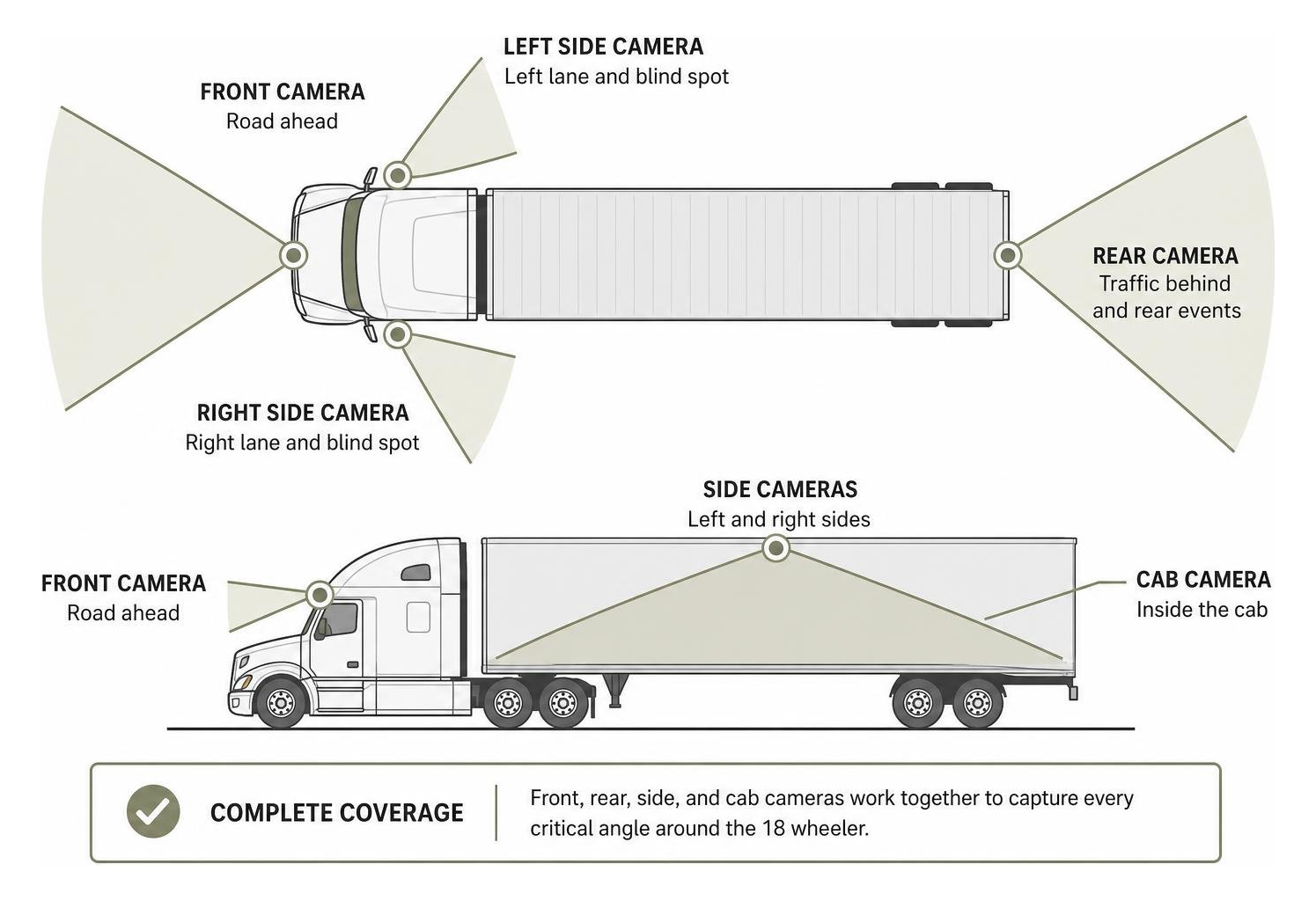
Simple 18 wheeler dash cam word guide:
Why Commercial Rigs Need Dedicated Dash Cams vs Passenger Units
Commercial big rigs face daily operational demands that easily overwhelm standard consumer electronics. A passenger car dash cam is built for short daily commutes inside a climate-controlled vehicle. In contrast, an 18-wheeler operating across Houston freight corridors like the Loop 610 or the Ship Channel bridge runs for ten to fourteen hours continuously.
Heavy-duty commercial driving generates sustained chassis vibrations, major electrical spikes from auxiliary equipment, and huge temperature swings inside the cab. Standard suction cups fall off windshields under diesel engine vibration, and standard consumer batteries can swell or fail when exposed to prolonged Texas sun. Choosing dedicated equipment ensures your footage remains intact when an incident occurs.
Essential Heavy-Duty Features in an 18 Wheeler Dash Cam
To survive long-haul trucking, commercial cameras incorporate specific mechanical and electrical enhancements:
- Supercapacitor Power Supplies: Instead of volatile lithium-ion batteries, commercial units use supercapacitors. These components handle cab temperatures ranging from -20°C to 75°C (-4°F to 167°F) without expanding, melting, or losing the ability to save final video clips when power cuts out.
- Vibration-Resistant Hardware: Heavy-duty mounts utilize industrial-grade adhesive plates, metal brackets, and locking screws to maintain level framing despite continuous highway vibrations.
- Wide Dynamic Range (WDR) and High Dynamic Range (HDR): High-contrast lighting—such as exiting a dark warehouse into blazing Texas sunlight or driving past bright high-beam headlights along rural stretches of I-10—requires dynamic optical sensors to keep license plates readable.
- High-Endurance Memory Support: Semi-truck setups require support for high-endurance Class 10/U3 microSD cards (128GB to 256GB and above) that survive thousands of continuous write-and-overwrite loop cycles.
- Integration with Vehicle Diagnostics: Many systems pair directly with All About Trucking Black Box Data (Engine Control Modules and Electronic Logging Devices) to cross-reference video timestamps with speed, engine RPM, and braking metrics.
ADAS and Driver Monitoring Technology
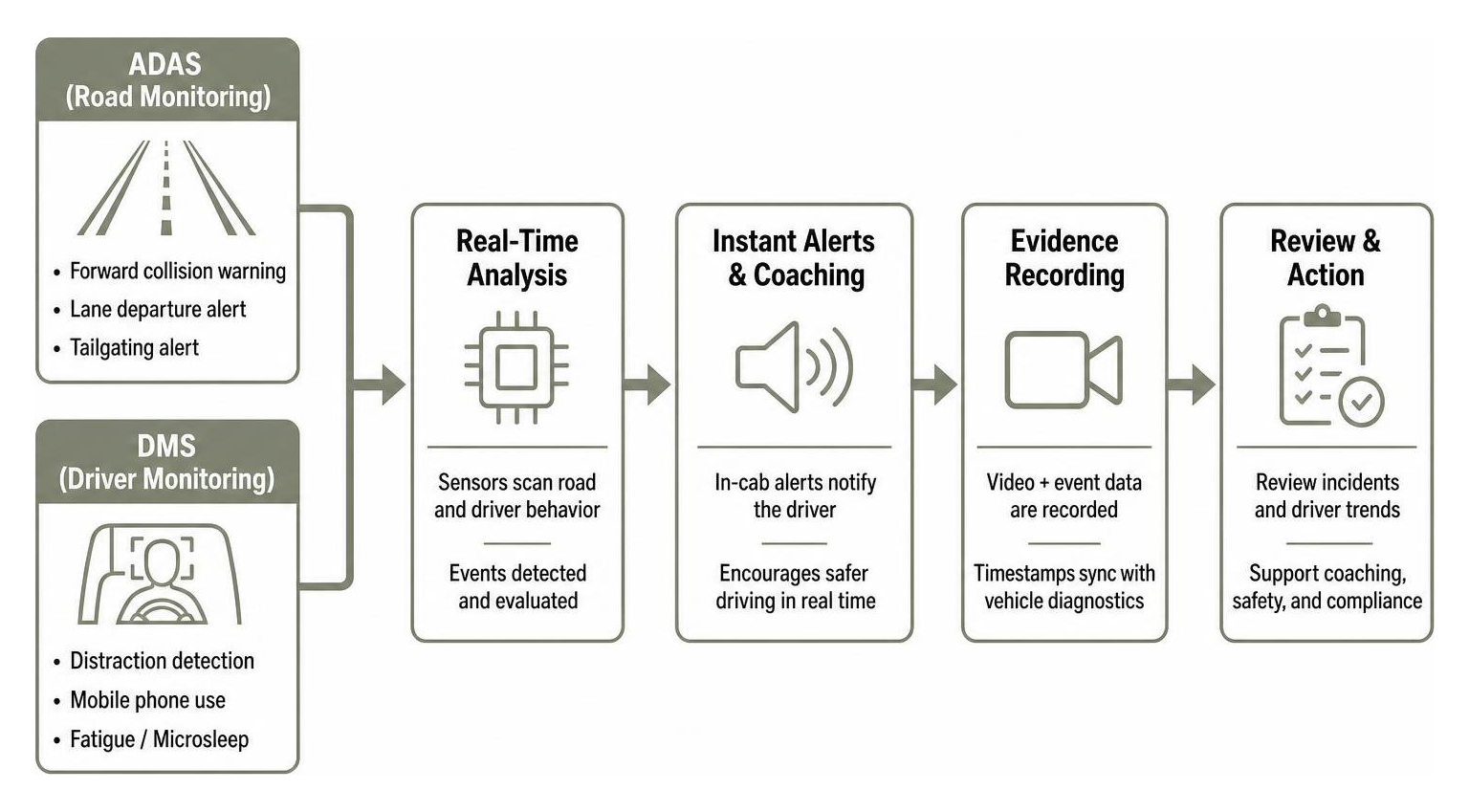
Modern commercial setups often include Advanced Driver Assistance Systems (ADAS) and Driver Monitoring Systems (DMS). These forward-facing and cab-facing sensors scan both the road ahead and the interior environment to actively coach drivers and document safety compliance.
Forward-looking ADAS features calculate closing distances to deliver forward collision warnings, lane departure alerts, and tailgating notices. Concurrently, interior DMS lenses use optical sensors to recognize signs of driver distraction, mobile phone use, and physical fatigue or microsleep patterns.
| Feature / Specification | Standard Passenger Dash Cam | Commercial 18-Wheeler Multi-Camera System |
|---|---|---|
| Power Source | Lithium-ion battery (heat-sensitive) | Supercapacitor / Hardwired auxiliary circuit |
| Operating Temperature | 0°C to 45°C | -20°C to 75°C |
| Camera Channels | 1 to 2 channels (Front/Cabin) | 3 to 8 channels (Front, Sides, Rear, Cargo, Cab) |
| Storage Capacity | 32GB to 64GB typical | 128GB to 512GB+ High-Endurance |
| Telemetry & Telematics | Basic GPS speed stamp | Real-time 4G cloud streaming, ELD integration, DMS |
| Housing & Durability | Lightweight plastic | Heavy-duty, IP67/IP69 weatherproof exterior housings |
Best 18 Wheeler Dash Cam Configurations and Camera Angles

A single front-facing camera leaves massive blind spots along the perimeter of a 70-foot tractor-trailer. Complete situational awareness requires multi-channel setups that document all quadrants of the commercial vehicle. High-end multi-channel systems, such as the 4 Channel AI dashcam Pro for Fleet Safety | TruckX, combine multiple perspectives into a single unified DVR hub with split-screen in-cab monitoring.
Popular heavy-duty systems on the market also include options from Dansker 2-Channel Solar Powered HD Dash Cam for Commercial Trucks and Vans – DANSKER Dash Cams, 360 Degree Semi Truck Camera System for Surround View with DVR (2023 Model), Truck Driver High Def 4k 2k 1080p HD resolution dash cam windshield camera wifi from Dieselboss, and Best Dash Cams For 18-Wheelers: Top 5 Picks For Truckers (2026).
Choosing the Best 18 Wheeler Dash Cam Setup for Fleet Safety
When selecting an optimal camera arrangement, commercial operators should evaluate their route types, trailer interchange frequencies, and cargo risk profiles:
- Forward-Facing 4K/2K Cameras: Placed high on the windshield within the windshield wiper sweep. This lens captures traffic signals, lane markers, and lead vehicle brake lights with maximum resolution.
- Side-Mirror Blind-Spot Cameras: Mounted below the West Coast mirrors pointing backward along the trailer sides. These lenses capture passenger vehicles lingering in blind spots or attempting unsafe right-side passes.
- Rear Trailer Cameras: Heavy-duty, IP69 waterproof rear cameras with infrared night vision. These assist with tight dock maneuvers and record rear-end impacts on high-speed freeways.
- Interior Cab and Cargo Views: Wide-angle lenses that record steering inputs, driver attentiveness, and freight integrity during transit to help investigate the 5 Common Causes Of Truck Accidents.
Installation and Maintenance Best Practices for Semi-Trucks
Proper installation prevents electrical malfunctions, dash clutter, and camera downtime. Semi-trucks run complex 12-volt or 24-volt electrical systems, meaning cameras should be cleanly integrated rather than plugged into loose accessory sockets that can vibrate free.
For complex multi-channel systems requiring exterior wiring along the chassis and trailer, working with a Professional Dash Cam Installation Service in Houston ensures cables are protected from road debris, moisture intrusion, and engine heat.
Essential Pre-Trip Dash Cam Inspection Steps
- Verify that the camera power indicator is solid and recording upon ignition start.
- Check the monitor display to ensure lenses have not shifted out of alignment.
- Clean the windshield and external camera lenses using a microfiber cloth to remove bugs and diesel soot.
- Confirm that the memory card is actively writing without memory error prompts.
- Test the manual emergency lock button to ensure critical incident files save properly.
- Format the microSD card once every 30 to 60 days to prevent file allocation table errors.
Legal and Insurance Value: Protecting Your CDL on Texas Highways
Commercial drivers face immense scrutiny following any highway collision. Because of the size differential between commercial trucks and passenger cars, fault is often unfairly assumed before an investigation concludes. Objective video evidence is one of the most reliable tools available to establish the truth.
A clear video recording provides undeniable facts that can refute false claims, show sudden unsafe cut-offs by other motorists, and demonstrate that a commercial driver followed all traffic rules. When legal challenges arise in local courts, working with an experienced Commercial Truck Accident Lawyer Houston ensures that video evidence, black box logs, and maintenance records are handled correctly. Our team at Westloop Law Firm understands how digital evidence shapes claims in local courts and why Truck Accident Lawyers Houston Why Harris County Cases Hit Different.
Frequently Asked Questions About Truck Dash Cams
How much storage capacity is recommended for continuous long-haul recording?
For multi-channel or 4K dash cams, a high-endurance microSD card of 128GB to 256GB is recommended. This capacity provides roughly 12 to 24 hours of multi-camera footage before loop recording begins overwriting older, unlocked files. High-endurance cards rated for continuous writing are essential to prevent data corruption.
Can dash cam footage protect a driver’s CDL after a disputed crash?
Yes. Dash cam footage captures objective, time-stamped visual proof of traffic light colors, vehicle lane positioning, following distances, and unexpected maneuvers by third parties. Presenting clear video can quickly dismiss wrongful citations and protect a commercial driver’s safety score and livelihood.
How does parking mode work on commercial rigs without draining the battery?
Commercial parking modes utilize hardwire power kits equipped with intelligent low-voltage cutoff modules. If the truck’s battery voltage drops below a set threshold (such as 11.8V or 12.0V), the camera powers off automatically. Alternatively, cameras enter low-power sleep modes and only wake up to record when the internal G-sensor detects an impact or motion near the rig.
Securing Your Digital Evidence on Houston Corridors
Equipping your rig with a heavy-duty, multi-channel camera system is an essential step toward staying protected on busy Texas roadways. Whether navigating congested interchanges or managing dock deliveries, reliable video documentation preserves the facts and provides peace of mind.
When serious incidents occur on Houston highways, securing and presenting that evidence properly is vital. For comprehensive information on handling highway claims, explore our detailed Houston Truck Accident Lawyers Ultimate Guide. At Westloop Law Firm, we stand ready to help commercial operators and motorists protect their rights with clear, proven legal guidance.