 Skip to content

Can You Avoid a Truck Lane Change Crash on Interstate 610?
What to do first
- To avoid a truck lane change in Houston, stay out of a truck’s blind spots. Leave space near ramps and never rush to pass a truck that is moving over.
- If a truck hits you, move to safety if you can, call 911, and get medical care.
- Take photos and collect witness details if it is safe to do so.
- Contact a truck accident lawyer to discuss your options before giving a recorded statement to an insurance company.
On Interstate 610, busy exits and merging traffic can leave little time to react. A truck needs more room to change lanes and stop than a car. This guide explains where these crashes happen, how to reduce the risk, and what to do if you are injured.
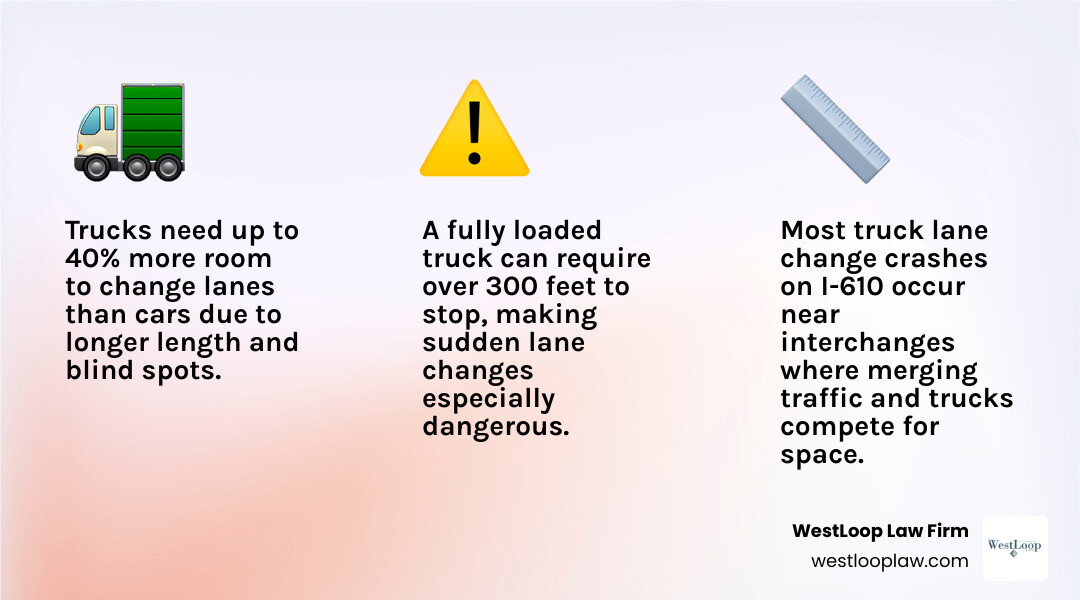
Important Houston truck lane change terms:
Understanding Houston Truck Lane Change Accidents and Freeway Risks
Freeway congestion across Harris County creates persistent hazards for motorists sharing lanes with multi-ton commercial vehicles. A fully loaded tractor-trailer or three-axle dump truck can weigh up to 80,000 pounds, requiring significantly greater stopping distance than a standard passenger vehicle. When heavy traffic slows abruptly on high-speed loops, the disparity in braking ability and mass dramatically escalates crash severity.

Navigating these dynamics requires an understanding of how commercial vehicles operate in high-density corridors. In our Houston truck accident complete guide, we outline the engineering and human factors that contribute to major collisions across the regional highway network.
Why Blind Spots Cause a Catastrophic Houston Truck Lane Change
Commercial motor vehicles possess massive blind spots—often called “No-Zones”—on all four sides. Unlike passenger cars, large commercial rigs have extensive areas where adjacent vehicles disappear entirely from view:
- The Right-Side Blind Spot: Extending across multiple traffic lanes, this is the most dangerous zone for passenger cars.
- The Left-Side Blind Spot: Originating behind the cab door and running backward along the trailer.
- Directly Behind the Trailer: Eliminating the truck operator’s rear vision completely.
- Directly in Front of the Cab: Extending up to 20 feet ahead, blocking the view of low-profile vehicles.
When a commercial driver executes a maneuver without verifying these zones, side-swipe and squeeze-play wrecks occur. State instructional materials, including the Texas Behind-the-Wheel Instruction Guide 30 Hours, emphasize that drivers must maintain space management and search their path of travel 20 to 30 seconds ahead on freeways to identify merging hazards before entering blind spots.
High-Risk Interchange Corridors on Interstate 610 and Major Connectors
The Interstate 610 Loop serves as the central artery for regional freight and commuter travel, making its major interchanges notorious for complex lane shifts. Key conflict points include:
- The West Loop at the Galleria (I-610 West and Westheimer Road): Continuous weaving between local shopping traffic and through-freight.
- The US 290 Interchange (Northwest Freeway connector): Tight multi-lane merges where commercial trucks transition between restricted freeway systems.
- The I-10 Katy Freeway Interchange: Massive multi-tier junctions requiring rapid lateral shifts across heavy traffic streams.
- The North Loop at I-45: Frequent bottlenecks where abrupt speed reductions lead to forced lateral maneuvers.
These complex merging zones demand total awareness from all operators. Catastrophic side-impact collisions often mirror the circumstances handled by a Houston commercial vehicle accident lawyer following complex highway collisions, where rapid weaving and failure to yield produced multi-vehicle pileups.
Left-Lane Truck Restrictions Across Houston Freeways and Loop 610
To mitigate severe side-swipes and improve traffic flow, local authorities partnered with state agencies to remove heavy commercial vehicles from high-speed travel lanes.
According to empirical Truck Lane Restrictions research, implementing lane restrictions for heavy trucks produced a 68% crash reduction in studied Houston corridors while maintaining compliance rates above 95%. These rules limit heavy vehicles to right-hand lanes, reducing the turbulence caused by massive speed variances between commercial freight and passenger cars.
Designated Restricted Corridors for Multi-Axle Commercial Vehicles
Under Texas Transportation Commission directives and municipal traffic rules, vehicles with three or more axles face 24/7 left-lane restrictions across four critical corridors:
- Interstate 10 East (East Freeway): From Waco Street to the Harris/Chambers County line.
- State Highway 225 (La Porte Freeway): From Loop 610 East to State Highway 146.
- Interstate 45 North (North Freeway): From Loop 610 North to the Montgomery County line.
- US Highway 290 (Northwest Freeway): From Loop 610 to Beltway 8 (and extending past Mueschke Road).
Dump trucks, cement mixers, and long-haul rigs must stay out of the far-left lane in these designated zones. Failure to observe these posted corridors results in strict moving violation citations.
Enforcement Practices by the Houston Police Department Truck Enforcement Unit
The Houston Police Department (HPD) Truck Enforcement Unit, working alongside Texas Department of Public Safety (DPS) Commercial Vehicle Enforcement troopers and the Harris County Sheriff’s Office, monitors these freight corridors.
Officers conduct targeted roadside stops to enforce lane restrictions, perform Level I through Level V North American Standard Inspections, verify logbooks, and inspect safety equipment. Drivers pulled over for improper lane usage are subject to mechanical scrutiny, weight checks, and driver credential verification.
Commercial Fleet Compliance, Driver Discipline, and Route Planning
Fleet safety programs rely on dedicated systems to ensure operators comply with regional restrictions and execute safe lane changes.
| Feature | Standard Passenger GPS | Commercial Fleet Truck GPS |
|---|---|---|
| Lane Restriction Routing | Not Included | Restricts routes using municipal left-lane rules |
| Vehicle Weight & Axle Limits | Not Calculated | Routes based on GVWR, bridge formulas, and axles |
| Overhead Clearance Alerts | Not Available | Accounts for low-clearance bridges and utility lines |
| Exit Planning Lead Time | Short (0.5 – 1 mile) | Extended (2 – 3 miles) for multi-lane deceleration |
Commercial telematics allow dispatchers to assist drivers in planning exits early, preventing the last-second lateral cuts that cause collisions near major freeway forks.
Operational Impacts of CDL Moving Violations and Motor Vehicle Records
Under Texas Department of Public Safety regulations and the Texas Transportation Code, an improper lane change is categorized as a serious traffic violation.
- Two serious violations committed within a three-year period result in a mandatory 60-day CDL disqualification.
- Three serious violations within three years trigger a 120-day disqualification.
These administrative suspensions apply whether the infraction occurred in a commercial rig or a personal car. Furthermore, under federal regulations (49 CFR 387.9), for-hire motor carriers operating vehicles over 10,000 pounds must maintain a minimum of $750,000 in public liability insurance for non-hazardous freight. When drivers accumulate moving violations on their Motor Vehicle Record (MVR), fleet insurance premiums skyrocket, often rendering operators unemployable. Injured motorists can consult a commercial truck accident attorney in Houston to learn how fleet violations influence carrier accountability.
Preventive Driving Protocols and Early Exit Planning for Heavy Trucks
Professional fleet safety protocols focus on space management:
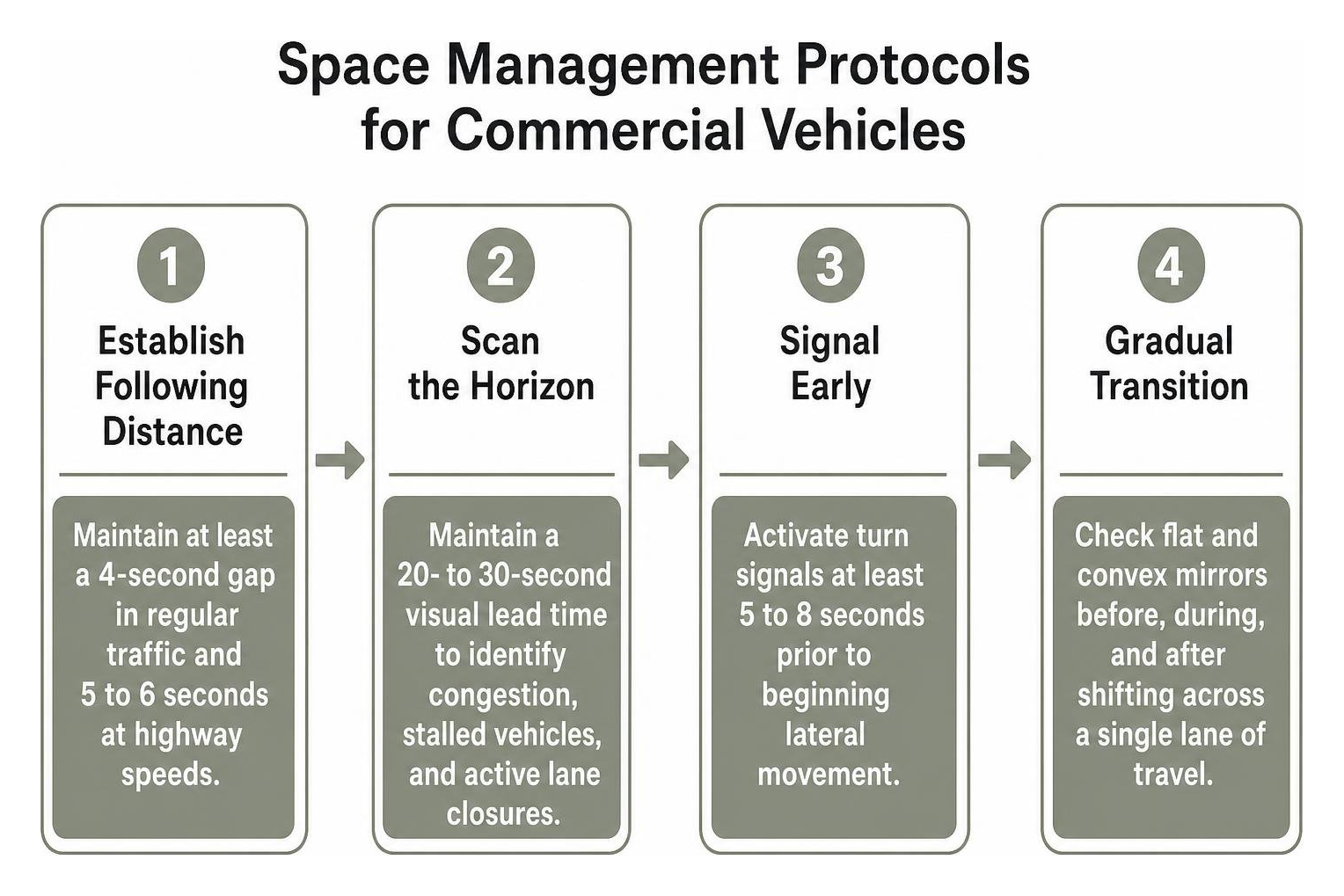
- Establish Following Distance: Maintain at least a 4-second gap in regular traffic and 5 to 6 seconds at highway speeds.
- Scan the Horizon: Maintain a 20- to 30-second visual lead time to identify congestion, stalled vehicles, and active lane closures.
- Signal Early: Activate turn signals at least 5 to 8 seconds prior to beginning lateral movement.
- Gradual Transition: Check flat and convex mirrors before, during, and after shifting across a single lane of travel.
Special care must be taken when passing through ongoing road repairs or construction zones. Operators should review semi truck construction zone safety dynamics to understand how narrowed lanes and shifting barricades compound lane-change dangers.
Texas Legal Framework: Proving Fault and Recovering Damages After a Crash
When a truck operator fails to navigate safely and causes an accident, establishing liability requires securing physical and digital evidence before motor carriers can alter or overwrite records.
Critical evidentiary sources include:
- Electronic Control Module (ECM) Black Box Data: Details vehicle speed, throttle position, brake application, and steering angle leading up to impact. To learn more about this technology, consult our review of all about trucking black box data.
- Electronic Logging Devices (ELDs): Verifies whether driver fatigue or Hours of Service (HOS) violations contributed to impaired judgment.
- Dual-Facing Dashcam Footage: Visual confirmation of turn indicator activation, mirror checks, and traffic positioning.
- Driver Qualification Files: Documenting training deficiencies, previous moving violations, and medical certifications.
A qualified trucking regulations violation lawyer uses formal preservation letters to prevent the destruction of these electronic logs.
Legal Liability Following a Negligent Houston Truck Lane Change
Under Texas Transportation Code Section 545.060, an operator on a roadway divided into two or more clearly marked lanes:
- Shall drive as nearly as practical entirely within a single lane; and
- May not move from the lane unless that movement can be made safely.
A driver who cuts across lanes without clearance violates statutory duties, establishing grounds for negligence per se. Beyond driver liability, trucking companies can be held liable under the doctrine of respondeat superior (vicarious liability) or through direct claims of negligent hiring, negligent training, and negligent entrustment. Investigating carrier background files is critical to uncovering Houston trucking negligence and driver hiring history.
Texas Injury Claim Laws: PIP, Comparative Negligence, and Deadlines
Pursuing a personal injury claim after a truck wreck in Houston involves specific Texas statutes:
- Personal Injury Protection (PIP): Under Texas Insurance Code Section 1952.151, auto policies include PIP coverage unless rejected in writing. PIP provides no-fault compensation for medical expenses and 80% of lost income up to your policy limit, offering immediate financial relief while fault is resolved.
- 51% Modified Comparative-Fault Bar (Texas Civil Practice and Remedies Code Chapter 33): Under Texas proportionate responsibility laws, an injured party can recover damages as long as their share of responsibility is 50% or less. If a plaintiff is found 20% responsible for a crash, their total financial recovery is reduced by 20%. If they are found 51% or more at fault, they are completely barred from recovering compensation.
- Two-Year Statute of Limitations (Texas Civil Practice and Remedies Code Section 16.003): You have exactly two years from the date of the crash to file a formal personal injury or wrongful death lawsuit. Failing to file within this window permanently extinguishes your legal right to seek compensation.
Litigation involving complex multi-vehicle wrecks is typically filed in the Harris County Civil Courts at Law or the Harris County District Courts located in downtown Houston. Navigating these regional courts requires a deep understanding of local trial procedures, which experienced Houston truck accident lawyers utilize when handling Harris County litigation.
Frequently Asked Questions About Houston Commercial Vehicle Collisions
What Houston Freeways Prohibit Commercial Trucks from Using the Left Lane?
Commercial trucks with three or more axles are banned 24/7 from using the far-left lane on:
- Interstate 10 East (East Freeway) from Waco Street to the Chambers County line.
- State Highway 225 (La Porte Freeway) from Loop 610 to State Highway 146.
- Interstate 45 North (North Freeway) from Loop 610 to the Montgomery County line.
- US Highway 290 (Northwest Freeway) from Loop 610 to past Beltway 8.
These rules allow commercial vehicles to pass slower traffic using middle lanes while keeping high-speed left lanes clear for lighter passenger transit.
How Does Texas Comparative Fault Impact a Truck Lane Change Claim?
Commercial insurance adjusters frequently claim that passenger vehicle drivers were lingering in blind spots or passing improperly. Under the Texas 51% modified comparative-fault rule, defense attorneys attempt to assign at least 51% of the blame to the injured motorist to eliminate the insurer’s payment obligation. To defeat these tactics, our legal team reconstructs the crash using ECM data, witness statements, and physical road markings to prove that the commercial driver failed to verify lane clearance.
What Immediate Steps Should You Take After a Commercial Truck Collision in Houston?
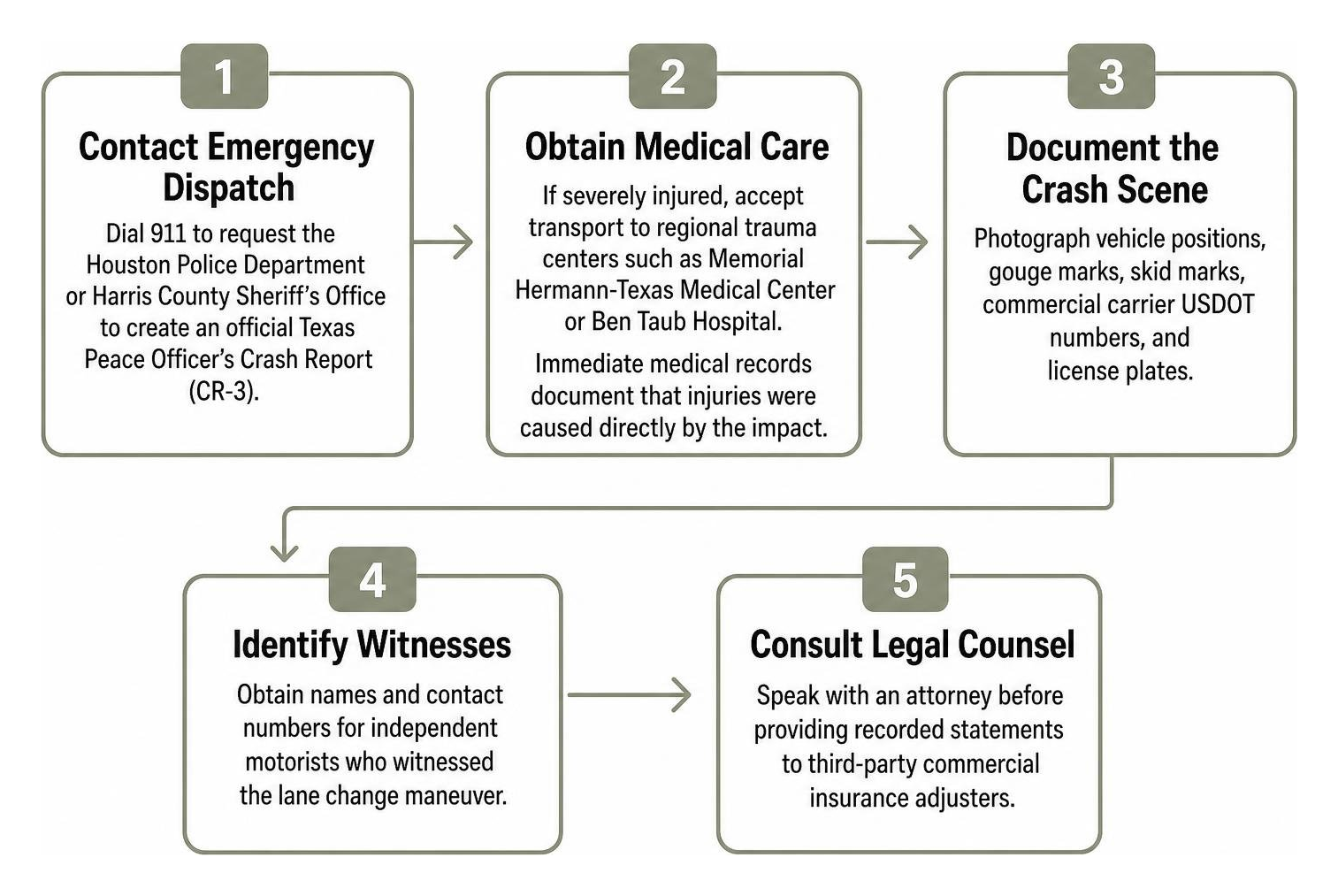
- Contact Emergency Dispatch: Dial 911 to request the Houston Police Department or Harris County Sheriff’s Office to create an official Texas Peace Officer’s Crash Report (CR-3).
- Obtain Medical Care: If severely injured, accept transport to regional trauma centers such as Memorial Hermann-Texas Medical Center or Ben Taub Hospital. Immediate medical records document that injuries were caused directly by the impact.
- Document the Crash Scene: Photograph vehicle positions, gouge marks, skid marks, commercial carrier USDOT numbers, and license plates.
- Identify Witnesses: Obtain names and contact numbers for independent motorists who witnessed the lane change maneuver.
- Consult Legal Counsel: Speak with an attorney before providing recorded statements to third-party commercial insurance adjusters.
Strategic Legal Representation for Houston Highway Collisions
Navigating recovery after a severe highway collision requires dedicated advocacy and deep knowledge of both personal injury law and probate considerations in the event of catastrophic loss. At Westloop Law Firm, we represent injured victims and families across the Greater Houston area, holding negligent motor carriers and their insurers accountable.
If you or a loved one suffered injuries in a commercial vehicle collision along Loop 610, I-10, I-45, or any regional corridor, our team can help you assert your rights. Explore our Houston truck accident guide or contact our office to schedule a confidential case consultation today.