 Skip to content
Houston Car Accident Attorney: What You Need to Know Right Now
If you need a car accident attorney in Houston, here’s a quick summary of the 7 most important things to know before you hire:
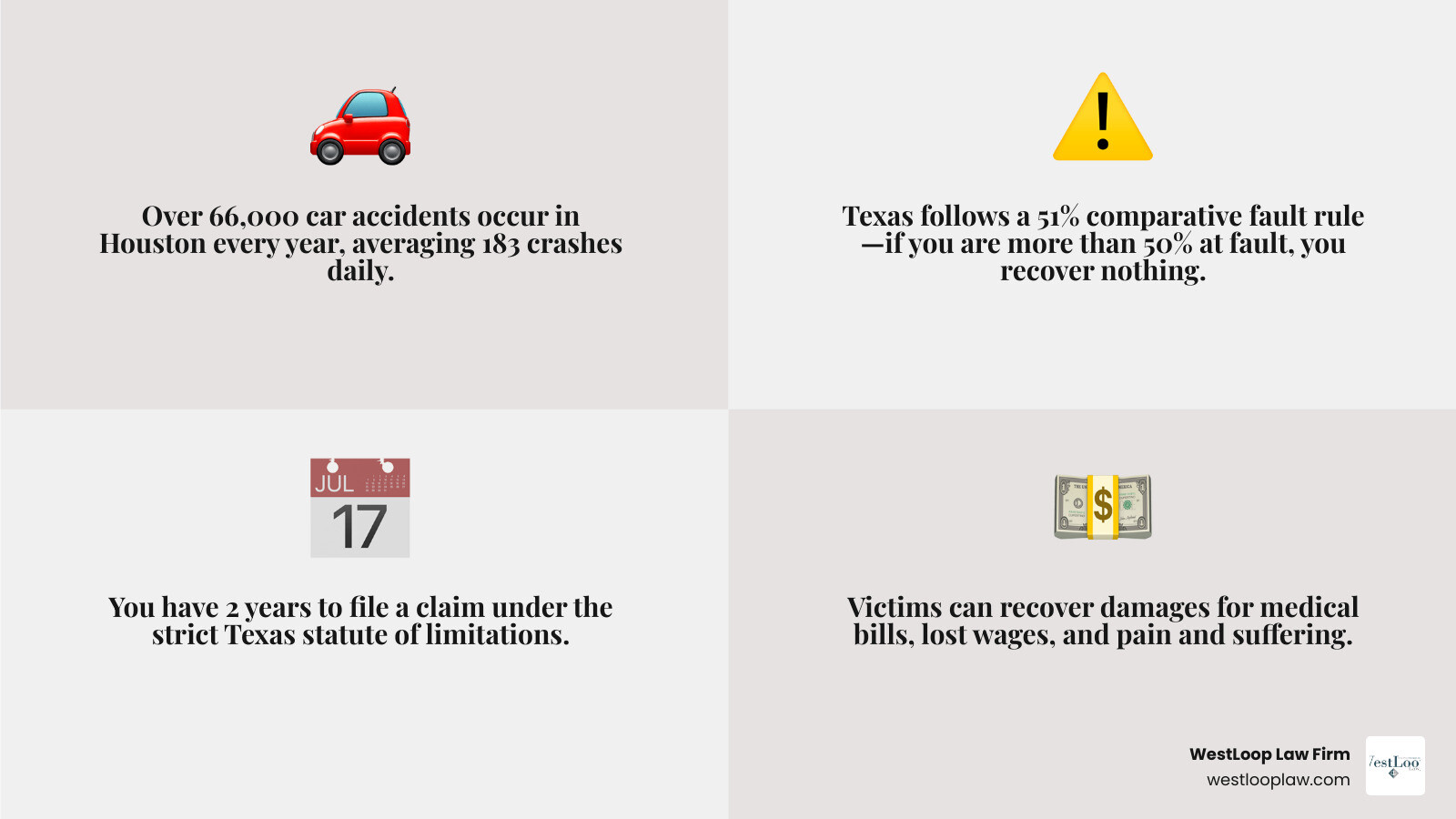
- Houston’s roads are among the most dangerous in the U.S. — over 66,000 crashes happen every year
- Texas follows a 51% comparative fault rule — if you’re more than 50% at fault, you recover nothing
- You have 2 years to file — the Texas statute of limitations is strict and missing it ends your claim
- Take action at the scene — call 911, document everything, and seek medical care immediately
- Insurance adjusters work against you — never give a recorded statement without legal counsel
- You can recover multiple types of damages — medical bills, lost wages, pain and suffering, and more
- Most attorneys work on contingency — no upfront costs, you only pay if you win
Houston is in a genuine crisis on its roads. In 2021 alone, the city recorded 66,988 car accidents — that’s roughly 183 crashes every single day. Those crashes killed 327 people and left thousands more with life-changing injuries.
This isn’t just a statistic. Behind every number is a real person dealing with emergency room visits, missed paychecks, and a stack of bills that keeps growing.
If you were hurt on I-45, Westheimer Road, or anywhere else in Harris County, the decisions you make in the days and weeks after your crash can have a massive impact on your financial recovery. The insurance company already has a team working on your case. You deserve one too.
This guide walks you through everything you need to know — from dangerous Houston roads to how Texas fault laws work — so you can make a confident, informed decision about hiring legal representation.
Related content about Car accident attorney Houston:
1. Houston’s Dangerous Roads and Common Causes of Accidents
Houston traffic is legendary, but it is also exceptionally dangerous. Our city consistently ranks near the top of national lists for the worst traffic congestion, meaning drivers spend hours trapped in gridlock. This frustration, combined with sprawling highways and high speed limits, creates a volatile environment for motorists.
Several specific corridors carry a notorious reputation for serious collisions:
- Interstate 45 (I-45): The stretch of I-45 running through Houston, particularly between Exit 63 and Metro TX 249, is frequently cited as the deadliest stretch of highway in the entire state of Texas.
- Bissonnet Street: This road is widely known for having some of the highest rates of fatal accidents within Houston’s city limits.
- Westheimer Road: Combining heavy commercial traffic, frequent turning vehicles, and distracted shoppers, Westheimer is a hotbed for rear-end and T-bone collisions.
- Beltway 8 and the I-610 Loop: These high-speed loops see massive daily volume, leading to high-impact, multi-vehicle pileups when traffic suddenly grinds to a halt.
To understand why these locations are so hazardous, you must also look at local driving patterns. If you commute from the suburbs, you already know that the Sugar Land commute is a hazardous route where drivers frequently speed, cut across lanes, and struggle with ongoing construction zones. Navigating these highly congested paths requires absolute focus, yet many drivers fail to pay attention.
The most common causes of car accidents in Houston include:
- Distracted Driving: Texting, adjusting navigation systems, or talking on the phone while traveling at 70 mph on the highway.
- Speeding: Drivers routinely exceed the posted limits to beat gridlock, reducing their reaction times.
- Drunk and Impaired Driving: Harris County consistently ranks first in Texas for alcohol-related traffic fatalities.
- Reckless Driving and Failing to Yield: Aggressive lane changes and running red lights at busy city intersections.
When these negligent behaviors occur at some of our most dangerous intersections, the physical and financial consequences are devastating.
2. How Texas Comparative Negligence and Fault Laws Work
If you are involved in a wreck, you must understand how Texas determines financial responsibility. Texas is an “at-fault” state, meaning the driver who caused the crash is responsible for paying for the resulting damages. However, real-world accidents are rarely entirely one-sided.
Texas handles shared blame using a system called modified comparative negligence, also known as the 51% bar rule. Under this rule, you can recover compensation from another driver as long as your share of the responsibility is 50% or less. If you are found to be 51% or more at fault for the crash, you are legally barred from recovering any damages.
If you are partially at fault but remain under the 51% threshold, your total compensation is reduced by your percentage of blame. For example, if a jury determines your total damages are $100,000, but they find you were 20% responsible because you were traveling slightly over the speed limit, your final payout is reduced by 20%, leaving you with $80,000.
Because of this rule, insurance companies will work tirelessly to shift the blame onto you. If they can convince a jury or an adjuster that you were mostly to blame, they do not have to pay you a single cent. This makes understanding comparative negligence absolutely critical when building your claim. The Texas Department of Transportation compiles extensive crash data that helps paint a clear picture of how accidents occur, but proving who was actually negligent in your specific crash requires careful legal analysis.
Proving Liability with a Car Accident Attorney Houston
Proving that another driver was negligent requires more than just pointing fingers. You must establish four key legal elements:
- Duty of Care: The other driver owed you a duty to operate their vehicle safely.
- Breach of Duty: They violated that duty (e.g., by running a red light or texting).
- Causation: Their violation directly caused your accident.
- Damages: You suffered actual physical or financial injuries as a result.
To build a bulletproof case, a car accident attorney in Houston will gather and analyze critical evidence. This process of proving fault involves securing official police reports, interviewing eyewitnesses, obtaining traffic camera or dashcam footage, and analyzing vehicle “black box” data. In complex cases, we may work with accident reconstruction professionals to demonstrate exactly how the collision occurred and shield you from unfair accusations of shared blame.
3. Crucial Steps to Take After a Houston Car Wreck
The moments immediately following a crash are chaotic, but the actions you take at the scene can protect your physical health and preserve your legal rights.

If you are involved in a collision, follow these essential steps to take after a wreck:
- Move to Safety: If possible, move your vehicle out of active traffic to the shoulder of the road to prevent a secondary collision. Turn on your hazard lights.
- Call 911: Report the accident to the Houston Police Department or the Harris County Sheriff’s Office. Request an officer to the scene so they can file an official police report. This report is a vital piece of evidence for your insurance claim.
- Document the Scene: Take detailed photos and videos of the vehicles, their positions, the damage, any skid marks on the road, traffic signs, and your injuries.
- Exchange Information: Collect names, phone numbers, driver’s license numbers, and insurance details from all involved drivers. Avoid discussing fault or apologizing at the scene, as these statements can be used against you later.
- Gather Witness Contacts: If anyone stopped to help, ask for their names and phone numbers. Their unbiased accounts can be incredibly powerful.
- Seek Immediate Medical Attention: Go to an emergency room or urgent care clinic right away. Even if you feel fine, adrenaline can mask serious injuries like internal bleeding, concussions, or herniated discs. Getting evaluated at local facilities like Memorial Hermann Hospital or Ben Taub Hospital creates an immediate, official medical record linking your injuries directly to the crash.
4. Navigating Insurance Tactics and Maximizing Your Damages
Dealing with insurance adjusters can be incredibly frustrating. While they may sound friendly and supportive on the phone, their primary goal is to protect their company’s bottom line. Insurance corporations rely on a strategy often described as “delay, deny, defend” to pay out as little as possible.
Common tactics used by insurance adjusters include:
- Soliciting Recorded Statements: They will ask you to describe the accident on a recorded line, hoping you will make an offhand comment that can be used to minimize your injuries or shift fault to you.
- Rushing Early Settlement Offers: They may offer you a quick cash settlement days after the crash. These lowball offers rarely cover the long-term costs of medical care and require you to sign away your right to pursue further compensation.
- Delaying Your Claim: They may drag out the claims process, hoping you will grow desperate under the weight of mounting medical bills and accept a lower payout.
To protect yourself, you should never sign medical releases or give recorded statements without consulting a lawyer. The Texas Department of Insurance regulates these companies, but having a strong legal advocate is the most effective way to hold them accountable and maximize compensation for your losses.
Overcoming Lowball Offers with a Car Accident Attorney Houston
When you work with a skilled attorney, you can accurately calculate the true value of your claim so you do not settle for less than you deserve. In Texas, accident victims can pursue several categories of damages:
- Economic Damages: These are quantifiable financial losses, including:
- Past and future medical expenses (surgeries, physical therapy, medication)
- Lost wages from missed work
- Loss of earning capacity if you can no longer work at the same capacity
- Property damage (vehicle repairs or replacement)
- Non-Economic Damages: These compensate you for subjective, non-financial harm, such as:
- Physical pain and suffering
- Mental anguish and emotional distress
- Loss of enjoyment of life
- Disfigurement or permanent physical impairment
- Punitive Damages: In rare cases involving extreme recklessness, gross negligence, or drunk driving, Texas courts may award punitive damages. These are designed to punish the wrongdoer and deter similar behavior in the future.
5. Understanding the Texas Statute of Limitations and Complex Claims
Time is not on your side after a car wreck. Under the Texas Civil Practice & Remedies Code Section 16.003, the statute of limitations for a personal injury claim is generally two years from the date of the accident. If you do not file a formal lawsuit before this window closes, you lose your legal right to seek compensation forever.
While two years may seem like a long time, building a strong case takes months of preparation. Furthermore, vital evidence like nearby security camera footage, commercial vehicle logbooks, and witness memories can disappear within days or weeks. If your accident involved state or municipal property (such as a city bus or government vehicle), you may have as little as six months to file a formal notice of claim.
Acting quickly is even more critical when your crash involves complex legal elements:
- Commercial Vehicle Crashes: Accidents involving 18-wheelers or delivery trucks require navigating federal trucking regulations and holding wealthy transport companies accountable.
- Rideshare Accidents: If you are hit by an Uber or Lyft driver, the insurance coverage changes dynamically depending on whether the driver was logged into the app, carrying a passenger, or offline.
- Uninsured Motorists: If the driver who hit you has no insurance or flees the scene, you must navigate your own insurance policy to secure compensation.
Understanding how a lawsuit works can help demystify the process, but having a dedicated legal team handling these complexities allows you to focus entirely on your physical recovery.
6. How a Car Accident Attorney Houston Protects Your Rights
Navigating the aftermath of a serious crash on your own can be overwhelming. When you hire Westloop Law Firm, we take the entire burden off your shoulders. We handle the paperwork, gather the necessary evidence, manage all communication with aggressive insurance adjusters, and build a compelling case on your behalf.
Our approach is built on preparing every single case as if it is heading directly to a courtroom. While many claims are resolved through negotiation, preparing for trial shows the insurance company that we will not back down. This aggressive stance often forces them to offer a much fairer settlement.
If they refuse to negotiate in good faith, we are fully prepared to take your case to court. Understanding the dynamics of litigation vs settlement is essential to making smart legal moves, and we will guide you through every choice. Do not let insurance companies take advantage of your situation—secure your attorney today to protect your future.
Frequently Asked Questions About Houston Car Accidents
Navigating the legal landscape after a crash can raise many questions. Below, we compare your primary legal options to help you understand how the recovery process works.
| Feature | Insurance Claim | Personal Injury Lawsuit |
|---|---|---|
| Where Filed | Directly with the at-fault driver’s insurance company | In a Texas civil court |
| Timeline | Typically settled in weeks to a few months | Can take several months to a year or more |
| Decision Maker | Insurance adjuster | Judge or jury |
| Resolution | Out-of-court settlement agreement | Court verdict or pre-trial settlement |
| Key Advantage | Faster access to funds for repairs and medical bills | Ability to pursue full compensation if the insurer refuses to cooperate |
What is the average car accident settlement in Houston?
There is no single “average” settlement because every accident involves unique circumstances. The financial value of your claim depends heavily on the severity of your injuries, the cost of your medical bills, the amount of lost wages, the clarity of fault, and the insurance policy limits available.
A minor fender-bender with soft-tissue injuries might settle for a few thousand dollars, whereas a catastrophic crash resulting in permanent disability or a traumatic brain injury can result in a multi-million dollar recovery. To learn more about how these calculations are made, read our guide on the average car accident settlement.
What if the other driver is uninsured or it was a hit-and-run?
If you are hit by an uninsured driver or are the victim of a hit-and-run, you can still pursue compensation if you carry Uninsured/Underinsured Motorist (UM/UIM) coverage or Personal Injury Protection (PIP) on your own auto insurance policy.
Texas insurance companies are required to offer these coverages, and they can only be excluded if you rejected them in writing when you purchased your policy. Filing a UM/UIM claim with your own insurer should not raise your rates under Texas law, as the crash was not your fault.
How much does it cost to hire a Houston car accident lawyer?
At Westloop Law Firm, we work on a contingency fee basis. This means there are absolutely no upfront, out-of-pocket costs for you to hire us. We cover all the expenses of investigating your crash, filing court documents, and hiring professionals.
We only get paid if we successfully recover a settlement or jury verdict for you. If we do not win your case, you do not owe us a dime. Your initial consultation is always completely free and carries no obligation.
Conclusion
A serious car crash can turn your life upside down in an instant, leaving you with physical pain, emotional stress, and a mountain of unexpected bills. You do not have to carry this heavy burden alone.
At Westloop Law Firm, we believe in providing compassionate, aggressive legal advocacy to help you rebuild your life. We combine our deep knowledge of personal injury law with a client-first approach, ensuring you receive the personalized attention and maximum compensation you deserve.
If you or a loved one was injured on our local roads, contact Westloop Law Firm today to schedule your free, no-obligation case evaluation. Let us handle the legal battle while you focus on healing.