 Skip to content

What to Do After a Truck Crash on Houston’s West Loop
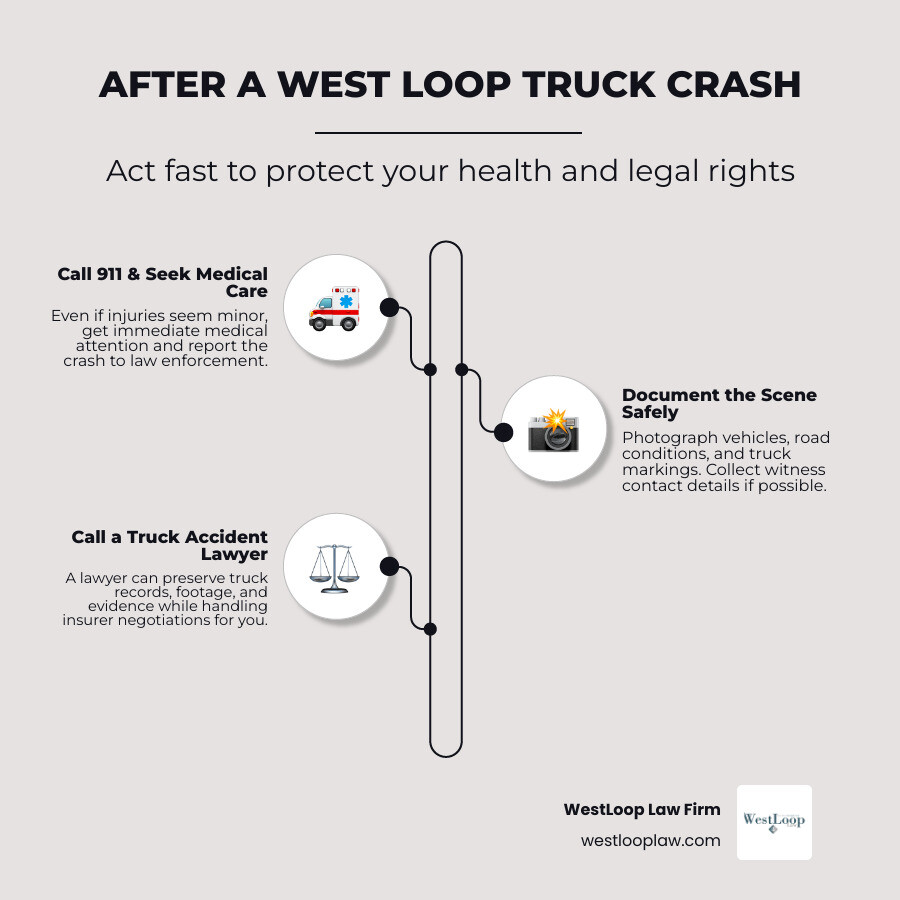
What to do first:
- Call 911 and get medical care, even if your injuries seem minor.
- If it is safe, photograph the vehicles, road, and truck markings. Get witness contact details.
- Contact a West Loop Houston truck accident lawyer soon. Ask them to preserve truck records and footage, review who may be at fault, and handle talks with the insurers.
A crash on I-610 can leave you facing medical bills and missed work while key evidence is at risk of being lost. WestLoop Law Firm can review your case and help you understand your options under Texas law.
West Loop Houston truck accident lawyer further reading:
How a West Loop Houston Truck Accident Lawyer Protects Your Legal Rights
Navigating the aftermath of a major crash involves complex state laws, large corporate insurance policies, and aggressive defense teams. When an 80,000-pound commercial vehicle collides with a standard passenger vehicle on Loop 610 or near the Galleria interchange, the physical and financial consequences are severe. Under Texas law, injured motorists have explicit legal protections, but securing fair recovery requires an in-depth understanding of statutory liability and insurance structures.
In Texas, personal injury claims operate under Chapter 33 of the Texas Civil Practice and Remedies Code, which establishes a modified comparative fault rule. Under this 51% modified comparative-fault bar, you can recover financial compensation as long as your share of responsibility does not exceed 50%. However, your final financial award is reduced by your exact percentage of fault. If a court finds you 20% responsible for a collision, your final payout is reduced by 20%. If your responsibility reaches 51% or higher, Texas law completely bars you from recovering compensation.
Commercial motor carriers maintain substantial liability insurance policies, often ranging from $750,000 to over $5,000,000, depending on the type of cargo transported. Because these financial stakes are exceptionally high, trucking corporations deploy rapid response teams—including private investigators, defense attorneys, and accident reconstructionists—to the scene within hours. Their primary objective is limiting financial exposure for the motor carrier.
Your own auto policy may also provide immediate relief through Personal Injury Protection (PIP). In Texas, insurance companies must provide PIP coverage unless you explicitly rejected it in writing. PIP covers reasonable medical expenses and up to 80% of lost income regardless of who caused the crash. This coverage provides vital support while your legal team builds a fault-based claim against the trucking company and begins understanding liability after a catastrophic crash.
| Feature | Standard Passenger Car Crash | Commercial Truck Collision |
|---|---|---|
| Vehicle Weight | 3,000 to 4,500 lbs | Up to 80,000 lbs (or more with permits) |
| Governing Regulations | Texas Transportation Code | FMCSA Federal Regulations + Texas State Law |
| Potentially Liable Parties | Usually just the involved drivers | Driver, carrier, broker, cargo loader, mechanic |
| Minimum Insurance Requirements | $30,000 / $60,000 / $25,000 | $750,000 to $5,000,000+ |
| Digital Evidence Sources | Basic dashcams, smartphone data | Black boxes (ECM/EDR), ELD logs, telematics |
| Defense Strategy | Single insurance adjuster review | Rapid response team, corporate legal defense |
Why You Need a West Loop Houston Truck Accident Lawyer After a Commercial Crash
Houston’s highway corridors are among the busiest freight transit routes in the United States. Commercial drivers face demanding schedules, often leading to fatigue, distraction, and unsafe driving behaviors. These factors become hazardous near congested bottleneck points like the I-610 West Loop at US-59/I-69 and the I-10 Katy Freeway interchange.
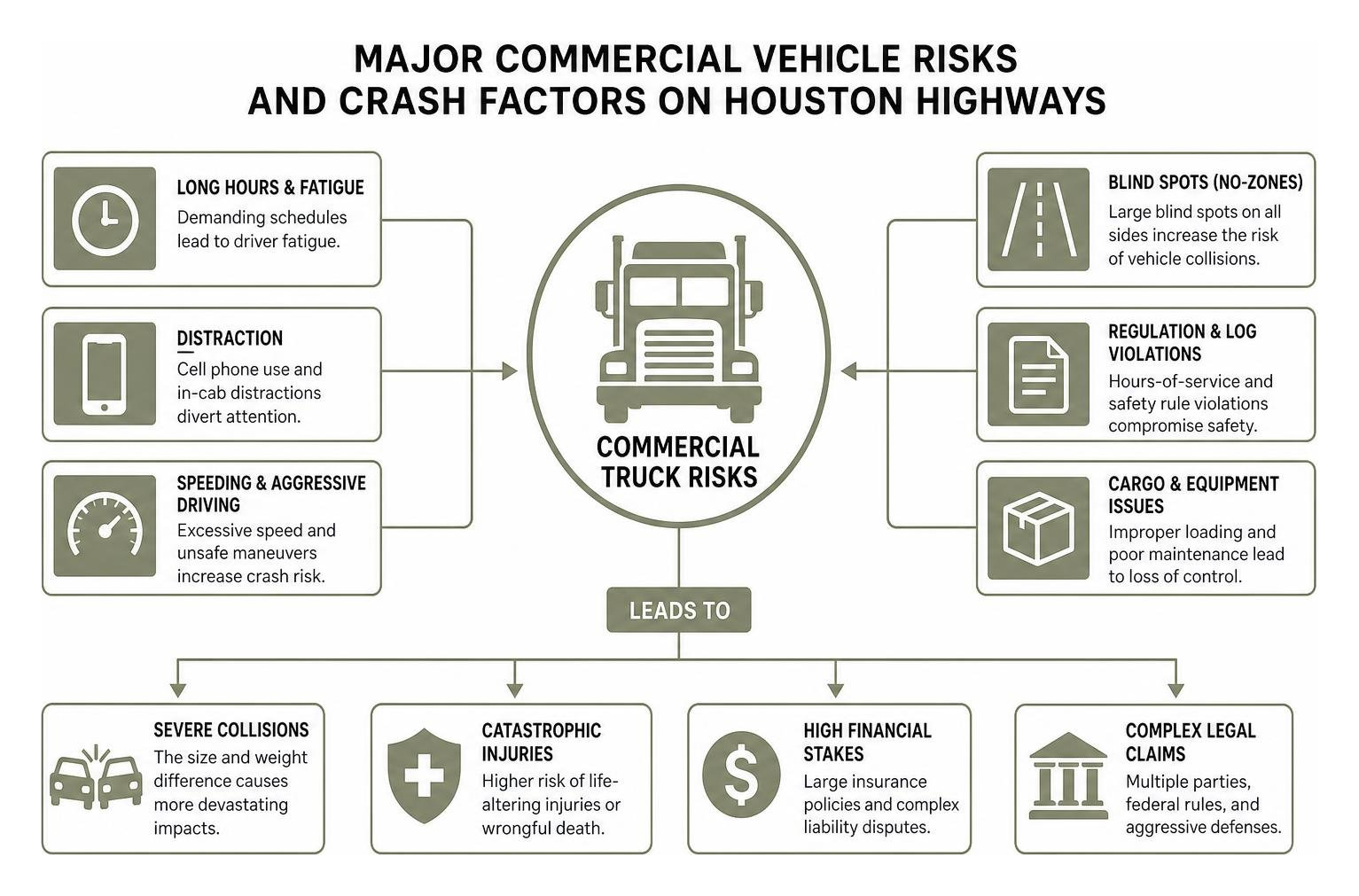
Commercial trucks have large blind spots—frequently called “No-Zones”—extending along both sides, directly behind the trailer, and directly in front of the cab. When an operator attempts sudden lane changes along crowded stretches near Post Oak Boulevard or Westheimer Road without checking mirrors, passenger vehicles can be crushed or pushed into concrete barriers.
Addressing these complex challenges requires comprehensive legal advocacy. Working with a dedicated team allows you to build a complete case, starting with navigating comprehensive injury claims with a Houston truck crash lawyer.
How Multi-Party Liability Is Evaluated by Your Legal Team
Unlike standard auto accidents where fault typically rests solely with one driver, commercial vehicle wrecks involve multiple commercial entities. Holding every responsible party accountable requires a detailed review of contractual relationships, employment statuses, and operational logs.
- The Commercial Driver: Direct liability applies when the driver commits traffic violations, drives distracted, speeds, or violates federal rest break rules.
- The Motor Carrier (Trucking Company): Under Texas legal doctrines like respondeat superior, employers are liable for the negligent actions of their employees acting within the scope of their employment. Carriers can also be sued directly for negligent hiring, improper training, or pressuring drivers to violate safety schedules.
- Freight Brokers and Third-Party Logistics Providers: Freight brokers arrange cargo transportation. If a broker hires an unsafe trucking company with a history of safety violations without proper vetting, they may face direct negligence claims.
- Cargo Loading Companies: Unevenly distributed or improperly secured freight can cause shifting cargo mid-transit, leading to rollovers or jackknife crashes on highway ramps.
- Maintenance Contractors and Equipment Manufacturers: Third-party repair shops that fail to repair faulty brakes or inspect steering systems can share liability, as can manufacturers of defective automotive components.
Uncovering these complex connections requires investigating employer liability and trucking firm negligence to confirm all available insurance coverage is identified.
Step-by-Step: Navigating Your Houston Truck Accident Claim
Successfully managing a commercial vehicle injury claim requires a methodical, step-by-step approach. Following proper procedures from the initial crash through settlement negotiations helps protect both your physical recovery and your financial interests.
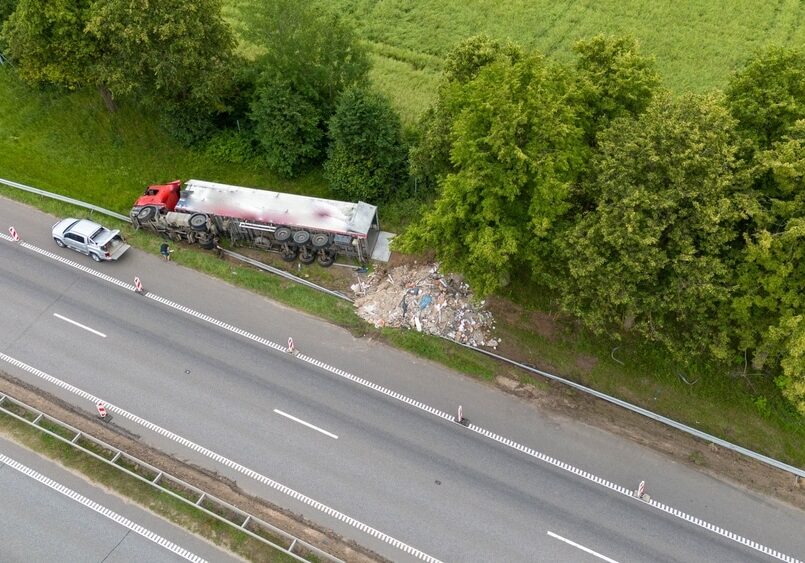
When an accident occurs, insurance carriers quickly begin working to minimize payouts. Knowing how to handle interactions with claims adjusters and preserve medical records helps prevent costly errors. Understanding these steps starts with identifying critical mistakes to avoid after an accident.
Critical Actions to Take Immediately After an Interstate Collision
The actions you take in the hours and days following a crash directly shape the strength of your legal claim.
- Call 911 Immediately: Request local law enforcement and emergency medical services. In Houston, the Houston Police Department or Harris County Sheriff’s Office will secure the scene, perform initial interviews, and create an official Texas Peace Officer’s Crash Report (Form CR-3).
- Seek Comprehensive Medical Attention: Even if you feel stable, adrenaline can mask serious internal injuries, soft tissue damage, or concussions. Visit a local emergency facility—such as Memorial Hermann in the Texas Medical Center or Ben Taub Hospital—for a thorough medical assessment. Consistent medical documentation establishes a clear link between the crash and your injuries.
- Document the Crash Scene Safely: If you can do so safely, take detailed photographs and videos of the scene. Capture vehicle damage, license plates, the trucking company name and US DOT number on the truck cab door, roadway skid marks, traffic signals, and weather conditions.
- Identify Witnesses: Collect names, phone numbers, and email addresses from any eyewitnesses before they leave the area.
- Decline Recorded Statements to Insurance Adjusters: Insurance adjusters representing the trucking company may contact you shortly after the incident. Politely decline to provide recorded statements or sign medical authorizations until you consult your attorney.
Reviewing what injured motorists should do immediately after a truck collision helps ensure your rights remain protected from the start.
Preserving Essential Trucking Evidence Before It Disappears
One of the biggest risks in a commercial vehicle claim is the loss of crucial digital evidence. Commercial motor carriers are legally permitted to delete or overwrite digital records after set retention periods—sometimes within 30 to 180 days—unless formal legal action is taken.
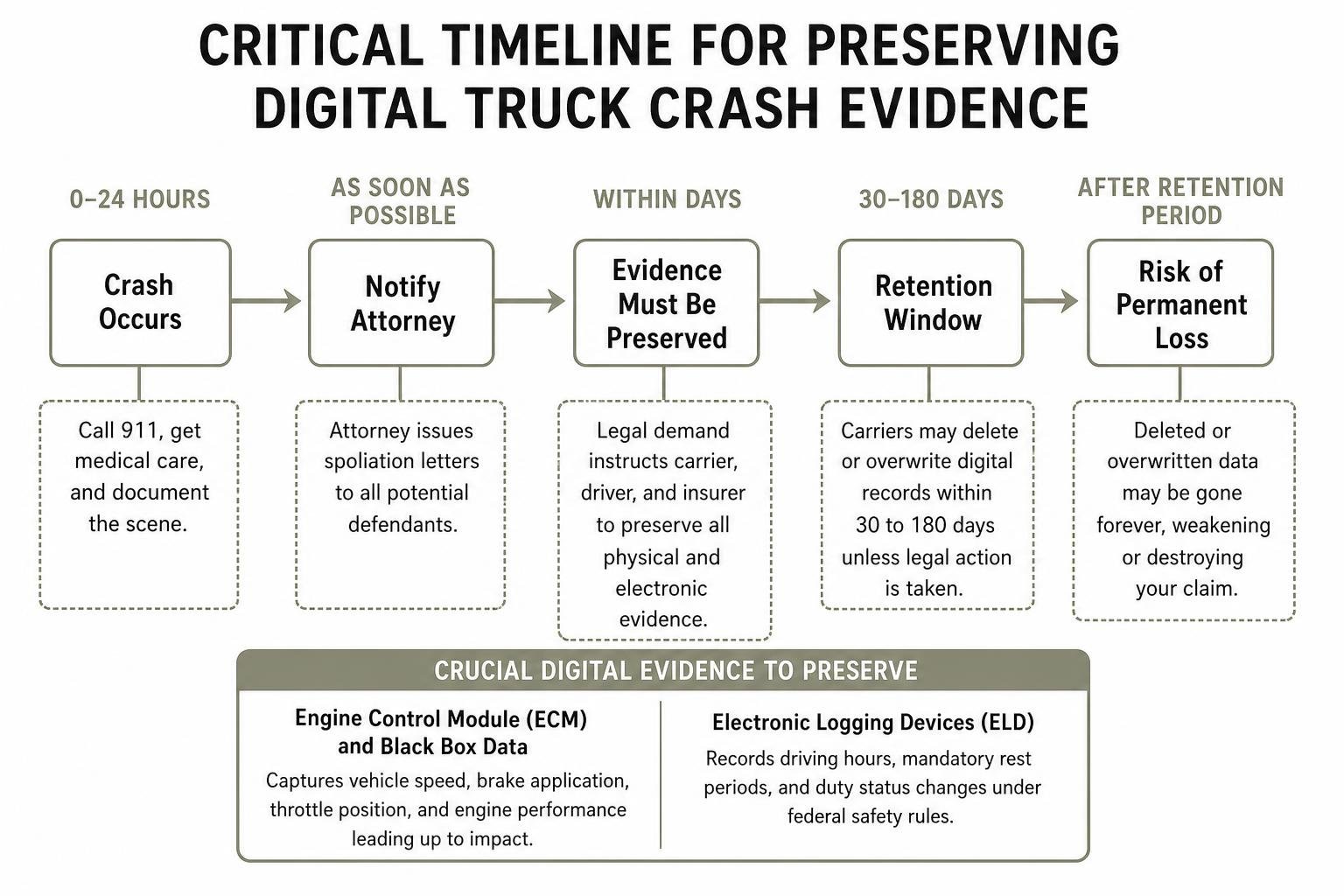
To prevent this loss, we issue formal spoliation letters to all potential defendants immediately upon taking a case. A spoliation letter is a formal legal demand that instructs the carrier, driver, and their insurer to preserve all physical and electronic evidence connected to the collision.
Crucial evidence that must be preserved includes:
- Engine Control Module (ECM) and Black Box Data: Captures vehicle speed, brake application, throttle position, and engine performance leading up to impact, making securing black box data before deletion essential to building a claim.
- Electronic Logging Devices (ELD): Records driving hours, mandatory rest periods, and duty status changes under federal safety rules.
- Driver Qualification Files (DQF): Contains the driver’s background checks, medical examiner certifications, commercial driver’s license (CDL) verification, and prior driving records.
- In-Cab Dashcam Footage: Video showing both forward-facing road conditions and driver behavior inside the cab.
- Maintenance and Inspection Records: Documents pre-trip inspection reports, brake servicing, tire tread measurements, and historical repair work.
Calculating Damages and Establishing Trucking Regulation Violations
Calculating the true value of a commercial truck claim requires a thorough review of both current and long-term costs. Because commercial collisions often cause severe injuries, settlements and verdicts must account for lifelong care rather than just short-term emergency bills.
- Economic Damages: Quantifiable financial losses, including past and future hospital stays, surgeries, physical rehabilitation, medication, adaptive medical equipment, lost income, and diminished future earning capacity.
- Non-Economic Damages: Intangible losses such as physical pain and suffering, emotional distress, mental anguish, loss of enjoyment of life, and physical impairment or disfigurement.
- Exemplary (Punitive) Damages: In cases involving gross negligence—such as driving under the influence or knowingly operating a truck with failed brakes—Texas courts may award exemplary damages under Texas Civil Practice and Remedies Code § 41.003 to penalize the wrongdoer.
Effectively calculating these losses involves evaluating collision compensation and maximum recovery options to ensure all future medical and financial needs are fully addressed.
Federal Regulations and FMCSA Violations That Prove Negligence
The commercial trucking industry is closely regulated by the Federal Motor Carrier Safety Administration (FMCSA) under Title 49 of the Code of Federal Regulations (49 CFR). When a trucking company or driver violates these safety standards and causes a crash, those violations provide strong evidence of negligence in Texas courts.
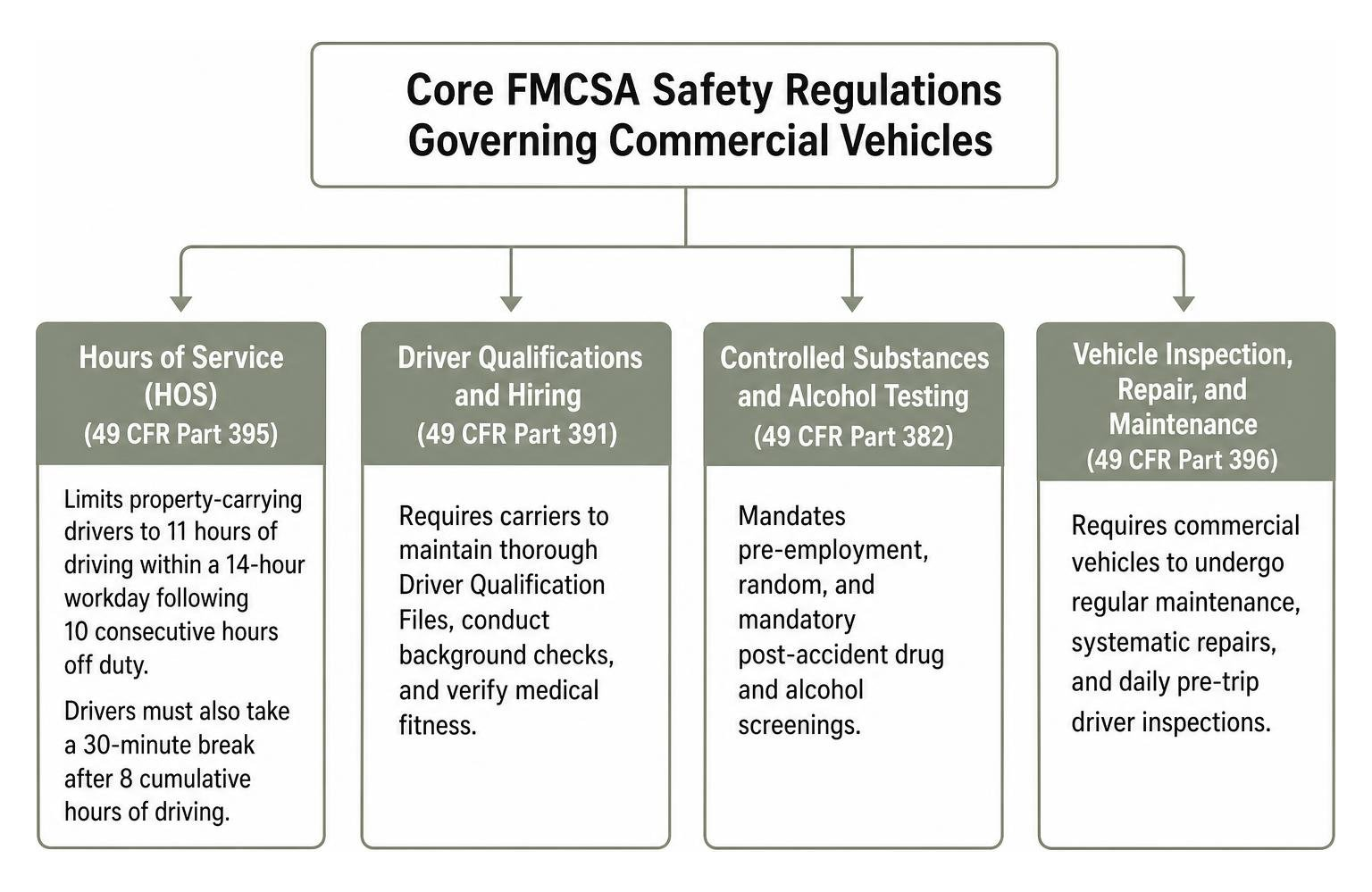
Key safety regulations include:
- Hours of Service (HOS) (49 CFR Part 395): Limits property-carrying drivers to 11 hours of driving within a 14-hour workday following 10 consecutive hours off duty. Drivers must also take a 30-minute break after 8 cumulative hours of driving.
- Driver Qualifications and Hiring (49 CFR Part 391): Requires carriers to maintain thorough Driver Qualification Files, conduct background checks, and verify medical fitness.
- Controlled Substances and Alcohol Testing (49 CFR Part 382): Mandates pre-employment, random, and mandatory post-accident drug and alcohol screenings.
- Vehicle Inspection, Repair, and Maintenance (49 CFR Part 396): Requires commercial vehicles to undergo regular maintenance, systematic repairs, and daily pre-trip driver inspections.
- Cargo Securement and Weight Limits (49 CFR Part 392 & 393): Enforces strict rules on cargo tie-downs, weight distribution, and adherence to gross vehicle weight limits.
Proving that a carrier violated these rules is central to holding trucking companies accountable for safety regulation violations.
Working with a West Loop Houston Truck Accident Lawyer on Contingency Fees
High-stakes commercial vehicle litigation requires substantial resources. Investigating complex crashes, preserving digital evidence, and retaining accident reconstruction and medical professionals involves significant upfront expense.
At WestLoop Law Firm, we handle commercial truck accident cases on a contingency fee basis. This payment structure ensures every injured person has access to strong legal representation:
- Zero Upfront Costs: You pay nothing out of pocket to begin your legal claim or retain our firm.
- We Advance Case Expenses: We cover all initial costs for investigations, black box downloads, court filing fees, depositions, and trial preparation.
- No Fee Unless We Win: Our legal fee is paid as an agreed-upon percentage of the final financial recovery. If we do not successfully recover compensation through a settlement or verdict, you owe no attorney fees.
This approach aligns our goals directly with yours, focused on maximizing settlement valuation strategies while protecting your financial security.
Frequently Asked Questions About Houston Truck Accident Lawsuits
What is the statute of limitations for filing a truck accident lawsuit in Texas?
Under Texas Civil Practice and Remedies Code § 16.003, the statute of limitations for personal injury and wrongful death lawsuits is two years from the date of the incident. If you do not file a lawsuit within this two-year window, Texas courts will generally dismiss your case, preventing you from recovering financial compensation.
However, waiting to take action can harm your claim. Critical digital evidence—including black box records, electronic logging data, and video footage—can be deleted within weeks if a spoliation letter is not issued promptly.
Who can be held liable in a multi-party commercial truck crash?
Liability in a commercial vehicle collision often extends beyond the individual behind the wheel. Depending on the facts of the crash, responsible parties may include:
- The commercial driver (for reckless operation, speeding, distraction, or fatigue).
- The motor carrier or trucking firm (for vicarious liability, poor training, or safety violations).
- The freight broker (for negligently hiring an unsafe carrier).
- Third-party cargo loaders (for improper loading or failing to balance weight).
- Maintenance contractors (for faulty mechanical repairs).
- Equipment manufacturers (for defective tires, brakes, or safety parts).
How much does it cost to hire an attorney for an 18-wheeler crash case?
Hiring our firm requires no out-of-pocket investment. We represent clients on a contingency fee basis, meaning our fee is calculated as a percentage of the total financial recovery obtained through settlement or trial. We advance all litigation expenses, and if we do not secure compensation for your claim, you owe no attorney fees.
Take Decisive Action with Dedicated Advocacy for Your Houston Truck Collision Claim
Recovering from a catastrophic commercial truck collision is physically demanding and emotionally exhausting. While you focus on medical treatment and personal recovery, large corporate insurers work quickly to protect their own financial interests. You do not have to face their defense teams on your own.
At WestLoop Law Firm, we combine in-depth legal knowledge with medical and financial insight to hold negligent motor carriers accountable. Whether your crash took place along I-610, the I-10 Katy Freeway, Beltway 8, or I-45, we are prepared to file your claim in the Harris County Civil Courts at Law and advocate for your rights through trial if necessary.
If you or a family member was injured in a commercial vehicle wreck, contact an experienced Houston trucking accident lawyer today for a free, confidential case review. We will evaluate your claim, begin preserving essential evidence, and guide you through every step of the legal process.