 Skip to content

What to Do After a Houston Port Truck Accident
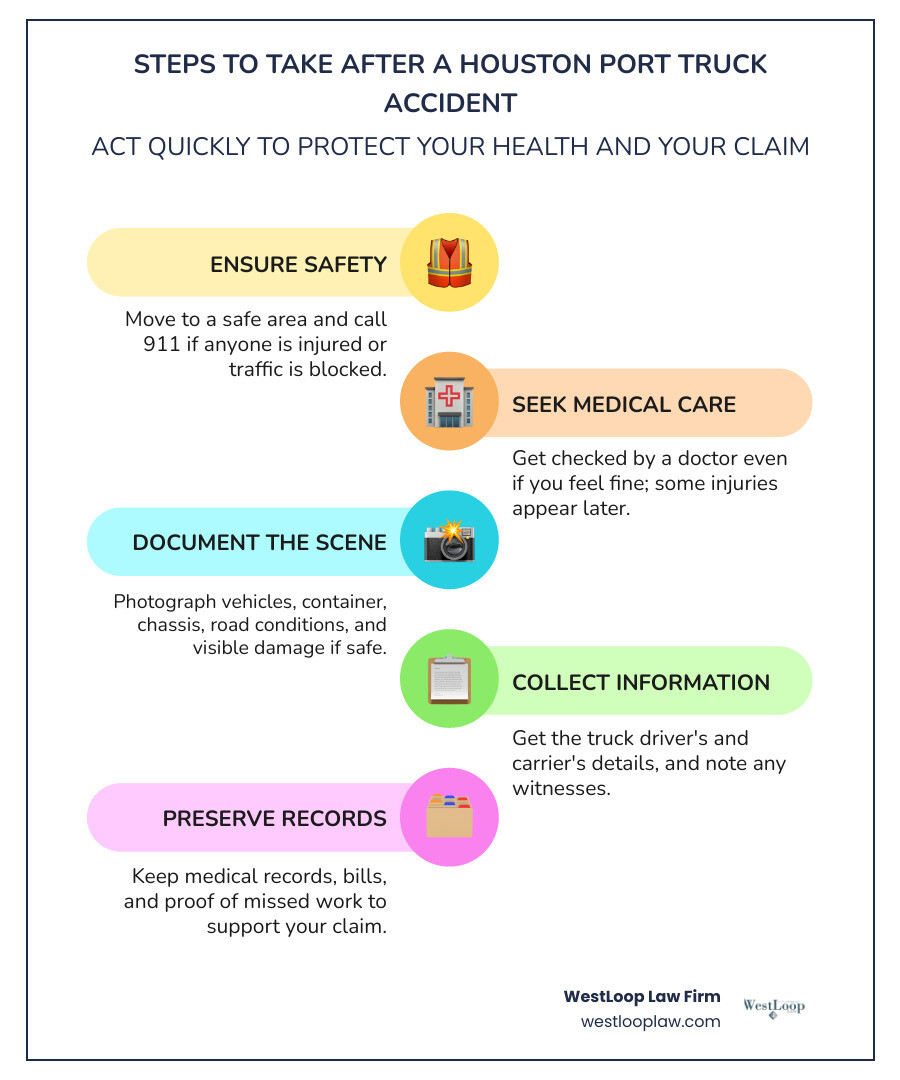
What to do first:
- Get to safety and call 911 if anyone is hurt or traffic is blocked.
- Seek medical care, even if your injuries seem minor.
- Photograph the vehicles, container, chassis, road conditions, and any visible damage if it is safe to do so.
- Get the truck driver’s and carrier’s details. Keep your medical records, bills, and proof of missed work.
A Houston port truck accident claim may involve more than the driver. The carrier, chassis provider, or cargo loader may also share responsibility, depending on what caused the crash. Early records can help show who was at fault and document your losses.
Houston port truck accident terms you need:
Port Houston Intermodal Traffic and Drayage Operations Overview
Port Houston serves as one of the busiest maritime and intermodal hubs in the United States, managing millions of tons of containerized cargo each year. Moving heavy international freight from ship to shore requires a continuous cycle of drayage trucks—short-haul commercial vehicles that transport shipping containers between marine terminals, rail yards, and distribution centers across Southeast Texas.
The primary centers for these intermodal exchanges are the Barbours Cut Container Terminal in Morgan’s Point and the Bayport Container Terminal in Pasadena. Every day, thousands of tractor-trailers haul multi-ton containers along vital transit corridors, creating intense traffic density.
Drayage routes funnel massive commercial rigs onto major regional thoroughfares, including:
- State Highway 225 (SH 225), connecting Pasadena and La Porte directly to industrial plants and rail hubs
- Interstate 610 (Loop 610), forming the inner beltway around industrial east Houston
- The Interstate 10 (I-10) East corridor, carrying freight eastward toward Beaumont and inland distribution points
- Interstate 45 (I-45), running south toward Galveston and north through downtown Houston
- Sam Houston Tollway (Beltway 8), handling freight bypass traffic across the metropolitan area
Because drayage operations rely on purpose-built intermodal container chassis—wheeled steel frames designed to lock international shipping boxes onto truck beds—equipment safety is critical. When these chassis are mismatched, improperly maintained, or overloaded, commercial vehicles present severe dangers to passenger cars sharing these crowded highway systems.
How Drayage Container Violations Cause a Houston Port Truck Accident
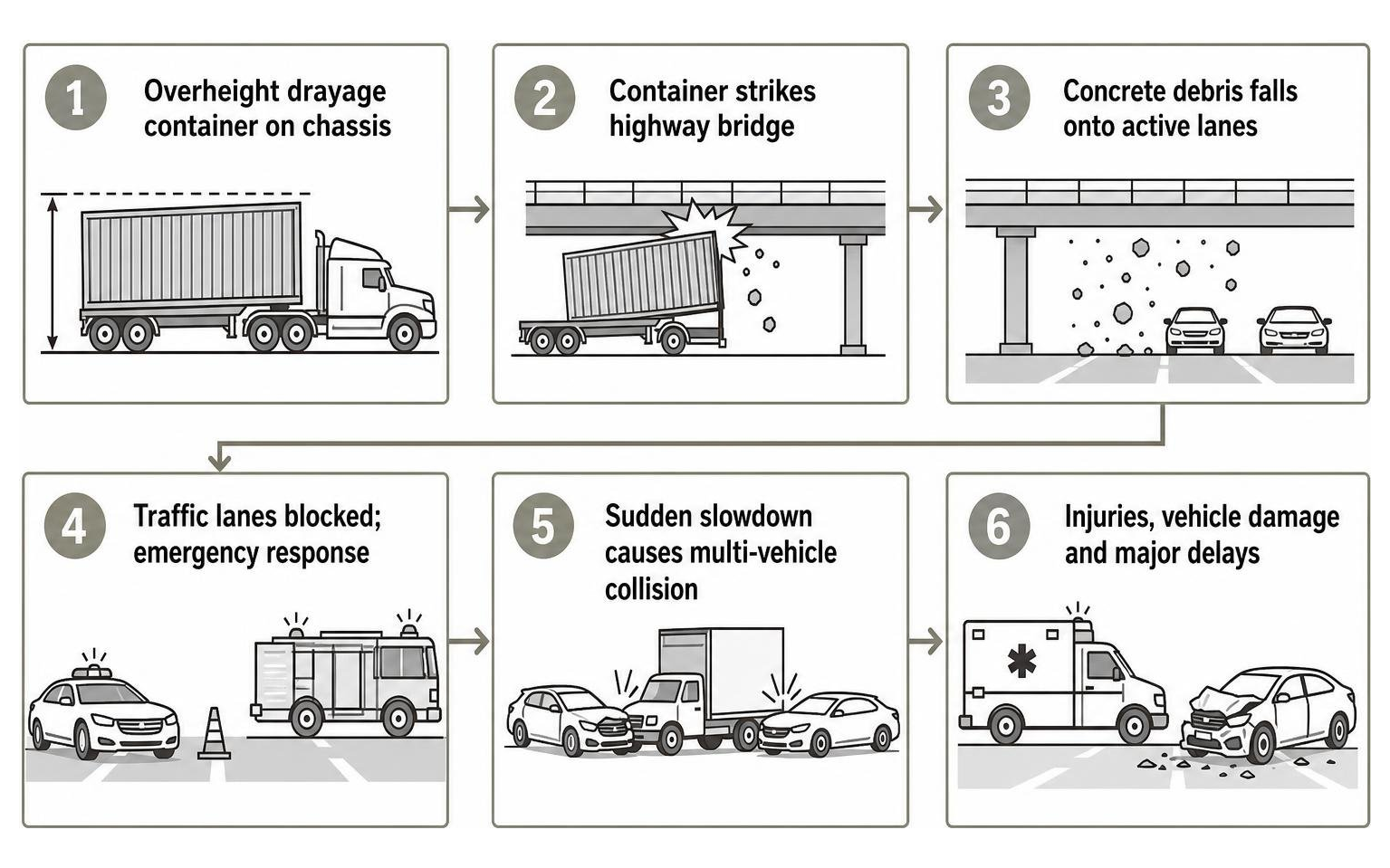
Container transport involves unique physical risks that standard dry van trailers do not encounter. A primary hazard is overheight cargo and improperly secured containers, which can cause catastrophic structural collisions. In Houston, instances where an overpass is struck by a container chassis demonstrate how quickly an off-terminal violation can damage public infrastructure and trigger secondary multi-vehicle collisions.
When an oversized drayage container strikes a highway bridge on routes like Loop 610 or I-10, concrete debris falls onto active traffic lanes, requiring hours of emergency stabilization and hazardous cleanup by local authorities and transportation departments. These impacts often stem from motor carriers failing to map safe routes, ignoring posted clearance limits, or improperly seating the container locking pins on the chassis.
Holding negligent logistics providers accountable requires a deep understanding of commercial transit regulations, which a dedicated Houston commercial truck accident lawyer can utilize when investigating the chain of events that led to a collision.
Common Hazards and Recent Incidents at Port Houston Terminals
The operational pressure to turn around cargo quickly creates hazardous environments both inside terminal gates and on nearby access roads. Terminal congestion frequently forces drayage drivers to wait in prolonged gate queues along Port Road or Highway 146, contributing to driver fatigue, rushed loading maneuvers, and mechanical strain.
Industrial and mechanical failures at maritime facilities highlight the continuous dangers present in port operations. For instance, terminal operations faced severe scrutiny following a fatal industrial incident at Bayport where heavy container-handling equipment collapsed, killing a worker on site.
Mechanical failures extend into maritime support operations as well. Federal safety regulators conducted an extensive NTSB fuel valve investigation on the container ship Stride after an incorrectly installed diesel fuel system valve directed fuel into an open vent pipe during fueling at Barbours Cut Marine Terminal on January 8, 2024. The resulting blaze led to two fatalities, one serious injury, and caused such severe structural damage that the vessel was declared a total loss and scrapped.
Whether an incident occurs at a terminal berth or on the public highways feeding the port, distinct liability frameworks govern how injury claims are handled.
| Incident Category | Primary Jurisdiction | Liable Entities | Typical Governing Laws |
|---|---|---|---|
| Drayage Truck Highway Collision | State / Federal Civil Law | Motor Carrier, Drayage Driver, Chassis Provider (IEP), Cargo Shipper | Texas Civil Practice & Remedies Code, FMCSA Regulations |
| Marine Terminal Worker Injury | Maritime / Federal Labor Law | Stevedore Company, Terminal Operator, Equipment Manufacturer | Longshore and Harbor Workers’ Compensation Act (LHWCA) |
| Vessel Fueling / Berth Incident | General Maritime Law / Admiralty | Vessel Owner, Shipbuilder, Maintenance Contractor, Fuel Supplier | Jones Act, Death on the High Seas Act (DOHSA), General Maritime Torts |
| Terminal Chassis Hand-off Defect | Mixed Tort / Contract Law | Intermodal Equipment Provider (IEP), Ocean Carrier, Terminal Gate Inspector | FMC Intermodal Rules, Texas Negligence Statutes |
Legal Liability and Fault in a Houston Port Truck Accident
Untangling fault after a drayage freight collision requires analyzing the entire supply chain. Unlike standard trucking accidents involving an independent owner-operator carrying standard freight, intermodal transport separates ownership of the tractor, the chassis, the container, and the cargo.
Potentially liable parties in an intermodal collision include:
- Motor Carriers: The trucking company employing the driver or leasing the rig must enforce Federal Motor Carrier Safety Administration (FMCSA) hours-of-service rules, perform background checks, and monitor vehicle operation.
- Intermodal Equipment Providers (IEPs): IEPs own and lease the container chassis pooled at terminals. Under federal “roadability” regulations, IEPs must ensure that chassis brakes, lighting systems, tires, and locking twist-locks meet strict safety standards before releasing equipment through terminal inspection gates.
- Cargo Shippers and Ocean Carriers: Companies that pack international containers overseas or at port staging facilities must distribute weight evenly. Uneven or improperly blocked cargo can shift during transit, causing a truck to roll over when negotiating tight highway entrance ramps like those connecting SH 225 to Loop 610.
- Third-Party Logistics (3PL) Brokers: Logistics intermediaries who hire substandard motor carriers with poor safety track records to save on transport costs can be held accountable for negligent hiring.
Uncovering maintenance failures or falsified inspection reports demands thorough legal discovery led by an experienced Houston trucking accident lawyer.
The Interplay Between Maritime Law and Commercial Trucking Claims
When an accident happens along port boundaries or involves intermodal logistics chains, federal maritime jurisdiction and state tort law often intersect. Understanding which legal structure governs your claim determines how damages are pursued and which court handles the lawsuit.
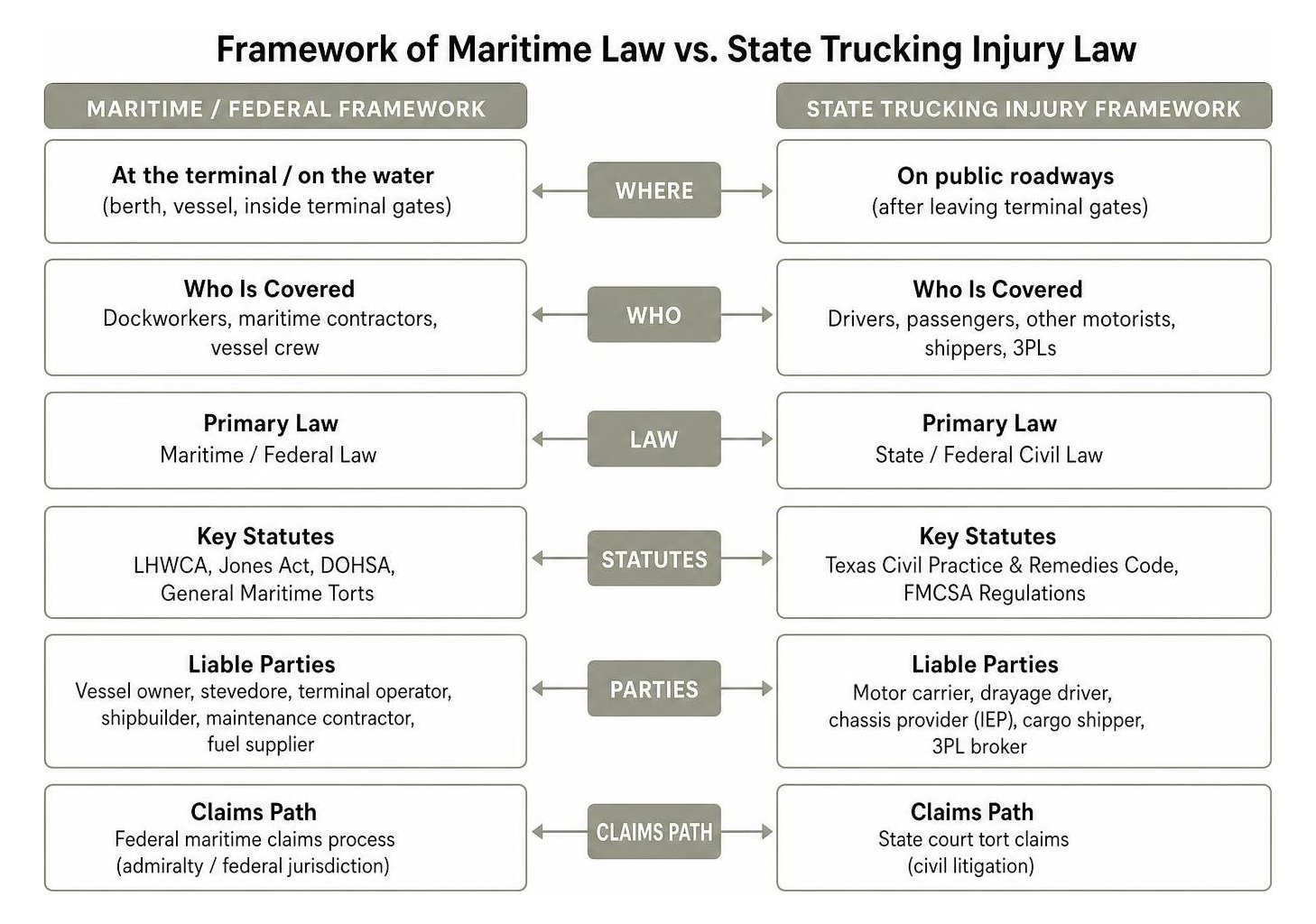
When dockworkers or maritime contractors suffer injuries inside terminal gates—such as at Barbours Cut or Bayport—claims generally fall under the Longshore and Harbor Workers’ Compensation Act (LHWCA), a federal statutory scheme providing medical benefits and disability compensation. Crew members injured aboard cargo vessels rely on the Jones Act to recover damages against negligent shipowners.
Conversely, once an intermodal container moves past the marine terminal gates and onto Houston public roadways, state tort law governs injuries sustained by passenger car occupants. However, shipping contracts, multimodal bills of lading, and ocean carrier liability limitations (such as the Carriage of Goods by Sea Act) can still influence cross-claims between transportation entities. Navigating these overlapping federal and state frameworks requires familiarity with maritime law in Houston alongside inland commercial vehicle litigation, as detailed in our comprehensive Houston maritime injury lawyers guide.
Texas Injury Laws Governing Port Truck and Maritime Collisions
Victims of commercial truck crashes in Texas must navigate complex insurance structures and specific statutory rules. Commercial motor carriers are required by federal and state law to carry substantial liability insurance limits—often ranging from $750,000 to over $5,000,000 depending on the cargo classification and hazardous material designations.
Following a crash, injured drivers can also turn to their own auto insurance policies for immediate relief. In Texas, auto insurers must offer Personal Injury Protection (PIP) unless the policyholder explicitly rejects it in writing. PIP provides no-fault coverage that pays for medical bills and a percentage of lost wages, offering vital financial support while liability claims against negligent motor carriers are pending. Working alongside a skilled Houston 18 wheeler accident lawyer ensures that all available primary, excess, and third-party insurance policies are identified.
Additionally, corporate defendants and their commercial insurers often deploy rapid-response teams to the crash scene within hours. A seasoned commercial truck accident attorney can intervene quickly to prevent the alteration or destruction of vital digital data.
Filing a Houston Port Truck Accident Claim in Harris County Courts
When settlement negotiations do not yield fair compensation, claims are filed in the local court system, primarily within the Harris County Civil Courts at Law or Harris County District Courts located in downtown Houston.
Successful litigation in Texas requires strict adherence to state procedural and liability rules:
- The 51% Modified Comparative-Fault Bar: Under Texas Civil Practice and Remedies Code Chapter 33 (Proportionate Responsibility), an injured party can recover damages only if their percentage of responsibility is 50% or less. If a jury finds you 51% or more at fault for the crash, you are legally barred from recovering any compensation. If you share 50% or less of the fault, your financial recovery is reduced proportionally by your fault percentage.
- Two-Year Statute of Limitations: In Texas, you generally have exactly two years from the date of the accident to file a formal personal injury lawsuit. Missing this statutory deadline almost always results in a permanent loss of your right to seek financial recovery in court.
- Crucial Evidence Preservation: Port truck crashes rely heavily on digital and electronic evidence that motor carriers may legally purge after standard retention windows unless formal preservation demands are sent. Essential evidence includes:
- Electronic Logging Device (ELD) data showing driver hours, speed, and braking inputs
- Terminal gate interchange receipts (TIR) recording chassis condition upon leaving Bayport or Barbours Cut
- Heavy vehicle Event Data Recorders (EDR or “black boxes”)
- Carrier maintenance logs and driver qualification files
Frequently Asked Questions About Houston Port Truck Accidents
Who is liable if an improperly secured port container causes an accident?
Liability often extends across multiple entities. While the drayage driver and motor carrier are responsible for conducting pre-trip inspections to ensure locking pins (twist-locks) are properly engaged, the ocean shipping line or terminal staging facility may share liability if they provided a damaged chassis with defective locks. Additionally, if an overseas shipper improperly loaded and balanced the cargo inside the sealed container, creating an undetectable center-of-gravity defect, they may be named in third-party liability claims under federal cargo securing standards set by the Federal Motor Carrier Safety Administration.
How long do I have to file an injury claim after a port truck collision in Texas?
Under the Texas Civil Practice and Remedies Code, the statute of limitations for personal injury and wrongful death claims is generally two years from the date the accident occurred. While two years may seem sufficient, commercial trucking claims require extensive preliminary investigation—including inspecting the truck, downloading black box data, and subpoenaing terminal gate records—making prompt legal action critical before key evidence is lost.
What role does comparative fault play in a Texas port truck crash?
Texas operates under a modified comparative fault rule with a 51 percent bar. If an injured motorist is found partially responsible for a crash—such as by following too closely or traveling slightly above the speed limit—their compensation is reduced by their assigned percentage of fault, provided their share does not exceed 50 percent. If the injured party is found 51 percent or more at fault, they receive zero recovery from the trucking company or chassis provider.
Protecting Your Rights After an Intermodal Freight Crash
Managing the aftermath of an intermodal trucking collision requires a clear legal strategy to hold commercial carriers, cargo loaders, and equipment providers accountable. Because port freight operations involve multi-layered corporate structures, complex federal regulations, and distinct insurance policies, preserving crucial evidence early is essential to building a strong case.
To gain a deeper understanding of commercial carrier litigation and safety rules, review our comprehensive Houston truck collision guide. If you or a loved one suffered injuries in a commercial vehicle collision near Port Houston or its surrounding highway corridors, reach out to Westloop Law Firm for dedicated, comprehensive legal representation designed to protect your financial recovery and long-term well-being.