 Skip to content
Start the Houston Probate Heir Determination Checklist
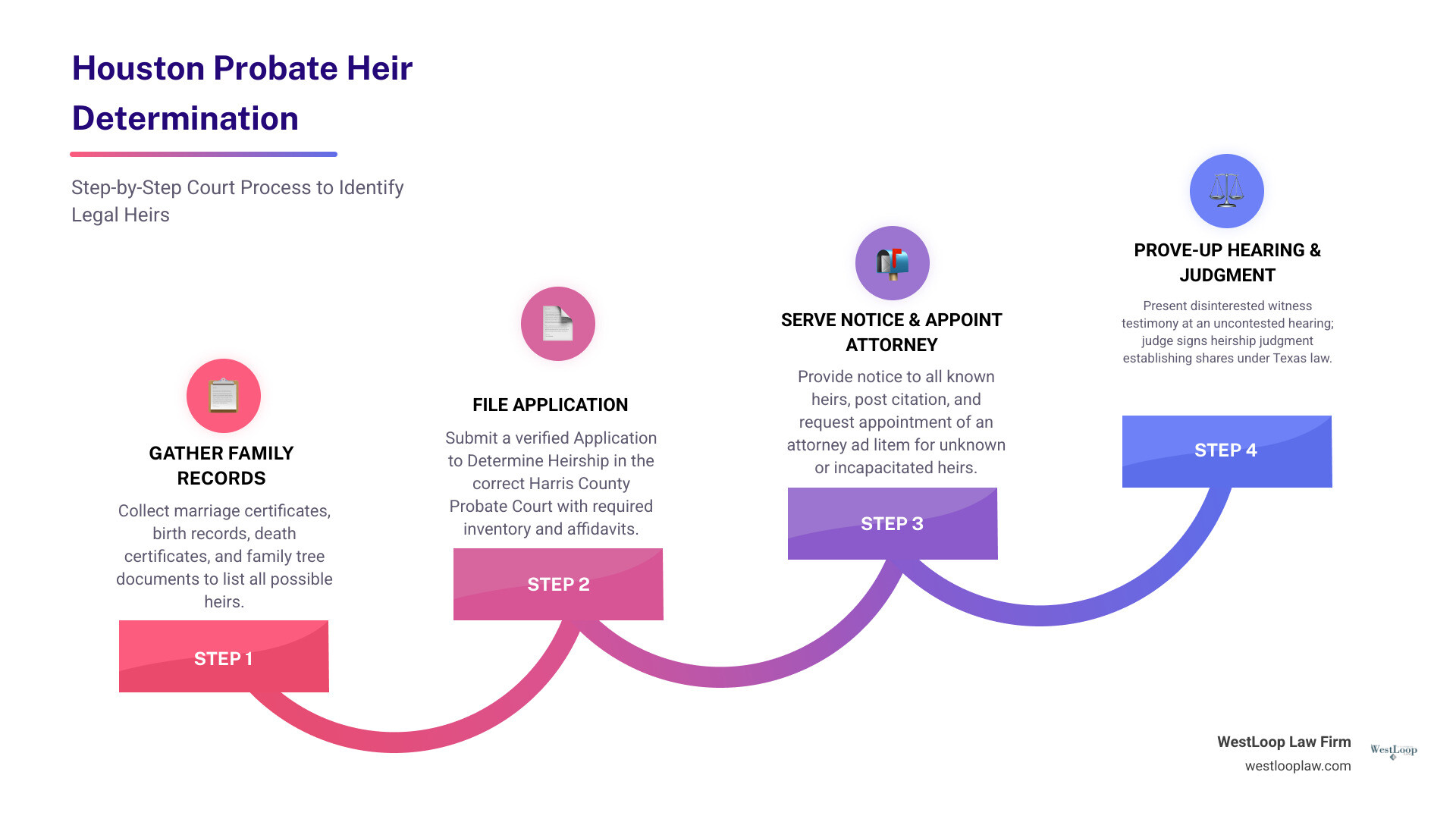
A Houston probate heir determination is the court process used to identify a deceased person’s legal heirs and state each heir’s share of Texas property. If a loved one died without a will, or Texas property was left out of an estate plan, start by gathering family-history records, identifying all possible heirs, and filing an Application to Determine Heirship in the appropriate Harris County Probate Court.
The court process matters because it can clear title to a home, land, bank funds, or other assets. It also protects people who may have inheritance rights but are not yet known or easy to locate.
Your initial checklist:
- Confirm whether there is a valid will and whether an estate administration is already open.
- List the decedent’s spouses, children, parents, siblings, and other possible relatives.
- Separate potential community property from separate property.
- Identify every known heir and their current address, if available.
- Prepare for required notice, an attorney ad litem for unknown heirs when needed, and witness evidence.
- Work with a licensed attorney before filing. Heirship cases involve court-required procedures that can affect ownership rights.
A judge’s heirship judgment establishes who inherits under Texas law. It does not always finish the estate administration or transfer every asset by itself. In many cases, the next step is appointing an administrator or using the judgment to complete a title transfer.
Westloop Law Firm can help families understand the documents, notice rules, witness requirements, and next steps involved in Harris County probate.
Similar topics to houston probate heir determination:
Understanding Houston Probate Heir Determination and When It Is Required
When someone passes away intestate (without a valid will) in Houston, or leaves behind property not addressed in an existing testamentary document, Texas law does not automatically hand assets over to family members. Instead, a formal legal mechanism is required to declare the true legal beneficiaries. Under the ESTATES CODE CHAPTER 202. DETERMINATION OF HEIRSHIP, a court proceeding resolves these ownership questions by establishing who inherits the decedent’s real estate, personal property, and financial accounts.
This statutory proceeding becomes necessary in several common scenarios across Houston:
- The decedent died without leaving a valid last will and testament.
- A will was admitted to probate, but it failed to dispose of all real or personal property owned by the decedent.
- Real estate title companies require a formal court decree before issuing title insurance to buyers or heirs.
- Financial institutions hold funds that cannot be released without a certified court order confirming the identity of the lawful successors.
Standing to initiate an heirship proceeding is clearly defined under Texas law. An application may be brought by a qualified personal representative, a person claiming to be an owner of all or part of the estate, a secured creditor holding a claim against estate assets, or a guardian acting on behalf of a ward. When navigating complex family dynamics or intestate estates, consulting Houston Texas probate lawyers ensures that all procedural statutory safeguards are observed from day one.
Step-by-Step Checklist to Navigate Harris County Probate Courts
Probate matters in Harris County are assigned across five statutory probate courts. Filing an heirship proceeding requires strict adherence to local court rules, mandatory electronic filing procedures, and state-mandated timelines. To successfully initiate this process, follow this structured procedural framework:

- Verify Court Jurisdiction and Standing: Ensure Harris County is the proper venue based on the decedent’s domicile at death or the location of their Texas real estate.
- Review the Four-Year Rule: Determine whether an administration is needed alongside the heirship. Under Texas law, requests for an estate administration must generally be filed within four years of the decedent’s death.
- Comply with E-Filing Mandates: Texas requires all attorney filings to be submitted electronically via statewide filing portals to the Harris County Clerk’s Office Probate Courts.
- Pay Court Costs and Filing Fees: The initial filing fee must be paid at case initiation unless a statutory exemption or court-approved indigency waiver applies.
- Request an Attorney Ad Litem: Harris County probate judges appoint an independent attorney ad litem in every heirship application to advocate for unknown, missing, or incapacitated heirs.
If you are unfamiliar with initiating these proceedings, reviewing how to start the formal probate process in Houston provides valuable clarity on court dockets and structural requirements.
Document Preparation for Houston Probate Heir Determination
Submitting an application to determine heirs requires comprehensive documentation detailing the decedent’s lineage and asset profile. A proper filing package includes:
- A Verified Application for Determination of Heirship: Stating the decedent’s date and place of death, marital history, children, and a comprehensive list of all known heirs, including their ages and physical addresses.
- Detailed Family History Summary: Outlining every marriage, divorce, birth, and adoption involving the decedent.
- Statement of Real and Personal Property: Describing real estate, mineral interests, bank holdings, and business assets situated in Texas.
- Supporting Affidavit of Facts: Signed under oath, confirming the accuracy of the family lineage presented to the court.
- Notice Waivers or Service Information: Contact addresses for all living heirs requiring formal citation.
Citation, Service of Notice, and Attorney Ad Litem Appointment
Due process requires that every individual with a potential claim to an estate receives proper notice. Texas Estates Code Section 202.051 mandates that all known heirs aged 12 or older, as well as the parents or guardians of heirs under 12, receive formal citation via certified mail or personal service by a process server.
For unknown heirs, citation must be posted at the county courthouse and published in an authorized local newspaper or public citation portal. To guarantee that omitted or incapacitated heirs are fully protected, Harris County probate judges appoint an independent attorney ad litem. The ad litem conducts independent family research, reviews birth and marriage records, contacts relatives, and files an answer before the court proceeds to a hearing. Navigating these requirements in Harris County probate cases prevents future challenges to the estate’s distribution.
Witness Testimony and the Houston Probate Heir Determination Prove-Up Hearing
To finalize an heirship declaration, the court conducts an evidentiary hearing (known as a prove-up hearing). Texas rules mandate clear and convincing evidence to establish family lineage:
- Two Disinterested Witnesses: The court requires testimony from two credible, disinterested individuals who knew the decedent’s family history intimately (such as longtime family friends, neighbors, or colleagues) and have no financial stake in the estate.
- Remote and Deposition Testimony: If disinterested witnesses reside outside Houston or cannot travel, their testimony may be taken by deposition on written questions pursuant to Texas Rule of Civil Procedure 200.
- Single Witness Exception: In narrow circumstances where a diligent search reveals only one living disinterested witness, the court may accept single-witness testimony alongside supporting historical records.
At the uncontested prove-up hearing, the applicant, their attorney of record, the attorney ad litem, and the witnesses appear before the judge. Once testimony confirms the decedent’s family tree, the judge enters a formal Judgment Declaring Heirship.
Texas Intestacy Calculations: Dividing Separate vs. Community Property
When an individual dies without a will in Houston, Texas intestacy laws govern how assets pass to surviving relatives. Texas is a community property state, meaning the court must classify each asset as either community property (acquired during marriage) or separate property (owned prior to marriage, or acquired via gift, devise, or personal injury settlement).
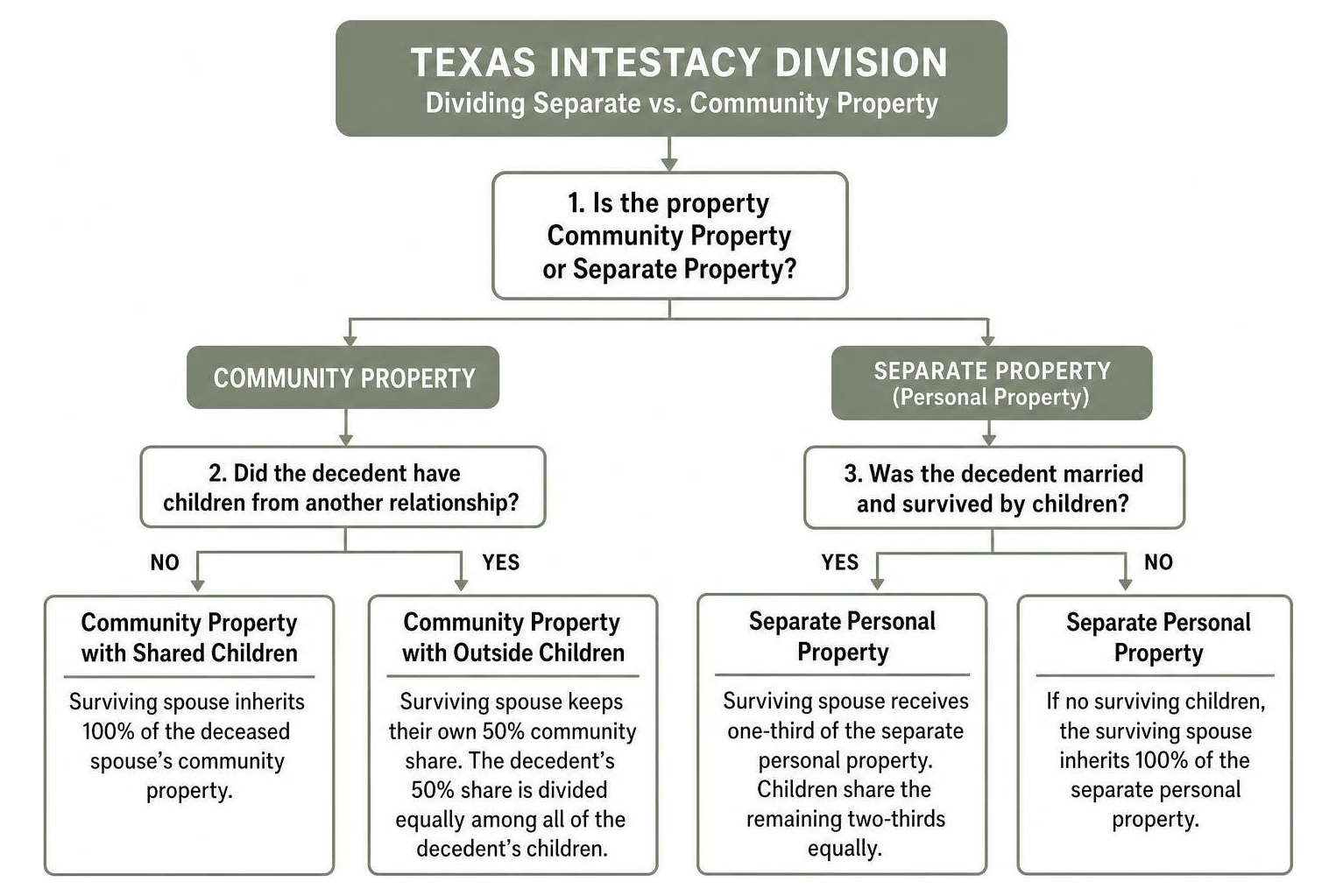
The division rules under the Texas Estates Code function as follows:
- Community Property with Shared Children: If all surviving children are also the children of the surviving spouse, the surviving spouse inherits 100% of the deceased spouse’s community property.
- Community Property with Outside Children: If the decedent had children from a prior relationship, the surviving spouse keeps their own 50% community share, while the decedent’s 50% share is divided equally among all the decedent’s children.
- Separate Personal Property: If married with children, the surviving spouse receives one-third of the separate personal property, and the children share the remaining two-thirds.
- Separate Real Estate and Mineral Rights: If married with children, the surviving spouse receives a life estate in one-third of the separate real property, while the children inherit the remaining two-thirds immediately plus the remainder interest after the spouse’s death.
Understanding these statutory splits is critical when dealing with real estate in probate and navigating Texas inheritance laws and probate standards.
Establishing Paternity, Missing Heirs, and Genetic Testing
In modern probate proceedings, unresolved paternity questions or unknown children can delay heirship determinations. Under Texas law, courts may order genetic testing upon a motion from any interested party or on the court’s own initiative to confirm biological lineage.
Genetic evidence helps prevent wrongful disinheritance and resolves disputed claims between biological descendants and surviving relatives. If a dispute arises regarding heir authenticity or biological relation, working with a probate challenge lawyer helps ensure that DNA sampling, laboratory testing chains of custody, and statutory presumptions conform strictly to Texas court requirements.
Judicial Heirship Determination vs. Nonjudicial Affidavit of Heirship
Families dealing with an intestate estate often wonder whether a full court proceeding is required or if an affidavit of heirship will suffice. While both address inheritance rights, they carry distinct legal weight:
| Feature | Judicial Heirship Determination | Nonjudicial Affidavit of Heirship |
|---|---|---|
| Governing Statute | ESTATES CODE CHAPTER 202 | ESTATES CODE CHAPTER 203 |
| Court Involvement | Full judicial proceeding in probate court | No court hearing or judicial sign-off required |
| Legal Effect | Final, binding court judgment declaring heirs | Prima facie evidence of family history |
| Timeline to Maturity | Effective immediately upon judge’s signature | Must be recorded in deed records for 5+ years |
| Title Company Acceptance | Universally accepted for title insurance | Subject to title underwriter discretion |
| Estate Administration | Can be paired with independent administration | Cannot appoint an executor or administrator |
An Affidavit of Heirship under Chapter 203 is often used to clear title to real property when there are no significant debts, no disputes among family members, and the estate requires no formal administration. However, because it only creates a rebuttable presumption after five years of recording, many banks and underwriters insist on a formal judicial heirship determination before releasing funds or approving real estate sales.
Frequently Asked Questions About Houston Probate Heir Determination
Do I need an attorney to file an heirship application in Harris County?
Yes. Under Texas law, an heirship determination is a formal judicial proceeding that affects the property rights of third parties and potential creditors. Individuals cannot represent the interests of an estate or other beneficiaries pro se (without a lawyer). A licensed attorney must prepare, file, and present the heirship application before the Harris County Probate Court.
What is the four-year deadline for heirship and administration?
A judicial declaration of heirship can technically be filed at any time after death—even decades later—to establish chain of title. However, an Application for Letters of Administration (appointing an administrator to manage and distribute estate assets) must generally be filed within four years of the decedent’s date of death. Missing this four-year window limits the family’s options to a declaration of heirship or a muniment of title.
What happens after the judge signs the heirship judgment?
Once the judge signs the Judgment Declaring Heirship, certified copies of the decree are recorded in the county deed records where any estate real estate is situated. If the court also approved an Application for Independent or Dependent Administration, the appointed administrator takes their statutory oath, posts any required bond, receives Letters of Administration, and begins collecting assets, settling legitimate creditor claims, and distributing property to the declared heirs.
Final Steps to Settle Your Family’s Houston Estate
Establishing rightful ownership after the loss of a loved one requires careful compliance with Texas statutory rules and Harris County court requirements. From gathering family lineage records and providing statutory notice to coordinating with court-appointed attorneys ad litem and disinterested witnesses, every step protects your family’s property rights.
At Westloop Law Firm, we guide Houston families through every phase of the probate docket, ensuring clear title transfers, proper heir declarations, and smooth estate administration. For proactive assistance with long-term asset management or guidance through an active probate matter, explore our comprehensive estate planning lawyer Houston resources and connect with our team today.