 Skip to content
What to Do After a Houston Truck Rollover Accident
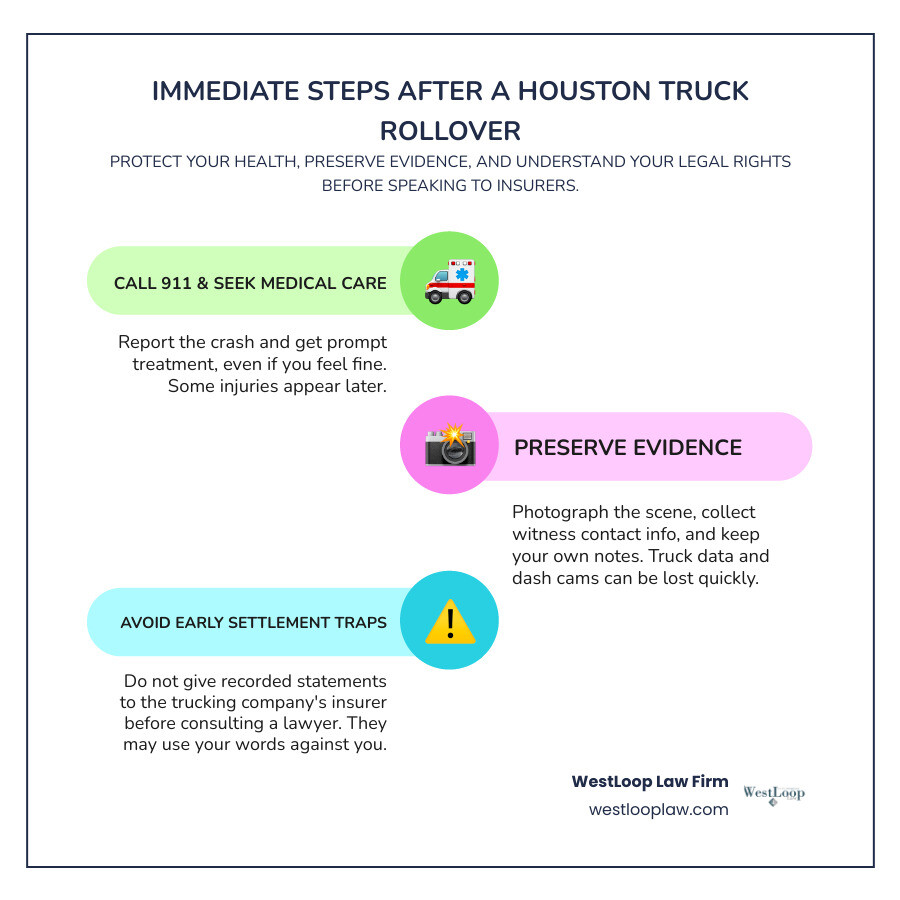
After a Houston truck rollover accident, get medical care, call 911, preserve any photos or witness information you can safely collect, and avoid giving a recorded statement to the trucking company’s insurer before you understand your rights. A crash investigation may show that the driver, trucking company, cargo loader, maintenance provider, or another party shares fault.
In Texas, an injured person may seek compensation for truck accident medical bills, lost income, vehicle damage, and pain and suffering through a Houston trucking insurance claim. Texas generally gives victims two years to file a personal injury lawsuit, but crucial evidence such as trucking black box data, dash camera footage, and driver logs can disappear much sooner.
Houston’s crowded freight routes create serious rollover risks. Harris County records more than 6,100 commercial-truck crashes each year, and dangerous incidents have recently affected the Southwest Freeway, I-610 East Loop, SH-225 ramps, and the Katy Freeway. Fast curves, sudden traffic changes, wet pavement, fatigue, brake or tire failures, and unsecured cargo can all make a fully loaded 18-wheeler unstable.
A rollover can block several lanes, crush nearby vehicles, or spill cargo across the roadway. The legal question is not only what happened, but whether preventable conduct caused or worsened the crash.
Introduction

Navigating Houston traffic can feel like a high-stakes obstacle course on any given day. Harris County recorded 579 traffic fatalities across 546 fatal crashes in 2024, holding the unfortunate title of leading all Texas counties in deadly motor vehicle collisions. With massive freight arteries weaving through residential neighborhoods and dense business districts, commuter cars constantly share tight road space with 80,000-pound tractor-trailers.
When an 18-wheeler loses its footing, the physical consequences are catastrophic. Commercial trucks possess a high center of gravity, which leaves them vulnerable to lateral forces that smaller passenger vehicles handle with ease. When an unstable tractor-trailer trips or slides, thousands of pounds of steel can roll across multi-lane expressways within seconds, leaving zero reaction time for surrounding motorists.
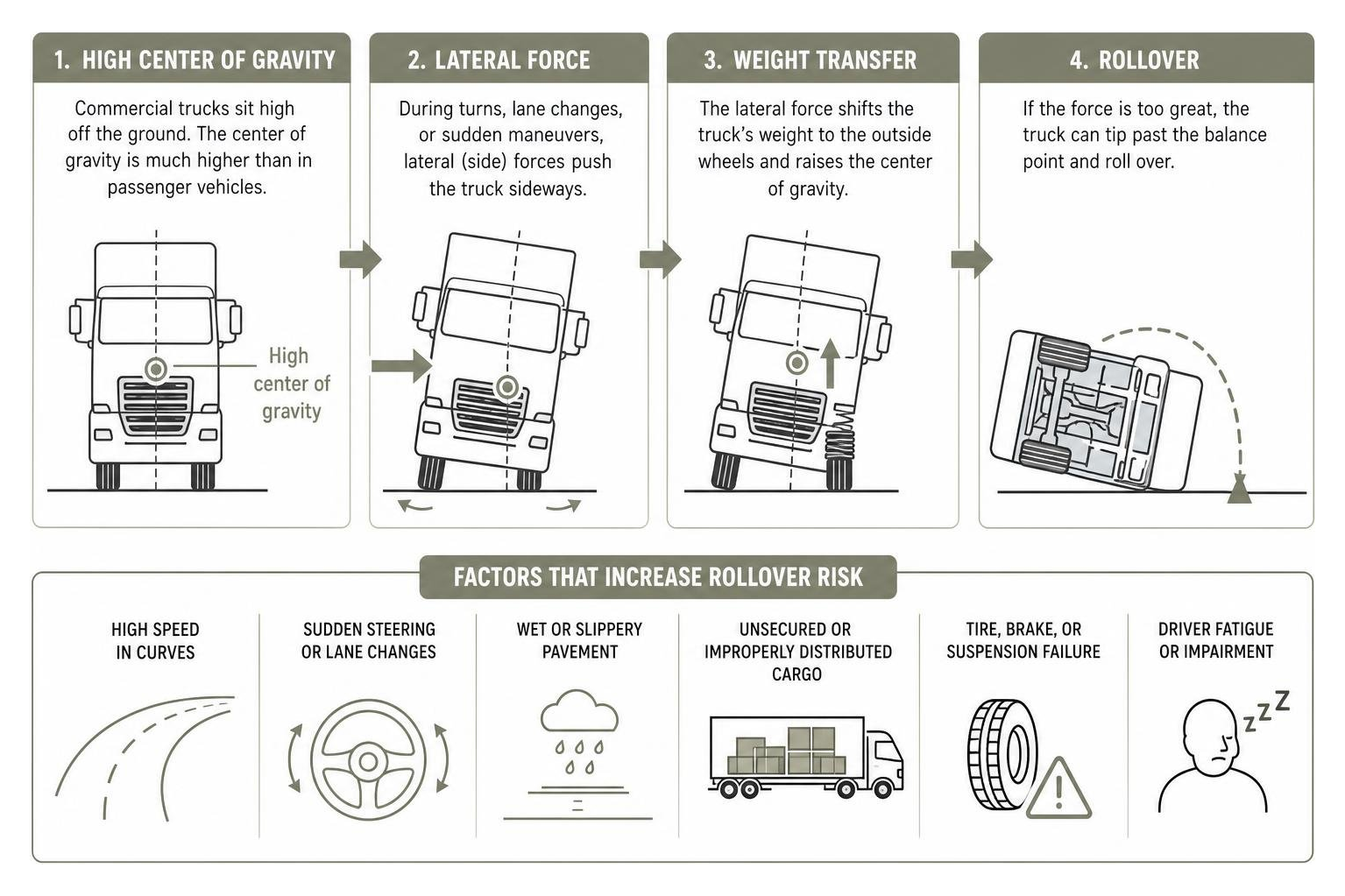
Understanding why these crashes happen, how federal and state safety rules apply, and how injured motorists can assert their rights under Texas law is critical. We believe that informed drivers are better equipped to protect their families both on the roadway and in the courtroom.
Common Causes of a Houston Truck Rollover Accident
Commercial truck rollovers rarely happen in a vacuum. Instead, they usually result from a chain reaction of speed, vehicle dynamics, road design, and human decision-making. Knowing the primary causes of truck accidents helps clarify who is responsible when a heavy vehicle topples over.
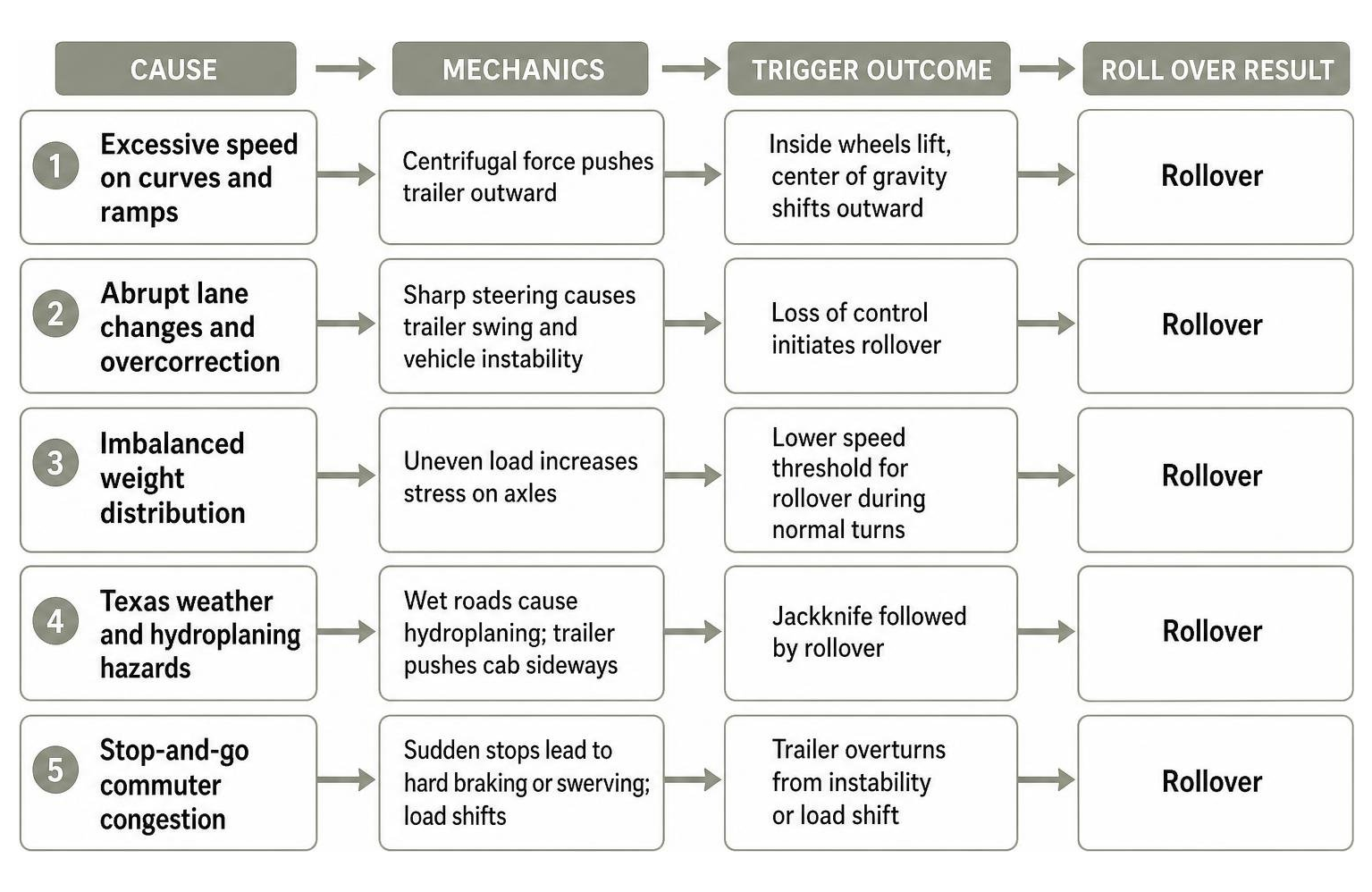
- Excessive Speed on Highway Curves and Ramps: Semi-trucks require calculated deceleration before entering curved flyovers or exit ramps. Taking a curved connector too fast generates centrifugal force that pushes the trailer’s center of gravity outward, causing the inside wheels to lift and initiating a rollover.
- Abrupt Lane Changes and Overcorrection: Dense Houston traffic often forces commercial drivers to react quickly. However, sharp steering inputs at highway speeds cause trailer swing, vehicle instability, and eventual rollover.
- Imbalanced Weight Distribution: Trailers packed unevenly place undue stress on specific axles, drastically lowering the speed threshold needed to induce a rollover during normal turns.
- Texas Weather and Hydroplaning Hazards: Sudden Gulf Coast downpours produce slick road surfaces and ponding on major routes like Interstate 45 and the Katy Freeway. When a big rig hydroplanes, the trailer can push the cab sideways, creating a classic jackknife-rollover scenario.
- Stop-and-Go Commuter Congestion: When traffic suddenly halts, a heavy truck trailing too closely must swerve or brake violently, unseating its load and causing the trailer to overturn.
Cargo Shifts and Mechanical Failures on Texas Highways
Cargo security plays a pivotal role in commercial vehicle stability. Under Federal Motor Carrier Safety Administration (FMCSA) regulations, freight must be contained, immobilized, or secured to prevent shifting during transit. When loaders fail to secure freight, cargo can slide violently to one side during a routine turn, pulling the entire trailer over.
Liquid cargo inside commercial tankers creates a unique hazard known as “liquid slosh.” As a tanker slows or turns, unsecured liquid surges forward and sideways, creating unpredictable kinetic forces. Similarly, heavy industrial materials such as construction pipes pose extreme danger when ties snap. When shippers or third-party logistics vendors cut corners, establishing trucking firm negligence is a primary focus of an injury claim.
Mechanical neglect also triggers rollovers. Common equipment failures include:
- Worn foundation brakes that pull unevenly during hard stops
- Steer-axle tire blowouts that jerk the tractor into adjacent lanes
- Defective fifth-wheel coupling mechanisms that detach or twist under load
- Worn suspension components that allow excessive body roll
Driver Fatigue and Hours of Service Violations
Commercial drivers operating long-haul routes across Interstate 10 or the US-59 corridor are bound by federal Hours of Service (HOS) rules. These regulations limit driving time and dictate mandatory rest breaks to keep tired operators off public roads.
Despite these safeguards, demanding shipping deadlines push some drivers beyond legal limits. Drowsiness impairs depth perception, slows reaction times, and leads to delayed steering corrections. When a nodding driver drifts onto the shoulder and jerks the steering wheel back toward the asphalt, the violent overcorrection frequently rolls the rig. Investigating these crashes often involves trucking log book disputes to determine whether electronic records were falsified or bypassed to conceal illegal driving hours.
High-Risk Corridors and Underride vs. Rollover Hazards in Harris County
Harris County is home to some of the busiest and widest freeways in the world. The Katy Freeway (I-10) expands up to 26 lanes in certain sections and carries over 300,000 vehicles daily, mixing high-speed passenger traffic with transcontinental freight. The convergence of heavy industrial transport and daily commuters creates notorious pinch points where rollover wrecks regularly occur.
Recent local events demonstrate these dangers. For example, local news covered how an 18-wheeler loses load, pipes spread across SH-225 at I-610 exit ramp, shutting down critical lanes for hours and showing how cargo failures disrupt the entire metropolitan transit grid.
Dangerous Interchanges Across the I-610 Loop and Southwest Freeway
Certain intersections throughout the Houston area present elevated rollover risks due to design, traffic volume, and high merge speeds:
- Southwest Freeway (I-69/US-59) near Chimney Rock Road: Sharp elevation changes and tight lane spacing have seen severe rollover crashes where overturned rigs crushed adjacent vehicles.
- I-610 East Loop at SH-225: Heavy petrochemical tanker traffic navigating elevated ramps makes this corridor a hotspot for rollover and load-spill incidents.
- I-10 East at Mercury Drive and the San Jacinto River Bridge: High truck density combined with sudden slowdowns frequently causes severe jackknife and rollover collisions.
- North Freeway (I-45) near the North Loop: Rapid merges, heavy traffic, and complex ramp designs demand intense driver vigilance.
When a rollover happens on these elevated structures, emergency recovery requires heavy-duty rotators, hazardous materials mitigation teams, and immediate transport of injured victims to regional trauma centers such as Memorial Hermann-Texas Medical Center or Ben Taub Hospital.
Comparing Underride Collisions and Overturned Big Rigs
While rollovers involve a commercial vehicle falling onto its side or roof, underride collisions represent another catastrophic truck accident category. An underride occurs when a smaller passenger vehicle slides underneath the body of a tractor-trailer because the trailer’s base sits higher than the car’s hood.
The following comparison illustrates how vehicle dynamics, passenger risks, and regulatory standards differ between these two severe crash types:
| Crash Factor | Rollover Accidents | Underride Collisions |
|---|---|---|
| Primary Crash Dynamic | Big rig loses lateral equilibrium and tips onto its side or roof across lanes. | Passenger vehicle travels beneath the elevated side or rear frame of a trailer. |
| Vehicle Damage Pattern | Massive crushing forces from above, cargo spillage, multi-vehicle chain reactions. | Direct passenger compartment intrusion (shearing of roof, windshield, and pillars). |
| Occupant Risk Factors | Blunt force trauma, vehicle entrapment, traumatic brain injuries, crushing injuries. | Decapitation risk, severe upper-body trauma, high immediate fatality rate. |
| Safety Equipment Role | Electronic Stability Control (ESC) systems, cab crush resistance standards. | Rear impact guards (FMVSS 223/224); voluntary or lack of side underride guards. |
| Common Trigger Events | High curve speed, sudden overcorrection, cargo shifting, tire blowouts. | Low trailer visibility, sudden braking ahead of traffic, night-time side turns. |
Underride crashes claim roughly 89 lives each year nationwide. While Federal Motor Vehicle Safety Standards (FMVSS 223 and 224) mandate rear impact guards on commercial trailers, there is currently no federal requirement for side underride guards. This regulatory gap was highlighted during a tragic collision reported in Fatal Katy Freeway Crash: SUV Underrides 18-Wheeler in Houston, where an SUV passed beneath a commercial rig, causing fatal intrusion into the passenger compartment.
Legal Recourse and Liability for Injured Motorists
Recovering from a major crash involves medical, emotional, and financial challenges. Under Texas tort law, injured drivers and passengers can hold negligent parties financially responsible for their actions. Working alongside a dedicated truck rollover accident lawyer ensures that every responsible entity is identified.
Texas follows a proportionate responsibility rule (modified comparative negligence with a 51 percent bar). Under this system (Texas Civil Practice and Remedies Code Chapter 33):
- You can recover compensation as long as you are 50% or less at fault for the wreck.
- Your total financial recovery is reduced proportionally by your percentage of responsibility.
- If you are found to be 51% or more at fault, you cannot recover damages from the other parties.
Liability in a commercial rollover extends far beyond the truck driver alone. Multiple entities may share financial responsibility:
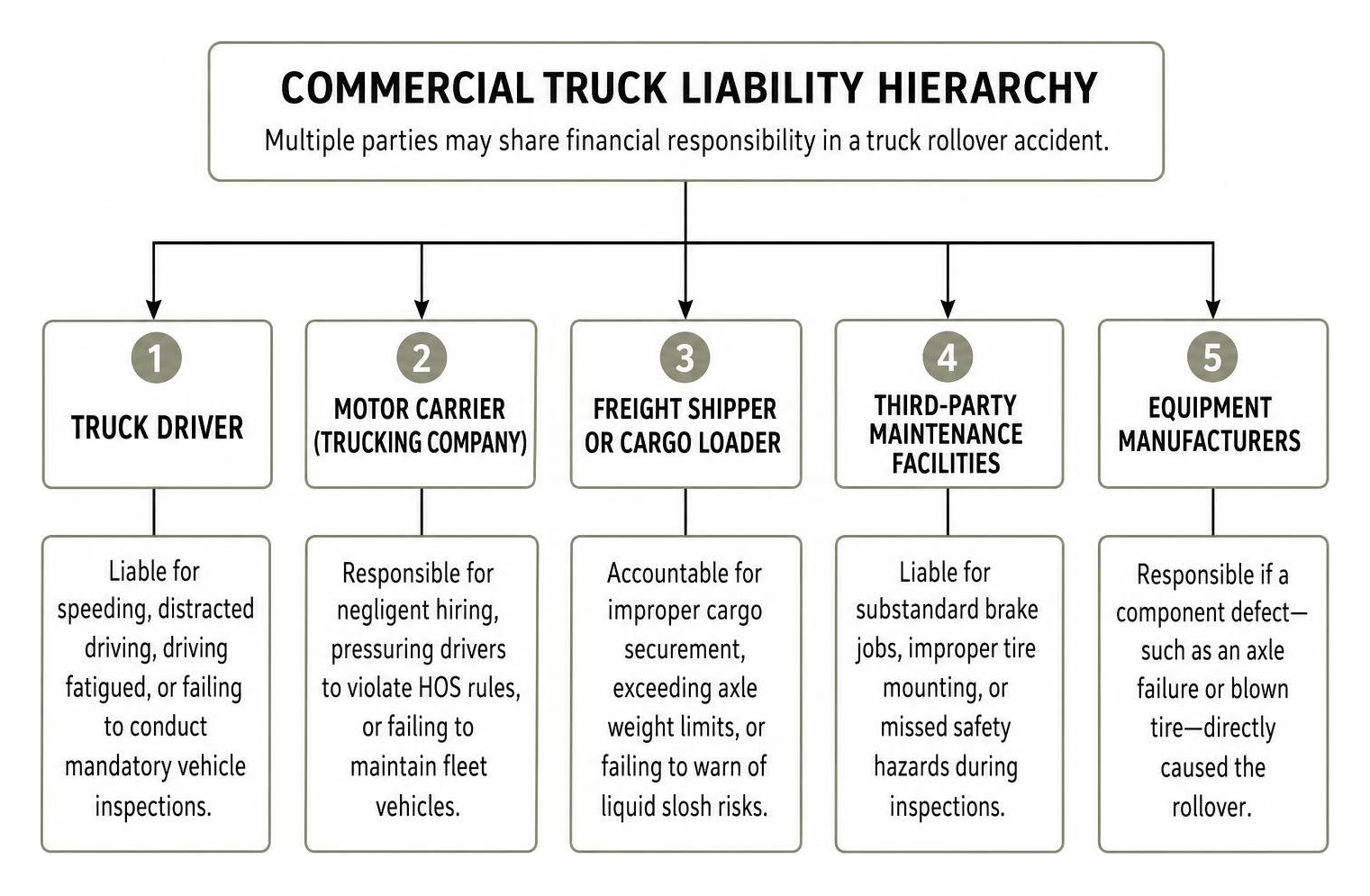
- The Truck Driver: Liable for speeding, distracted driving, driving fatigued, or failing to conduct mandatory vehicle inspections.
- The Motor Carrier (Trucking Company): Responsible for negligent hiring, pressuring drivers to violate HOS rules, or failing to maintain fleet vehicles.
- The Freight Shipper or Cargo Loader: Accountable for improper cargo securement, exceeding axle weight limits, or failing to warn of liquid slosh risks.
- Third-Party Maintenance Facilities: Liable for substandard brake jobs, improper tire mounting, or missed safety hazards during inspections.
- Equipment Manufacturers: Responsible if a component defect—such as an axle failure or blown tire—directly caused the rollover.
Investigating Evidence in a Houston Truck Rollover Accident
Securing critical crash evidence right away is essential. Commercial trucking companies dispatch rapid-response defense teams to accident scenes within hours to protect their bottom line. To build a strong case, your legal team must act quickly to preserve key evidence:
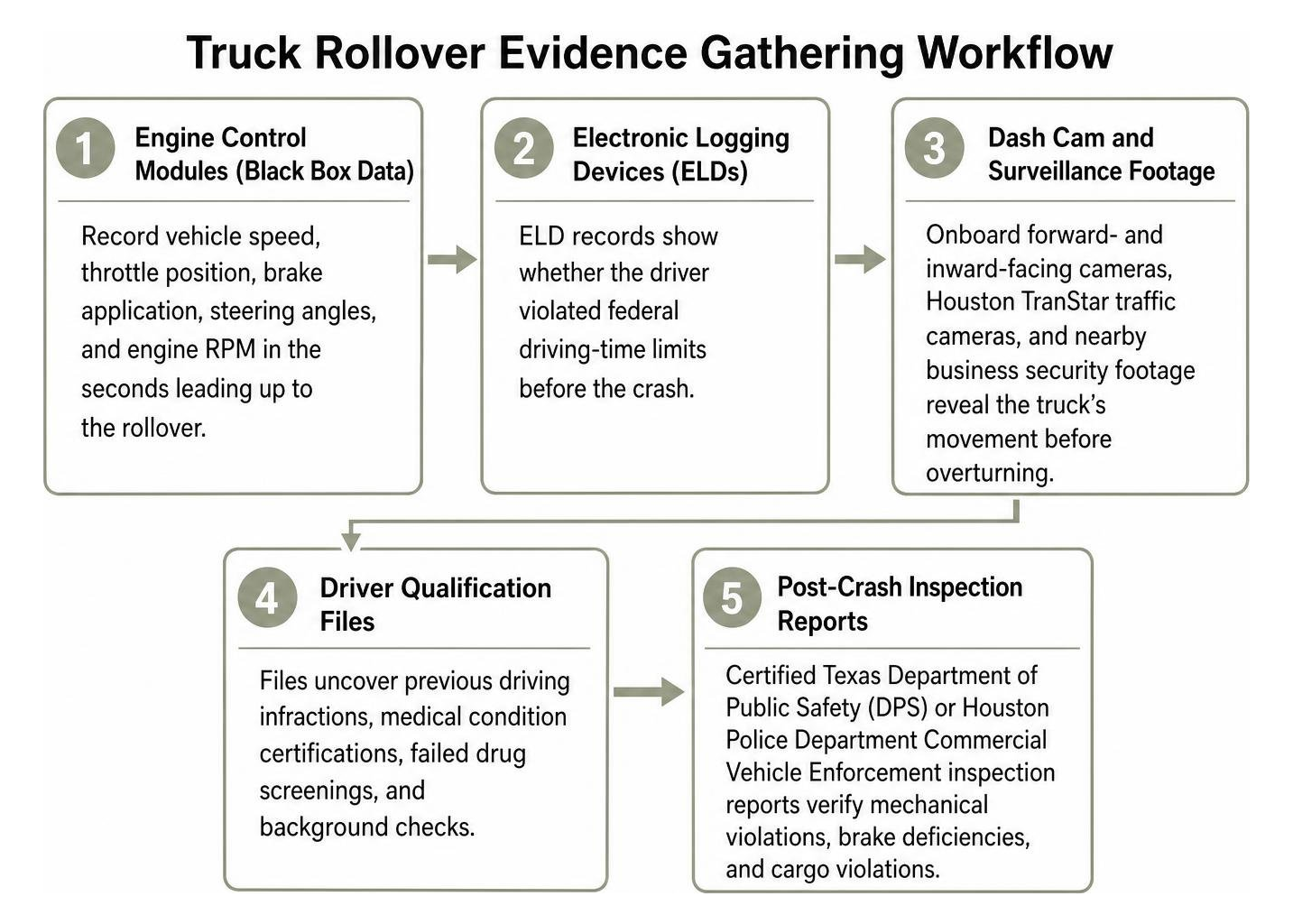
- Engine Control Modules (Black Box Data): Modern commercial trucks carry electronic control modules that record vehicle speed, throttle position, brake application, steering angles, and engine RPM in the seconds leading up to a wreck. Reviewing this electronic black box data provides objective proof of how the rollover started.
- Electronic Logging Devices (ELDs): ELD records show whether the driver violated federal driving-time limits before the crash.
- Dash Cam and Surveillance Footage: Onboard forward- and inward-facing cameras, Houston TranStar traffic cameras, and nearby business security footage can reveal the truck’s exact movement before overturning.
- Driver Qualification Files: These files uncover previous driving infractions, medical condition certifications, failed drug screenings, and background checks.
- Post-Crash Inspection Reports: Certified Texas Department of Public Safety (DPS) or Houston Police Department Commercial Vehicle Enforcement inspection reports verify mechanical violations, brake deficiencies, and cargo violations.
A formal spoliation letter must be sent immediately to the motor carrier and its insurers. This legal notice demands that the company preserve all electronic data, maintenance logs, and physical components, preventing them from destroying or altering vital evidence.
Recovering Compensation After a Houston Truck Rollover Accident
Securing a fair recovery requires identifying all available insurance coverage. Under Texas law, victims of truck rollovers can pursue both economic and non-economic damages to make them whole again. Comprehensive truck accident settlements typically account for:
- Past and Future Medical Expenses: Emergency room care, trauma surgeries, intensive care stays, physical therapy, prescription medications, and long-term in-home nursing support.
- Lost Income and Earning Capacity: Wages lost during recovery, as well as compensation for reduced future earning capacity if a disability prevents returning to your career.
- Property Damage: Complete vehicle replacement, personal belongings destroyed in the crash, and rental vehicle expenses.
- Physical Pain and Suffering: Compensation for physical agony, ongoing discomfort, and physical limitations caused by the trauma.
- Mental Anguish and Emotional Distress: Post-traumatic stress disorder (PTSD), anxiety, depression, insomnia, and the emotional impact of life-changing injuries.
- Physical Impairment and Disfigurement: Compensation for permanent scarring, limb loss, spinal cord damage, or reduced mobility.
In cases involving egregious misconduct—such as a carrier forcing a driver onto the road while knowing their brakes were completely worn, or an operator driving under the influence—Texas courts may also award exemplary (punitive) damages to punish the wrongdoer and deter similar conduct.
Safe Driving Around Commercial Rigs on Houston Freeways
While truck drivers and commercial carriers carry the primary duty to operate safely, passenger vehicle drivers can use defensive driving techniques to lower their risk of being caught in a catastrophic rollover.
Understanding what commercial operators can and cannot see is your first line of defense. Rigs have extensive blind spots—known as “No-Zones”—located directly in front of the cab, closely behind the trailer, and along both sides (especially the right side). When passing an 18-wheeler, make sure you can see the driver’s face in their side mirror; if you cannot see their mirror, they cannot see you.
Follow these key safety rules when driving near commercial trucks on Houston roads:
- Maintain a Generous Following Distance: Leave at least four to six seconds of following distance behind a semi-truck. This gives you time to react if the rig suddenly brakes or drops cargo.
- Never Linger in Blind Spots: Complete passes cleanly and promptly. Avoid cruising alongside an 18-wheeler’s trailer wheels, especially when approaching curved ramps or construction zones.
- Give Wide Clearance on Ramps and Turns: Big rigs often swing wide to the left before making a sharp right turn. Never try to squeeze into the open right lane beside a turning truck.
- Pass on the Left Side: A truck’s right-side blind spot extends across several lanes. Whenever possible, always pass on the driver’s left side.
- Avoid Cutting Off Heavy Trucks: Fully loaded tractor-trailers traveling at 65 mph need nearly two football fields to come to a complete stop. Never cut sharply into a truck’s forward safety cushion.
- Watch for Cargo Shifts on Flatbeds: If you notice an open flatbed carrying heavy steel coils, pipe loads, or lumber leaning unnaturally, increase your distance and change lanes safely.
If you encounter an erratic or dangerous commercial truck on highways like Beltway 8 or US-290, keep your distance and report the vehicle to local law enforcement by calling 911 when it is safe to do so.
Frequently Asked Questions About Commercial Truck Rollovers in Texas
What is the statute of limitations for filing a truck rollover claim in Texas?
Under Section 16.003 of the Texas Civil Practice and Remedies Code, the statute of limitations for personal injury and wrongful death lawsuits is generally two years from the date the accident happened. Failing to file your claim within this statutory window permanently bars your right to pursue financial recovery in court.
However, waiting until the deadline approaches can severely harm your case. Crucial digital evidence—such as black box recordings, ELD logs, and dash camera video—is routinely overwritten or erased under standard motor carrier record-retention policies. Contacting an attorney immediately after the accident ensures that preservation notices are issued before key proof is lost.
How does cargo shifting cause commercial 18-wheelers to overturn?
Cargo shifts cause rollovers by suddenly destabilizing a truck’s center of gravity. When freight inside a dry van or on a flatbed is improperly secured, blocked, or braced, normal transit maneuvers create dangerous momentum shifts:
When heavy freight slides toward the outer wall during a curve, the truck’s center of gravity moves outside the wheel track. This physical shift exerts tremendous torque on the tractor-trailer frame, pulling the entire vehicle onto its side even at moderate speeds.
What safety regulations exist to prevent commercial big rig rollovers?
Both federal and state governments enforce safety standards designed to reduce rollover accidents:
- Electronic Stability Control (FMVSS 136): Federal Motor Vehicle Safety Standard No. 136 mandates Electronic Stability Control (ESC) systems on truck-tractors and large buses. ESC automatically detects loss of steering control or rollover risk, applying individual wheel brakes and reducing engine torque to stabilize the rig.
- Cargo Securement Rules (49 CFR Part 393): Detailed FMCSA standards specify the minimum number of tiedowns, working load limits, and bracing techniques required for different cargo types.
- Pre-Trip Vehicle Inspections (49 CFR § 396.11): Commercial drivers must complete daily pre-trip and post-trip vehicle inspection reports to identify and repair critical safety defects in brakes, steering gear, tires, and coupling devices.
- Periodic Texas DPS Inspections: State troopers and municipal commercial vehicle enforcement units conduct random roadside North American Standard Inspections to pull unsafe, mechanically deficient trucks off the road.
Protecting Your Rights After a Commercial Rollover Crash
A commercial truck rollover turns an ordinary commute into a life-changing event. When motor carriers cut corners on maintenance, load freight carelessly, or push tired drivers beyond legal limits, innocent motorists pay the price. Rebuilding your health, dealing with mounting hospital bills, and managing everyday expenses requires seasoned legal guidance.
At Westloop Law Firm, we stand up for injured drivers and grieving families across the greater Houston area. Our combined focus in personal injury and probate law allows us to manage every legal detail—from accident reconstruction and corporate liability claims to complex estate and wrongful death matters. We uncover what went wrong, identify every liable party, and fight for the full compensation you need to heal.
If you or a loved one suffered injuries in a collision with an overturned tractor-trailer, do not face the insurance companies alone. Explore our comprehensive Houston truck accident lawyers guide or visit our main site at Westloop Law Firm to schedule a free, confidential consultation. Let us handle the legal heavy lifting so you can focus on your recovery.