 Skip to content
Why Electronic Logs Matter in a Houston Trucker Fatigue Claim
What to do first if you suspect driver fatigue:
- Get medical care and report the crash to police.
- Save photos, witness details, and anything you recall about the truck drifting or failing to brake.
- Contact a lawyer promptly to request that the carrier preserve the driver’s electronic logbook, dispatch messages, and GPS records.
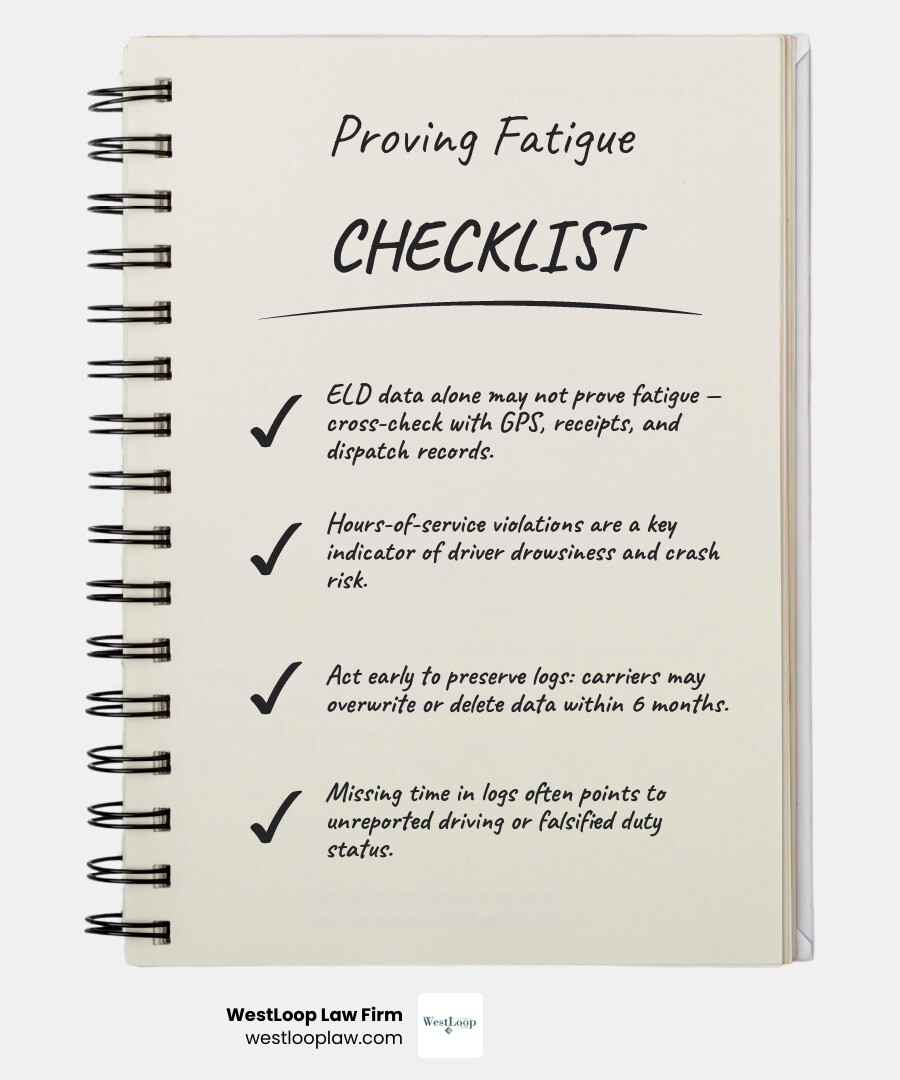
To file a Houston trucker fatigue claim, you must show that the driver or carrier acted carelessly and that this caused your injuries. Electronic logs can help establish when the driver was on duty and behind the wheel. But a log alone may not prove fatigue. Comparing it with GPS, receipts, and dispatch records can reveal missing driving hours or expose a critical trucking log book dispute. Working with a dedicated trucking regulations violation lawyer ensures you can cross-reference driver logs with trucking black box data before records are lost.
These records may not be kept indefinitely. Acting early gives you a better chance to preserve them before they are erased.
Federal Hours of Service Rules and Commercial Driver Fatigue in Houston
Houston is the energy capital of the world and one of the largest logistics hubs in North America. Day and night, heavy freight moves continuously across our major arteries, including Interstate 10, Interstate 45, Loop 610, and Beltway 8. Unfortunately, this constant flow of industrial commerce creates immense pressure on motor carriers and drivers to meet tight shipping deadlines.
The Texas Department of Transportation (TxDOT) reported over 6,300 commercial motor vehicle crashes in Harris County alone in a single recent year, resulting in dozens of deaths and thousands of life-altering injuries. Texas consistently records more fatal commercial vehicle wrecks than nearly any other state. National research cited by the National Transportation Safety Board (NTSB) reveals that operator fatigue is a primary factor in roughly one-third of all fatal commercial truck collisions.
To mitigate this danger, the Federal Motor Carrier Safety Administration (FMCSA) enforces strict Hours of Service (HOS) rules for interstate haulers. Texas also enforces state-specific rules for intrastate drivers who operate solely within state boundaries under the Texas Transportation Code.
A disproportionate share of fatal big rig collisions clusters between midnight and 6:00 a.m., when the human body experiences a natural circadian dip in alertness. When carriers push drivers past their legal shift limits, disastrous collisions on crowded highways like the North Freeway or Katy Freeway are the direct result.
| Rule Category | Federal Interstate Limit (FMCSA) | Texas Intrastate Limit (TXDOT) |
|---|---|---|
| Maximum Driving Window | Up to 11 hours after 10 consecutive hours off duty | Up to 12 hours after 8 consecutive hours off duty |
| Shift Duty Cap | Cannot drive past the 14th consecutive hour on duty | Cannot drive past the 15th consecutive hour on duty |
| Mandatory Rest Breaks | 30-minute break after 8 cumulative driving hours | No separate mandatory 30-minute break requirement |
| Weekly Driving Limit | 60 hours in 7 days or 70 hours in 8 days | 70 hours in 7 consecutive days |
| Cycle Restart | 34 consecutive hours off duty | 34 consecutive hours off duty |
Federal regulators can fine carriers up to $16,000 per HOS violation, yet many companies treat these fines as an ordinary cost of doing business. When these rules are ignored, working with a trucking regulations violation lawyer is essential to demonstrate how regulatory non-compliance caused your crash.
How HOS Violations and Microsleep Impair Big Rig Operators
Commercial motor vehicles can weigh up to 80,000 pounds. Operating a vehicle of that mass demands acute visual tracking, rapid spatial reasoning, and immediate reflexes. Sleep deprivation destroys these cognitive abilities.
Medical studies confirm that being awake for 18 consecutive hours produces cognitive and motor impairment equal to a Blood Alcohol Concentration (BAC) of 0.05%. Staying awake for 24 hours mimics a BAC of 0.10%—which exceeds the legal driving limit in all 50 states. Fatigued drivers suffer from:
- Tunnel Vision: An inability to scan side mirrors, monitor blind spots, or detect merging passenger cars on busy roads like Highway 290 or the Sam Houston Tollway.
- Delayed Braking Latency: Added seconds of perception and reaction time. At 65 mph, an 18-wheeler travels roughly 95 feet per second; a two-second delay adds nearly 200 feet to total stopping distance.
- Microsleep Episodes: Unintentional lapses into brief bouts of sleep lasting from 2 to 15 seconds. An 18-wheeler traveling at highway speeds during a four-second microsleep covers more than the length of an entire football field with no human control.
Drivers experiencing microsleep rarely engage the brakes before a collision. As a result, rear-end and underride collisions on local thoroughfares like the Eastex Freeway or the Southwest Freeway frequently happen without any skid marks left on the pavement.
Key Evidence in a Houston Trucker Fatigue Claim: ELD and Black Box Telematics

Proving driver fatigue requires hard, objective data. In the past, drivers recorded their duty statuses on paper logbooks, often called “comic books” in the industry because they were easily falsified. Today, the FMCSA mandates that commercial haulers use Electronic Logging Devices (ELDs) integrated directly into the truck’s engine control module (ECM).
An ELD records when the engine starts, vehicle speed, total engine hours, movement duration, and GPS coordinates. If a driver attempts to manipulate their rest breaks, comparing ELD time-stamps against trucking black box data and auxiliary telematics systems will expose discrepancies.
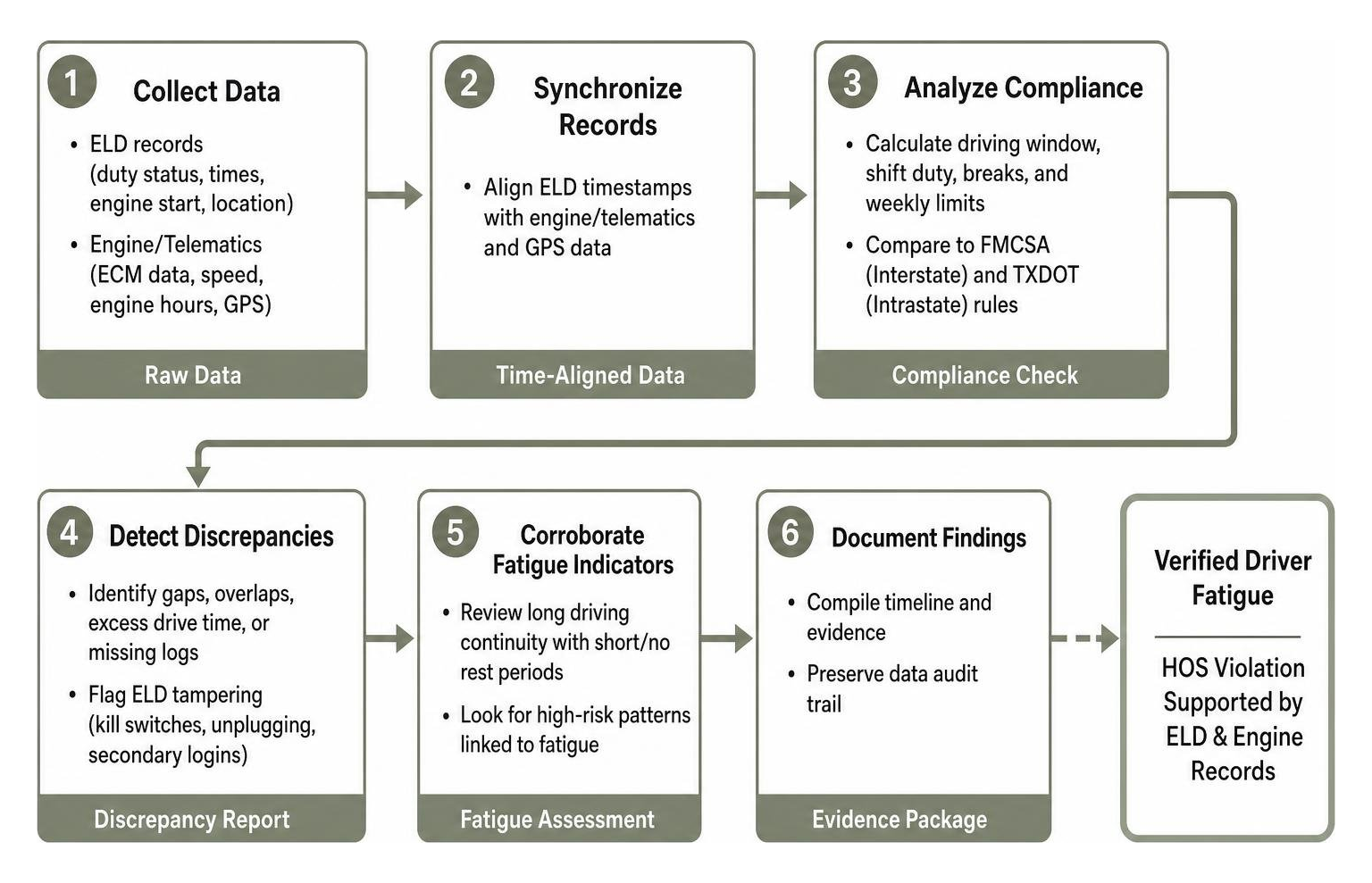
ELD data can still be compromised. Some operators use illicit software kill switches, unplug devices, or log in under secondary accounts to conceal unlawful driving time. Uncovering these deceptive practices demands a thorough review of the electronic audit trails embedded within the raw carrier data.
Establishing Liability in a Houston Trucker Fatigue Claim
Securing fair recovery under Texas personal injury law requires proving four core elements: duty of care, breach of duty, proximate causation, and measurable damages. All commercial drivers owe the motoring public a duty to operate their rigs safely and comply with safety regulations. Driving while dangerously exhausted or violating HOS rules constitutes a direct breach of that legal duty.
If you are navigating the aftermath of a catastrophic wreck, retaining a commercial truck accident lawyer in Houston allows you to immediately launch a comprehensive investigation into driver and motor carrier liability.
Holding the Truck Driver Accountable Under Texas Negligence Laws
When a tired driver causes an accident on a roadway like the Grand Parkway or Loop 610, they can be held individually liable for their negligence. Under the Texas Transportation Code, drivers are prohibited from operating vehicles at unreasonable speeds or in a reckless manner that endangers others.
Proving driver negligence involves analyzing:
- Pre-Crash Driving Patterns: Erratic lane departures, sudden swerving, or unexplained deceleration captured on surrounding traffic cameras or highway monitoring feeds.
- Post-Crash Admissions: Spontaneous statements made to responding Houston Police Department (HPD) officers or Harris County Sheriff’s deputies, such as admitting to falling asleep or driving for long stretches without rest.
- Logbook and HOS Discrepancies: Uncovering active trucking log book disputes where time cards, toll charges, and bill of lading signatures contradict the driver’s logged rest periods.
When driver impairment is demonstrated, the driver’s conduct establishes clear negligence under Texas common law.
Motor Carrier Responsibility and Respondeat Superior Claims
Truck drivers rarely operate in a vacuum; they work under the direct instructions of commercial motor carriers. Under the doctrine of respondeat superior (vicarious liability), an employer is held legally responsible for the wrongful or careless actions committed by its employees within the scope of their employment.
Texas Civil Practice and Remedies Code Section 72.054 governs actions involving commercial motor vehicle collisions, outlining requirements for holding trucking firms accountable. In addition to vicarious liability, carriers can be sued directly for independent acts of corporate negligence, including:
- Negligent Hiring: Retaining drivers with known histories of HOS violations, severe sleep apnea, or medical non-compliance.
- Coercive Scheduling: Forcing impossible delivery schedules that cannot be achieved without violating federal speed limits or mandatory off-duty rest breaks.
- Failure to Supervise and Audit: Failing to monitor ELD error reports, logbook discrepancies, and GPS alerts showing shift violations.
To learn more about holding motor carriers accountable for corporate wrongdoing, review our in-depth guide to Houston trucking firm negligence.
Critical Evidence and Overcoming Defense Tactics in Truck Crash Cases
Proving that a trucker fell asleep or was dangerously exhausted requires compiling multiple corroborating records. Commercial carriers rarely admit their driver was tired, which makes an independent evidentiary audit essential.
Key evidence needed to establish fatigue includes:
- ELD Audit Files: Raw background records that capture driver edits, manual duty-status overrides, and power disconnects.
- Engine Control Module (ECM) Downloads: Hard data detailing sudden stops, acceleration, steering inputs, and exact impact speed.
- Dispatch Communication Transcripts: Internal messages sent via dashboard fleet dispatch software, SMS, or dispatch calls showing delivery pressure.
- Toll and Weigh Station Records: Harris County Toll Road Authority (HCTRA) time stamps and TxDOT weigh-in-motion records that prove the truck was moving when the driver claimed to be off duty.
- Fuel and Lodging Receipts: Time-stamped credit card slips that contradict the driver’s recorded sleeper-berth hours.
- Cell Phone Call Logs: Call and data usage records proving the driver was awake during scheduled sleeper-berth off-duty windows.
- Driver Qualification Files: Medical certifications, sleep apnea screening reports, and prior disciplinary warnings.
Overcoming Defense Tactics in a Houston Trucker Fatigue Claim
Defense teams and their commercial insurance adjusters work quickly to minimize financial liability. Some common defense arguments include:
- The Unavoidable Accident Defense: The carrier may claim an unexpected mechanical failure, sudden phantom vehicle, or unforecasted weather event caused the crash. We counter this by analyzing ECM data and local atmospheric records to demonstrate that driver reaction latency was the real cause.
- Comparative Fault Accusations: Texas applies a modified comparative fault rule with a 51% bar under Texas Civil Practice and Remedies Code Chapter 33. If the defense can assign 51% or more of the blame to you, you are barred from recovering any damages. If your share of fault is 50% or less, your recovery is reduced by your percentage of responsibility. Carriers often claim the injured driver merged abruptly or braked without cause to shift blame.
- Hiding Internal Edits: Defense counsel may produce high-level ELD summaries that look compliant on the surface. We review the raw metadata files to expose unassigned driving time and administrative edits made by dispatchers.
Essential Steps to Prevent Spoliation and Preserve Logbook Data
Under FMCSA regulations, motor carriers are only legally required to retain ELD records and supporting documents for six months. Routine electronic data overwrites on engine black boxes can happen within 30 days or after the truck is driven for a few hundred miles following the wreck.
To protect this vital information from being erased, your legal team must immediately send a formal Spoliation of Evidence Letter to the motor carrier, its insurance underwriters, and its maintenance vendors. This legal demand requires them to preserve:
- Raw ELD files, server data, and audit tracking histories.
- ECM crash-data downloads and black-box memory units.
- Dashcam footage, fleet telematics, and in-cab driver monitoring video.
- Dispatch audio logs, fleet messaging records, and load tracking updates.
- The physical condition of the tractor and trailer before repairs or salvage occur.
If a motor carrier destroys or alters these records after receiving a spoliation notice, Texas courts can sanction the defense. Penalties may include striking their defenses or instructing the jury to presume that the missing evidence would have proven the carrier was at fault.
Compensation, Deadlines, and What to Do After a Severe Collision
Fatigue-related commercial truck collisions frequently cause life-altering harm, including traumatic brain injuries, spinal cord damage, severe burns, and compound fractures. Injured victims have the right to seek comprehensive financial compensation for both economic and non-economic losses.
For a deeper look into the costs associated with recovery, read our practical guide on paying truck accident medical bills.
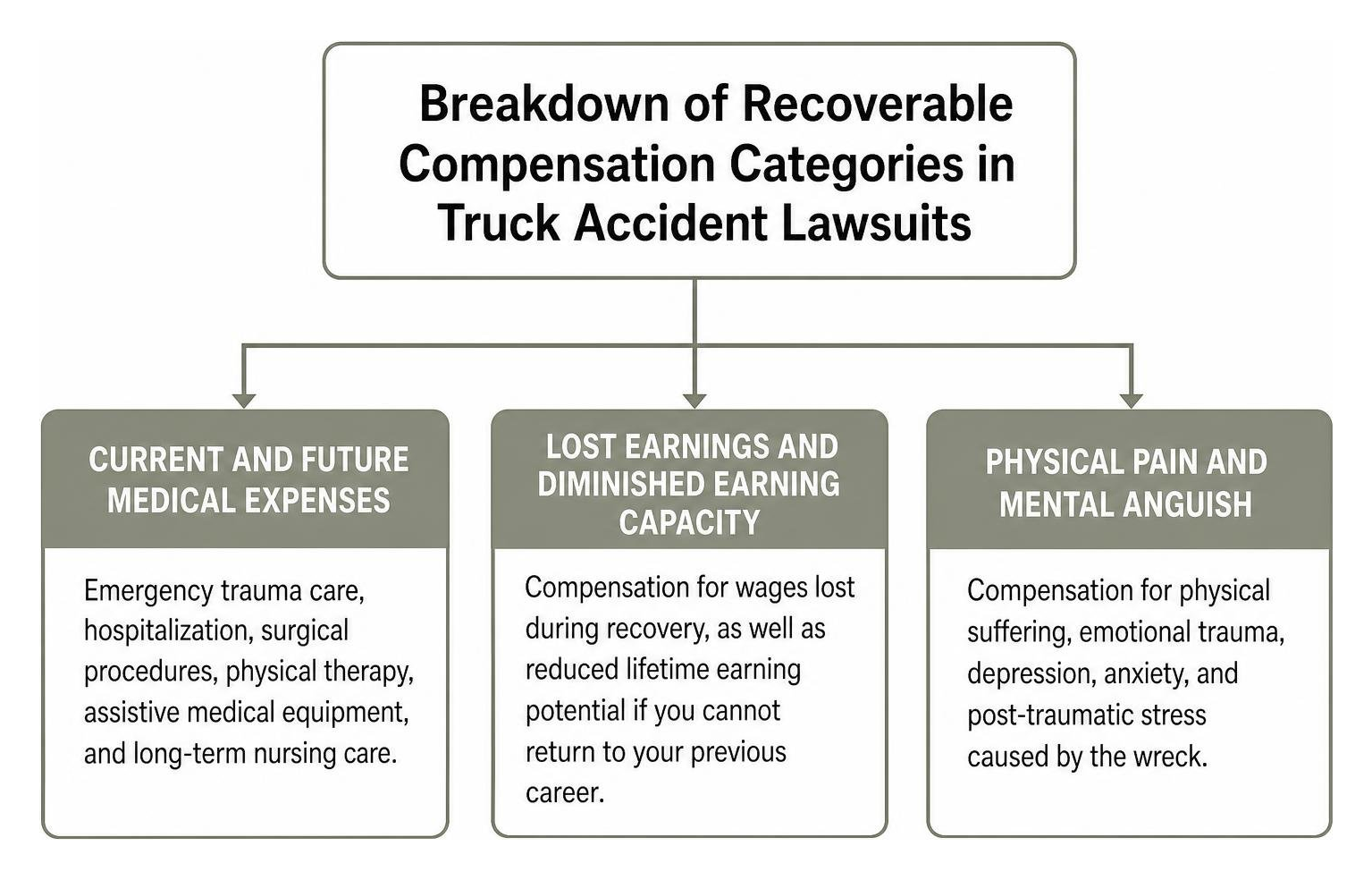
Recoverable damages typically include:
- Current and Future Medical Expenses: Emergency trauma care, hospitalization at facilities such as Memorial Hermann or Ben Taub, surgical procedures, physical therapy, assistive medical equipment, and long-term nursing care.
- Lost Earnings and Diminished Earning Capacity: Compensation for wages lost during recovery, as well as reduced lifetime earning potential if you cannot return to your previous career.
- Physical Pain and Mental Anguish: Compensation for physical suffering, emotional trauma, depression, anxiety, and post-traumatic stress caused by the wreck.
- Physical Impairment and Disfigurement: Damages for permanent disability, loss of mobility, scarring, or loss of limbs.
- Property Loss: Repair or total replacement value of your motor vehicle and personal property destroyed in the crash.
- Wrongful Death and Survival Damages: Surviving family members can recover funeral costs, lost financial support, and compensation for the loss of companionship when a collision proves fatal.
In cases involving gross negligence—such as a carrier forcing a driver to continue operating after 20 continuous hours on duty—Texas courts may also award exemplary (punitive) damages to punish the wrongdoer and deter similar conduct.
Recoverable Damages and the Texas Statute of Limitations
Under Texas Civil Practice and Remedies Code Section 16.003, the statute of limitations for personal injury and wrongful death lawsuits is two years from the date the crash occurred.
Failing to file your lawsuit in an appropriate court, such as the Harris County Civil Courts at Law or the Harris County District Court, before this statutory window closes will permanently bar you from recovering compensation. While two years may sound like plenty of time, essential evidence like ELD logs, black box data, and video footage can disappear within weeks.
You should also review your own auto insurance policy for first-party coverage options. In Texas, all personal auto policies include Personal Injury Protection (PIP) unless you specifically declined it in writing. PIP provides immediate financial relief for medical bills and 80% of lost income regardless of who caused the collision, helping you stay afloat while your liability claim progresses against the commercial motor carrier.
Immediate Actions to Protect Your Legal Rights After an 18-Wheeler Wreck
The steps you take immediately following a truck collision play a significant role in protecting both your health and your legal claim. Learn more about what to do if you are hit by a truck in Houston, TX by following these critical priorities:
- Call 911 and Request Emergency Assistance: Ensure law enforcement officers from HPD, the Harris County Sheriff’s Office, or the Texas Department of Public Safety respond to secure the scene, perform field investigations, and draft an official Texas Peace Officer’s Crash Report (CR-3).
- Seek Immediate Medical Attention: Go directly to an emergency department or urgent care facility. High adrenaline can mask serious internal trauma, head injuries, and spinal damage. Prompt medical evaluations create a direct, timely link between the crash and your physical injuries.
- Capture Scene Evidence: If safe to do so, use your smartphone to take photos and video of vehicle damage, overall road layouts, debris fields, road surface conditions, skid marks, commercial carrier USDOT placards, and visible injuries.
- Identify Witnesses: Collect names, telephone numbers, and addresses of all eyewitnesses before they leave the crash site.
- Do Not Give Recorded Statements to Carrier Adjusters: Commercial claims adjusters represent the trucking company’s interests, not yours. Politely decline to provide recorded statements or sign medical authorizations until you have retained legal counsel.
- Consult a Qualified Legal Team Promptly: Reach out to Westloop Law Firm as soon as possible so we can file an immediate spoliation notice to secure all ELD data, ECM logs, and fleet communications.
Frequently Asked Questions About Houston Truck Driver Fatigue
How many consecutive hours can a commercial truck driver legally operate in Texas?
Under federal regulations governing interstate commerce, a driver may operate for a maximum of 11 cumulative hours following 10 consecutive hours off duty. The driver cannot drive past the 14th consecutive hour after coming on duty, regardless of rest breaks taken in between. Drivers must also take a mandatory 30-minute uninterrupted rest break after every 8 hours of cumulative driving. For intrastate travel entirely within Texas, state law allows up to 12 hours of driving within a 15-hour on-duty window after 8 consecutive hours of rest.
Can a trucking company be held liable if a driver secretly falsified their logbooks?
Yes. Motor carriers have a non-delegable duty under both federal and state law to monitor, audit, and verify the accuracy of their drivers’ logbooks and duty statuses. If the trucking company failed to cross-reference electronic logs with GPS records, toll charges, fuel purchases, and delivery bills of lading, it can be held directly liable for negligent supervision and retention. If company dispatchers created schedules that implicitly forced the driver to falsify logs to make on-time deliveries, the carrier is directly responsible for that misconduct.
What is the deadline to file a fatigue-related commercial truck injury claim in Texas?
In Texas, the statute of limitations for personal injury and wrongful death lawsuits is two years from the exact date of the accident under Texas Civil Practice and Remedies Code Section 16.003. If you miss this deadline, Texas courts will dismiss your lawsuit with prejudice. You should act much sooner than two years, because electronic logging data and black box crash files are frequently purged by carriers within six months if a formal legal hold is not placed on the evidence.
Protect Your Rights with Westloop Law Firm
When commercial trucking companies cut corners on safety rules and push exhausted drivers onto Houston’s crowded freeways, innocent motorists pay the price. Proving driver fatigue requires extensive resources, deep knowledge of federal safety mandates, and immediate action to preserve electronic logbooks and telematics data before it is lost or destroyed.
Westloop Law Firm provides aggressive, compassionate representation for individuals and families across Harris County and throughout the greater Houston area. We handle personal injury claims and complex probate litigation, helping you secure full financial recovery while holding reckless motor carriers accountable for the harm they cause.
To explore all aspects of commercial vehicle litigation and learn how our team builds an ironclad case on your behalf, explore our ultimate guide to Houston truck accident lawyers. Contact our Houston legal team today to discuss your case and take the first step toward getting the justice and financial recovery you deserve.