 Skip to content

How to Prove Truck Driver Negligence in Houston
What to do first
- Get medical care and keep records of your injuries, bills, and missed work.
- Save photos, witness names, the crash report, and any details about the truck or driver. Trucking records and electronic data may be important evidence.
- Identify what the driver did wrong and how it caused your injury. A claim needs proof of a duty of care, a breach of that duty, a link to the harm, and damages.
Fatigue, distraction, and failure to watch for people nearby can all support a negligence claim. A trucking company may also be liable if the driver was working at the time or the company’s own conduct contributed to the crash. A serious injury alone does not prove fault; the evidence must connect the unsafe act to the harm. When truck driver negligence in Houston causes a collision, the injured person must show how the driver’s specific breach led to the losses claimed.
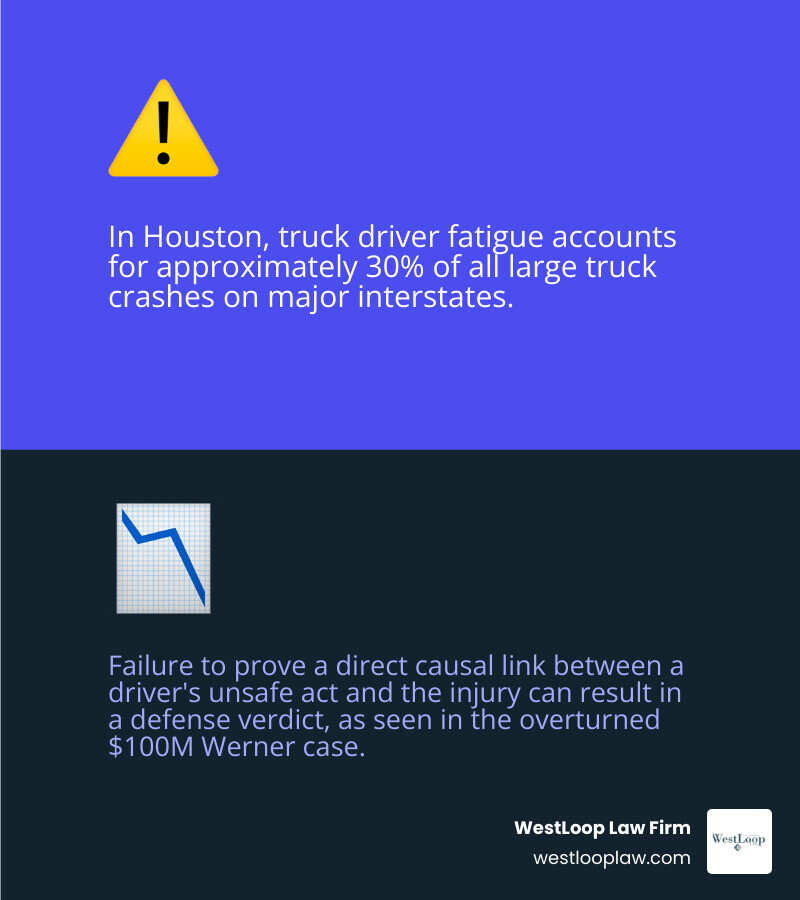
Truck driver negligence Houston terms simplified:
- Unsafe hiring or supervision can support a Houston trucking negligence claim.
- Driver exhaustion may be central to a Houston trucker fatigue claim.
- Violations of trucking regulations can help prove breach of duty.
Legal Grounds for Proving Truck Driver Negligence Houston Claims
Navigating the aftermath of a major commercial collision on busy thoroughfares like Loop 610, I-10, or Beltway 8 requires a thorough understanding of Texas civil law. To recover damages in Harris County Civil Courts at Law or Texas District Courts, an injured claimant must demonstrate the four pillars of a tort claim: duty, breach, causation, and damages.
- Duty of Care: Commercial motor vehicle operators must exercise reasonable care and follow all state traffic laws and Federal Motor Carrier Safety Regulations (FMCSRs).
- Breach of Duty: The driver failed to meet that standard through reckless actions, traffic violations, or regulatory noncompliance.
- Causation: The driver’s breach directly brought about the wreck (cause in fact) and the injury was a foreseeable outcome (proximate cause).
- Damages: The victim suffered actual physical, financial, or emotional losses.
Commercial drivers are held to demanding legal safety standards due to the sheer size and weight of an 80,000-pound rig. Investigating these claims involves reviewing the operator’s qualification file, safety record, and background for known safety issues. Identifying these issues early is vital, as shown in our review of 5 common causes of truck accidents.
How Truck Driver Negligence Houston Lawsuits Establish Duty and Breach
Proving that a commercial driver breached their legal duty involves comparing physical evidence against state statutes and federal safety mandates. Common forms of breach include:
- Exceeding statutory driving time limits without mandatory rest periods.
- Distracted driving, including illegal texting or mobile device use. Our guide to commercial truck texting explains the legal consequences in Houston.
- Operating at unsafe speeds during adverse weather, heavy traffic, or construction bottlenecks along I-45.
- Failing to perform pre-trip brake, tire, and steering inspections.
A clear example of a statutory breach occurred in the fatal collision involving Montgomery County Deputy Erika Serrato. A wrongful death lawsuit was filed after a commercial driver traveling around 65 mph allegedly fell asleep, failed to see emergency lights, and crashed into the officer’s scene, as detailed in the Serrato wrongful death lawsuit on I-45.
Under the Texas “Move Over or Slow Down” law (Texas Transportation Code § 545.157), drivers approaching stationary emergency vehicles with flashing lights must either vacate the adjacent lane or drop their speed to 20 mph below the posted speed limit. Violating this law demonstrates negligence per se, establishing an unexcused breach of safety statutes designed to protect first responders and highway workers.
Proving Proximate Cause and Distinguishing Direct Fault
Establishing a breach is only part of the equation; Texas law demands clear proof of proximate causation. The plaintiff must show that the collision would not have occurred “but for” the truck driver’s conduct, and that the resulting harm was a foreseeable consequence.
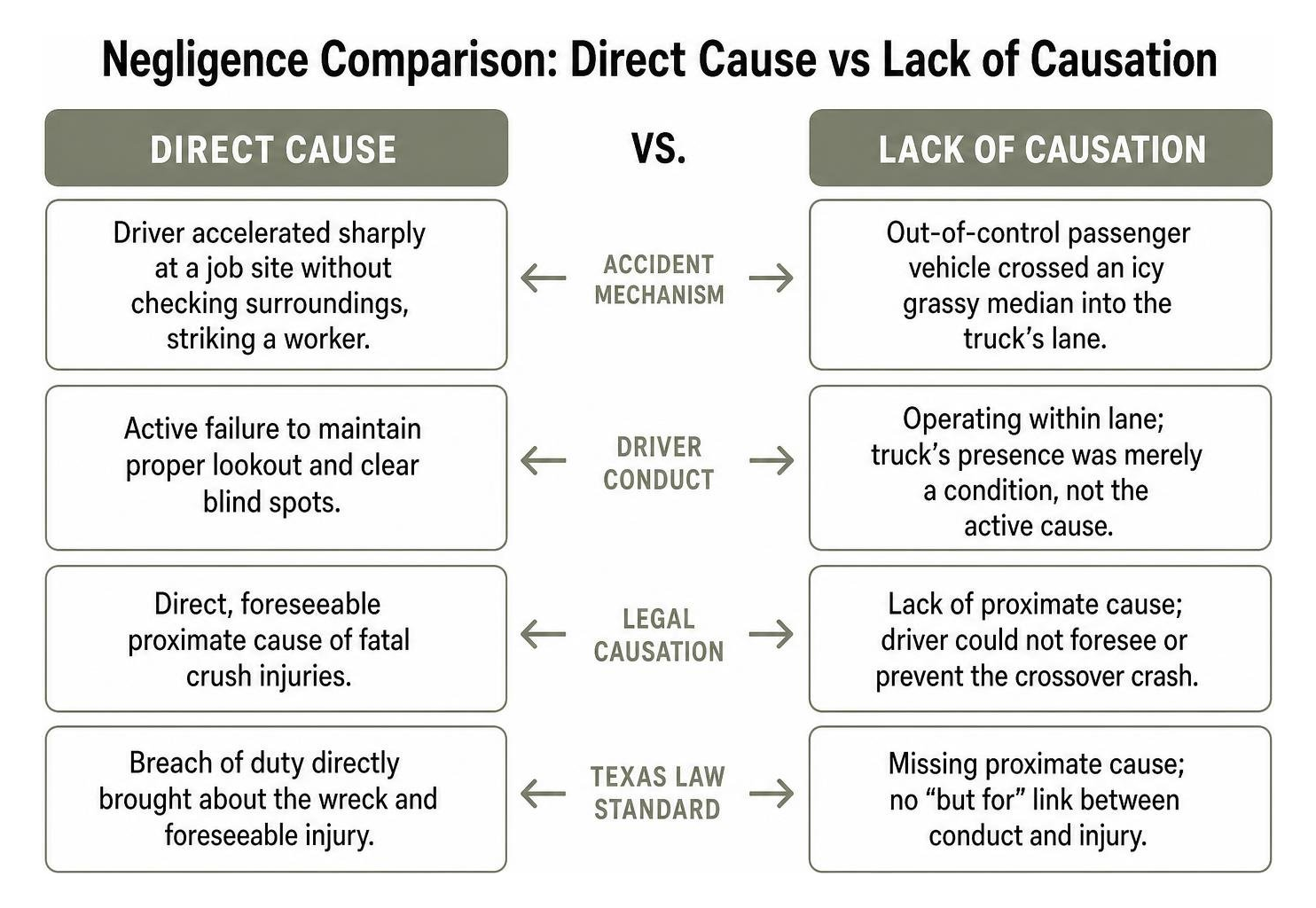
| Case Element | Andrew West Wrongful Death Case | Werner Enterprises Supreme Court Reversal |
|---|---|---|
| Accident Mechanism | Driver accelerated sharply at a job site without checking surroundings, striking a worker. | Out-of-control passenger vehicle crossed an icy grassy median into the truck’s lane. |
| Driver Conduct | Active failure to maintain proper lookout and clear blind spots. | Operating within lane; truck’s presence was merely a condition, not the active cause. |
| Legal Causation | Direct, foreseeable proximate cause of fatal crush injuries. | Lack of proximate cause; driver could not foresee or prevent the crossover crash. |
| Jury / Court Outcome | $46 million verdict affirmed against driver (90%) and carrier (10%). | Texas Supreme Court reversed the $100M verdict, finding no actionable negligence. |
The distinction between active fault and mere road presence is illustrated in the Werner Enterprises $100M verdict reversal. In that ruling, the Texas Supreme Court emphasized that an 18-wheeler being present on a highway when an out-of-control vehicle crosses a median does not create proximate causation without an independent act of negligence.
To prove liability, claimants must retrieve digital evidence before it is overwritten. Utilizing trucking black box data from the Electronic Control Module (ECM) reveals crucial metrics such as vehicle speed, braking applications, throttle position, and steering angles in the seconds leading to impact.
Corporate Liability and Motor Carrier Fault in Commercial Crashes
Trucking companies bear direct legal obligations to keep roadways safe. When an employee injures someone while on the job, the company faces liability under both vicarious liability principles and direct corporate negligence.

Under the common-law doctrine of respondeat superior, an employer is held vicariously liable for the negligent actions of its employee if the conduct occurred within the course and scope of employment. Claimants can also pursue direct claims against motor carriers for their own administrative and operational failures.
Holding Motor Carriers Liable for Truck Driver Negligence Houston Collisions
Direct carrier liability arises when a fleet operator disregards basic safety screening and fleet oversight obligations:
- Negligent Hiring: Failing to check a driver’s prior motor vehicle record, past crashes, license suspensions, or positive drug screens.
- Negligent Entrustment: Handing over a commercial vehicle to an operator the company knew, or should have known, was reckless or unqualified.
- Negligent Training and Supervision: Failing to ensure drivers understand hours-of-service limits, hazardous weather driving, and cargo security.
- Falsification of Records: Overlooking altered Electronic Logging Devices (ELDs) or encouraging drivers to exceed federally mandated drive-time ceilings.
Resolving these claims often involves uncovering trucking log book disputes to demonstrate that a company pushed its driver beyond safe limits. Uncovering electronic data is crucial, as establishing a Houston trucker fatigue claim requires reconciling GPS pings, fuel receipts, toll plaza records, and electronic logs.
Navigating Parallel Criminal Charges and Motions to Stay
When a driver’s conduct involves severe recklessness, criminal charges may arise alongside civil lawsuits. A prominent example occurred in Harris County when a trucker faced felony charges for assault with a deadly weapon after repeatedly swerving into highway traffic and striking a commuter vehicle.
In the federal court proceeding Quintanilla v. Brown, the United States District Court for the Southern District of Texas evaluated whether to pause (stay) the civil personal injury lawsuit while the driver’s criminal prosecution unfolded.
Federal judges in the Southern District of Texas apply a six-factor balancing test when ruling on motions to stay:
- The extent to which issues in the criminal and civil cases overlap.
- The current status of the criminal case (such as whether an indictment has been issued).
- The plaintiff’s interest in proceeding quickly versus potential prejudice caused by delay.
- The burden on the defendant if forced to choose between asserting Fifth Amendment rights or defending the civil claim.
- The convenience and efficiency of the court.
- The overarching public interest.
While a stay pauses active depositions of the defendant driver, it protects the integrity of the evidence. A criminal conviction can later serve as strong evidence of liability in the civil proceeding, strengthening the injured party’s claim for damages.
Calculating Damages and Maximizing Compensation in Serious Wrecks
Texas law allows injured victims and surviving family members to pursue economic and non-economic damages to address their losses.
- Economic Damages:
- Past and future medical bills, surgical interventions, and physical therapy.
- Lost income, loss of earning capacity, and vocational retraining.
- Property damage and out-of-pocket transportation costs.
- Non-Economic Damages:
- Physical pain and suffering.
- Mental anguish and emotional trauma.
- Physical impairment, scarring, and loss of enjoyment of life.
- Loss of companionship, society, and consortium in wrongful death claims.
These damages were illustrated in a significant Texas trial where a jury delivered a $46 million verdict against an at-fault driver (found 90% responsible) and his employer (10% responsible). As reported in the Hays County $46 million wrongful death verdict, the jury awarded $20 million for conscious pain and mental anguish, along with $13 million to each surviving parent for loss of companionship and society. To evaluate your potential claim value, explore our guide on recovering commercial vehicle collision damages.
Understanding Key Texas Legal Doctrines
- Personal Injury Protection (PIP): Texas auto insurance policies include PIP coverage unless explicitly rejected in writing. PIP provides prompt, no-fault compensation for immediate medical expenses and a portion of lost wages, assisting with financial needs while your third-party liability lawsuit progresses.
- The 51% Modified Comparative-Fault Bar: Under Texas Civil Practice and Remedies Code Chapter 33, an injured claimant can recover damages as long as their share of responsibility does not exceed 50%. If you are determined to be 20% responsible for a collision on the Southwest Freeway, your total financial recovery is reduced by 20%. If your fault reaches 51% or higher, Texas law bars any recovery from the other parties.
- Two-Year Statute of Limitations: Texas Civil Practice and Remedies Code § 16.003 requires that personal injury and wrongful death lawsuits be filed within two years from the date the crash occurred. Failing to meet this statutory window forfeits your right to seek financial recovery in a Texas court.
Step-by-Step Actions to Build an Unassailable Injury Claim
Building a strong commercial collision claim requires prompt action to preserve physical and digital evidence before motor carriers and their insurers attempt to minimize their liability.
- Obtain Immediate Emergency Care: Seek treatment from regional trauma centers such as Memorial Hermann-Texas Medical Center, Ben Taub Hospital, or Houston Methodist. Retain copies of admission charts, radiology scans, and treatment plans.
- File an Official Crash Report: Ensure the Houston Police Department, Harris County Sheriff’s Office, or Texas Department of Public Safety files a Texas Peace Officer’s Crash Report (Form CR-3).
- Issue Formal Spoliation Letters: Have your attorney send formal preservation notices instructing the motor carrier to secure dashcam footage, ECM black box data, ELD driving records, dispatch logs, and cell phone records.
- Identify Safety Violations: Review the driver’s history alongside an attorney handling federal trucking regulations violations to uncover hours-of-service breaches or maintenance noncompliance.
- Analyze Local Court Realities: Commercial injury claims filed in Houston require an understanding of local juries and court procedures. Our discussion of Harris County commercial crash cases explains how local court dynamics can affect these lawsuits.
Frequently Asked Questions about Truck Driver Negligence in Houston
What is the Move Over or Slow Down law in Texas truck accident claims?
Texas Transportation Code § 545.157 mandates that when drivers approach stopped emergency vehicles, tow trucks, TxDOT vehicles, or construction crews with flashing hazard lights, they must vacate the adjacent lane on multi-lane highways. If changing lanes is unsafe, drivers must reduce their speed to 20 mph below the posted speed limit (or 5 mph if the limit is under 25 mph). Failing to follow this statute constitutes negligence per se in a personal injury or wrongful death lawsuit.
How does a driver’s criminal indictment affect a civil truck crash lawsuit?
When a commercial driver faces criminal charges (such as felony assault with a deadly weapon or intoxication assault), the civil court may temporarily stay the injury lawsuit under a federal six-factor balancing test. While this pauses depositions to respect Fifth Amendment protections, physical evidence and corporate documents remain preserved. If the driver is convicted, that outcome helps establish negligence in the civil action.
Why did the Texas Supreme Court overturn the $100 million Werner Enterprises verdict?
The Texas Supreme Court overturned the verdict because the plaintiff failed to establish proximate causation against the motor carrier. In that case, another vehicle lost control on an icy highway, crossed the median, and collided with the commercial truck. The court determined that the commercial driver’s lawful presence on the roadway did not cause the collision, affirming that an unbroken causal connection must link a driver’s specific breach to the injuries sustained.
Holding Reckless Commercial Drivers and Trucking Companies Accountable
When an 18-wheeler causes a devastating collision on Houston highways, injured victims and grieving families face steep medical bills, extensive recovery periods, and complex corporate defenses. Recovering full compensation requires prompt action to hold negligent drivers and their employers accountable under Texas law.
At Westloop Law Firm, our team combines extensive trial experience in personal injury and probate law to protect our clients’ rights, preserve vital electronic evidence, and pursue justice in Harris County courts. For an in-depth breakdown of your legal options following a commercial crash, consult our ultimate guide to Houston truck accident representation. Contact Westloop Law Firm today to protect your claim and pursue the compensation you deserve.