 Skip to content
Estate Planning Attorney Houston Texas: 7 Essential Steps
Why Every Houston Family Needs an Estate Plan
An estate planning attorney houston texas helps you create legal documents that protect your assets, designate guardians for your children, and ensure your wishes are honored if you become incapacitated or pass away. Here’s what you need to know:
Key Services an Estate Planning Attorney Provides:
- Draft wills and trusts to distribute your property
- Create powers of attorney for financial and medical decisions
- Establish advance directives for end-of-life care
- Steer Texas probate laws and Harris County court processes
- Minimize taxes and protect assets from creditors
- Plan for business succession and special needs trusts
Why Houston Residents Need Estate Planning:
- Texas intestacy laws decide who gets your property if you die without a will
- Community property rules affect married couples differently than other states
- Avoiding probate saves your family time and money at Harris County Civil Courthouse
- Protecting minor children by naming guardians in legal documents
Life is unpredictable. Without an estate plan, the State of Texas makes decisions about your property, your children, and your healthcare. A comprehensive plan gives you control and spares your family from stress during difficult times.
Whether you’re a business owner on the Katy Freeway, raising a family in The Woodlands, or planning for retirement near Memorial Hermann Hospital, estate planning ensures your legacy reflects your values and protects the people you love.
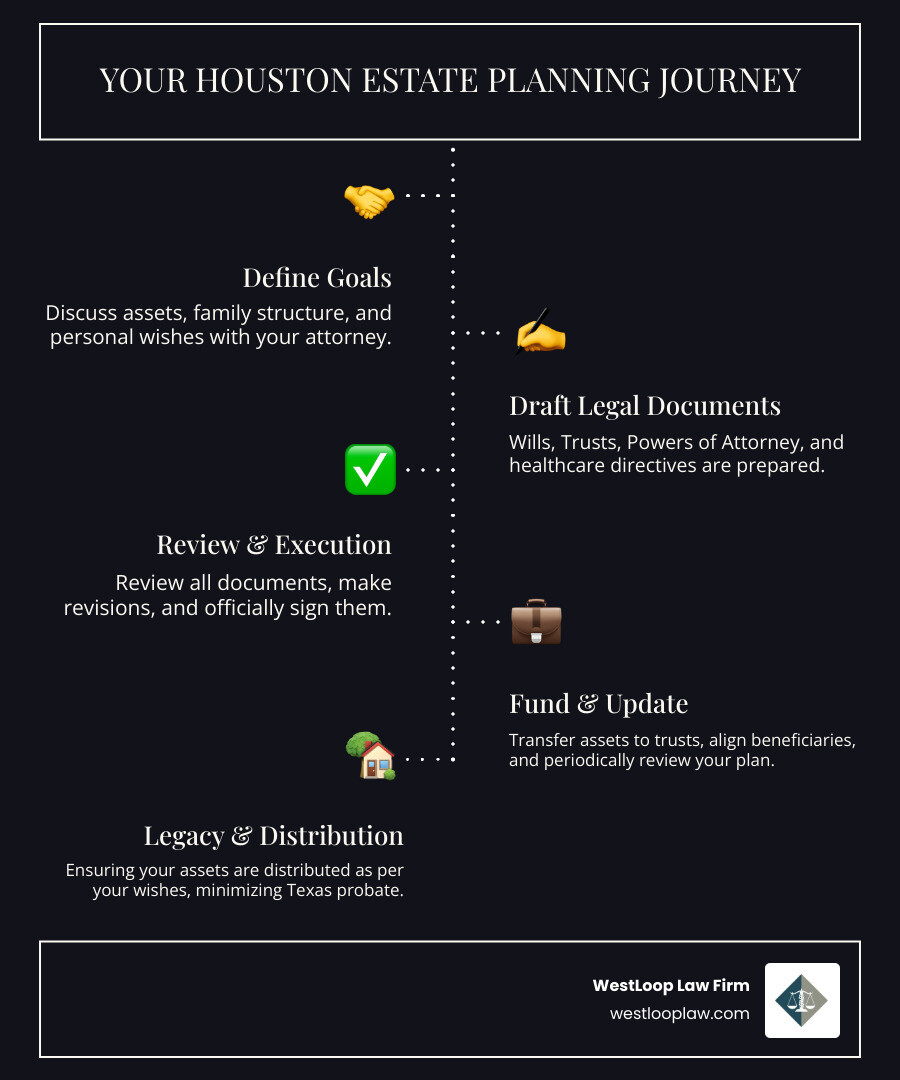
Simple guide to estate planning attorney houston texas terms:
What is Estate Planning and Why is it Crucial for Houstonians?
Estate planning is the process of identifying your long-term goals regarding your health, finances, and decision-making, and then implementing a series of plans to accomplish them. It’s not merely about what happens after you pass away; it’s about securing your future and providing peace of mind for you and your loved ones in Houston, Texas. A well-crafted estate plan ensures your assets are protected, your family is secure, and your wishes are respected, regardless of life’s uncertainties.
For Houstonians, understanding the nuances of Texas law is particularly important. Texas is a community property state, meaning that assets acquired during a marriage are generally considered jointly owned by both spouses. This can significantly impact how your property is distributed if you don’t have a clear plan. Without an estate plan, your family could face the lengthy and often costly process of probate court, where the state’s rigid intestacy laws dictate who inherits your property.
Beyond asset distribution, estate planning also addresses incapacity planning. What happens if you become unable to make decisions for yourself due due to illness or injury? A solid plan ensures that trusted individuals are in place to manage your finances and make healthcare choices on your behalf. If you have minor children, an estate planning attorney houston texas can help you formally designate guardians, ensuring their care aligns with your values. For more insights into how we help protect family futures through thoughtful planning, you can read more about Protecting Family Future of Estate Planning.
The Consequences of No Plan in Texas
Imagine a situation where you or a loved one in Houston passes away without a will or any estate plan in place. This is where Texas intestacy laws step in, and they might not align with what you would have wanted. If you die intestate, the state decides who inherits your property, not you. This often leads to state intervention and the appointment of court-selected administrators, which can be a source of significant stress and conflict for your grieving family.
The Harris County probate process, while necessary in the absence of proper planning, can be lengthy, expensive, and emotionally draining. Your family might face delays in accessing assets, mounting legal fees, and potential disputes over inheritances. These are precisely the “unfortunate circumstances” that proper estate planning aims to prevent. We want to help you avoid these pitfalls. For a deeper dive into common errors and how to steer clear of them, explore our guide on Houston Estate Planning Mistakes to Avoid.
Planning for Your Unique Houston Life

Houston is a vibrant, diverse city, and your estate plan should reflect your unique life and circumstances. What works for one family might not suit another. For instance, high-net-worth individuals in areas like River Oaks or those with significant business interests along the Katy Freeway corridor often require sophisticated strategies for wealth preservation and tax minimization.
Blended families, common in communities like The Woodlands or Pearland, have distinct needs to ensure all children from previous relationships are provided for fairly and lovingly. We can assist with these unique family dynamics. Find more information about Estate Planning for Blended Families. Similarly, LGBTQ+ couples in Houston benefit immensely from clear estate planning documents that affirm their relationships and wishes, especially where traditional legal frameworks might not fully recognize their partnerships. Learn more about Estate Planning for LGBTQ+ Couples.
Our approach is to work with you to understand your specific goals and tailor a plan that fits your life, whether you’re just starting a family, navigating complex business ventures, or planning for retirement. We help you fill in the blanks on life’s difficult questions, ensuring your legacy is protected.
The 7 Core Components of a Comprehensive Houston Estate Plan
A robust estate plan in Houston, Texas, is built upon several foundational legal documents. Each component serves a vital role in ensuring your wishes are carried out and your loved ones are cared for. Here are the seven core elements we often help our clients establish:
1. Last Will and Testament
Your Last Will and Testament is arguably the cornerstone of your estate plan. This legal document allows you to clearly state how you want your property distributed after your passing. Without it, Texas intestacy laws will determine the distribution, which may not align with your intentions. Within your will, you can appoint an executor—a trusted individual responsible for managing your estate, paying debts, and distributing assets.
Crucially, if you have minor children, your will is the place where you can name guardians to care for them, ensuring they are raised by people you trust and in a manner consistent with your values. This proactive step provides immense peace of mind. To understand the process of creating this vital document, review our guide on Creating a Last Will and Testament Process.
2. Trusts (Revocable and Irrevocable)
Trusts are powerful tools within estate planning that offer flexibility and control over your assets. They can be particularly advantageous for avoiding probate, a court process that can be time-consuming and public. By placing assets into a trust, they can pass directly to your chosen beneficiaries outside of the probate system.
Beyond probate avoidance, trusts are valuable for asset management, allowing you to control how and when your beneficiaries receive assets. Special needs trusts, for example, can provide for loved ones with disabilities without jeopardizing their eligibility for public benefits. Certain types of trusts can also play a role in tax reduction strategies, helping to preserve more of your wealth for future generations. For more information on how these structures can benefit you in Houston, see our article on Navigating Benefits of Revocable Living Trust in Houston.
3. Durable Power of Attorney
A Durable Power of Attorney is a legal document that grants a trusted person (your agent) the authority to make financial and legal decisions on your behalf if you become incapacitated. This authority can cover a wide range of responsibilities, from managing bank accounts and investments to handling real estate transactions and even overseeing business operations.
This document is “durable” because it remains effective even if you become mentally or physically unable to make decisions for yourself. It ensures that your financial affairs can continue smoothly, preventing the need for a court-appointed guardianship, which can be a more invasive and costly process. Understanding the scope of this document is vital for protecting your financial well-being. Explore more about the Power of Attorney: Managing Financial and Medical Affairs.
4. Medical Power of Attorney
Similar in concept to the Durable Power of Attorney, a Medical Power of Attorney specifically authorizes a chosen individual (your healthcare agent) to make medical decisions for you if you are unable to do so yourself. This empowers your agent to communicate with doctors, consent to or refuse treatments, and ensure your healthcare wishes are followed.
This document is crucial for ensuring that someone you trust can advocate for your health and well-being during a medical crisis. It removes the burden of difficult decisions from your family during an already stressful time and ensures that your healthcare choices are respected.
5. Advance Directive to Physicians (Living Will)
An Advance Directive to Physicians, often referred to as a Living Will, is your voice in critical end-of-life situations. This document allows you to state your wishes regarding life-sustaining treatment if you are diagnosed with a terminal or irreversible condition and are unable to communicate your decisions.
It can specify whether you want measures like artificial ventilation, feeding tubes, or other life-prolonging treatments. It can also include instructions regarding Do Not Resuscitate (DNR) orders. This directive guides your medical providers and your healthcare agent, ensuring your personal values and preferences for end-of-life care are honored. For a comprehensive look at this and other advance directives, please visit The Role of Living Will and Advance Directive.
6. HIPAA Release Authorization
The Health Insurance Portability and Accountability Act (HIPAA) protects the privacy of your medical information. While crucial for privacy, it can inadvertently prevent your loved ones and even your designated healthcare agent from accessing your medical records or speaking with your doctors if you become incapacitated.
A HIPAA Release Authorization specifically grants permission for designated individuals to access your health information and discuss your medical care with healthcare providers. This ensures that your Medical Power of Attorney agent has all the necessary information to make informed decisions on your behalf, and that your family can stay updated on your condition.
7. Beneficiary Designations
For many assets, the distribution upon your passing is determined not by your will, but by beneficiary designations. These are forms you complete directly with financial institutions or insurance companies. Common examples include life insurance policies, retirement accounts (like 401ks and IRAs), and even bank accounts.
It’s critical to understand that these designations typically supersede any instructions in your will. If your will states one thing, but your beneficiary designation form states another, the designation form will usually control. Regularly reviewing and updating these designations is essential to ensure they align with your overall estate plan and your current wishes for your loved ones.
Navigating the Texas Probate Process in Harris County
Probate is the legal process that takes place after someone passes away, regardless of whether they had a will. It’s the court-supervised procedure to validate the deceased person’s will (if one exists), identify and inventory their assets, pay their debts and taxes, and finally distribute the remaining assets to the rightful heirs or beneficiaries.
In Texas, and specifically in Harris County, the probate process can take several forms, depending on the complexity of the estate and whether a valid will is in place. Common procedures include:
- Independent Administration: This is the most common and generally preferred method when a will exists and names an independent executor, allowing the executor to act with minimal court supervision.
- Dependent Administration: This involves significant court supervision, typically used when there is no will, or the will does not provide for independent administration, or if there are disputes among heirs.
- Muniment of Title: A simplified probate procedure used when there is a will, no unpaid debts (other than those secured by real estate), and no need for an executor to manage the estate.
Understanding these distinctions is vital for anyone facing the administration of an estate in Houston. For a deeper understanding of the laws governing this process, refer to our article on Probate Laws Houston.
How an Attorney Simplifies Probate
Navigating the Texas probate process, especially in Harris County, can be overwhelming during a time of grief. An estate planning attorney houston texas can significantly simplify this complex journey. We guide families through each step, starting with filing the necessary court documents with the Harris County Civil Courthouse.
Our role includes assisting the executor with identifying and inventorying assets, notifying creditors, and ensuring all legal deadlines are met. When disputes arise among beneficiaries or heirs, we work to resolve them efficiently, aiming for amicable solutions that honor the deceased’s wishes and preserve family relationships. We facilitate the proper distribution of assets, helping to ensure that the process is as smooth and stress-free as possible. The benefits of having knowledgeable representation during this time are invaluable. For more details, explore the Benefits of Working with a Probate Lawyer in Houston.
The Role of an estate planning attorney houston texas in Litigation
While we strive for seamless estate administration, sometimes disputes are unavoidable. This is where the litigation aspect of estate law comes into play. An estate planning attorney houston texas can represent clients in probate litigation, addressing serious issues that challenge the validity of a will or the actions of an executor.
Common grounds for probate litigation include:
- Will contests: Allegations that a will is invalid due to improper execution, lack of testamentary capacity (the deceased wasn’t of sound mind), or undue influence (coercion).
- Allegations of fraud: Claims that a will or other estate document was created or altered through deceptive means.
- Undue influence: Arguments that someone manipulated the deceased into making certain provisions in their will that they wouldn’t have otherwise.
- Executor misconduct: Challenges to an executor’s management of the estate, including breach of fiduciary duty, misappropriation of assets, or failure to act in the best interest of the beneficiaries.
These situations can be highly contentious and require a deep understanding of Texas probate law and courtroom procedures. We provide strong advocacy for our clients, protecting their rights and interests during these challenging times. For more information on how we handle these disputes, you can read about Estate Litigation Lawyer in Texas.
The Key Benefits of Hiring an Estate Planning Attorney Houston Texas
Engaging an estate planning attorney houston texas offers numerous advantages that extend far beyond simply drafting documents. It’s about securing your future and protecting your legacy with thoughtful, legally sound strategies.
First and foremost, we provide customized legal documents custom to your unique circumstances. Unlike generic online forms, our documents are crafted to meet the specific requirements of Texas law and address your individual needs, ensuring they are legally enforceable. This helps you avoid common DIY mistakes that can render an estate plan ineffective or create unintended consequences.
We bring years of experience navigating complex Texas laws, which can be particularly intricate when it comes to property, probate, and taxation. Our objective advice helps you make informed decisions, considering all potential scenarios and their implications. Working with us provides peace of mind, knowing that your affairs are in order and your loved ones will be spared unnecessary burdens. As the American Bar Association notes, estate planning attorneys help clients prepare for the end of life and the proper distribution of responsibility and assets, through end-of-life healthcare, powers of attorney, revocable trusts, wills, and more. You can learn more about What an estate planning attorney does.
Protecting Your Assets and Providing for Loved Ones
One of the primary goals of estate planning is to safeguard your assets and ensure they benefit your loved ones as intended. We can help you implement strategies for minimizing taxes, such as estate and gift taxes, allowing more of your wealth to pass to your heirs. We can also explore options for shielding assets from potential creditors, providing an additional layer of protection for your legacy.
For families with vulnerable members, creating special needs trusts is vital. These trusts are carefully designed to provide financial support for individuals with disabilities without affecting their eligibility for essential government benefits. We ensure your wishes for providing for loved ones are not just heartfelt but also legally binding and effective. For more on this crucial aspect, visit Establishing Special Needs for Disabled Loved Ones.
Specific Needs for Business Owners and High-Net-Worth Individuals
Houston’s vibrant economy means many residents are business owners or high-net-worth individuals with complex financial portfolios. Their estate planning needs are often more intricate and require sophisticated strategies.
For business owners, succession planning is paramount. What happens to your business if you retire, become incapacitated, or pass away? We can help you develop a clear plan for the transfer of your business, ensuring its continuity and protecting its value. This might involve creating family limited partnerships or other legal structures. High-net-worth individuals often benefit from advanced tax strategies, including charitable giving, to optimize wealth transfer and minimize tax liabilities, ensuring their assets continue to serve their philanthropic goals or support future generations. For more insights into planning for business owners, refer to Estate Planning for Small Business Owners.
Frequently Asked Questions about Houston Estate Planning
We understand that you may have many questions about securing your future and protecting your loved ones in Houston. Here are some of the most common questions we hear regarding estate planning attorney houston texas services:
How much does an estate planning attorney houston texas charge for a will?
The cost of drafting a will in Houston can vary significantly depending on its complexity and your specific needs. While some basic wills might cost as little as $300, more comprehensive wills, especially those that are part of a larger estate plan, can range closer to a thousand dollars or more. Many firms offer flat fees for specific estate planning documents, while more complex matters like probate or guardianship might be billed at an hourly rate. It’s important to discuss the fee structure upfront to ensure transparency. That a full estate plan, which includes multiple documents like trusts and powers of attorney, will naturally involve a different, often higher, overall cost than a standalone will.
What is the difference between an estate planning attorney and a probate lawyer?
While there’s often an overlap in their work, the primary difference lies in the timing and focus of their services. An estate planning attorney houston texas works proactively with individuals to create legal documents and strategies before any illness, incapacity, or passing occurs. Their goal is to plan for the future, ensuring wishes are known and assets are protected.
A probate lawyer, on the other hand, works reactively after someone has passed away. Their role is to guide the executor or administrator through the legal process of probate, which involves validating the will, inventorying assets, paying debts, and distributing inheritances. Many attorneys are proficient in both areas, offering a comprehensive approach to clients throughout their lives and assisting their families afterward. To learn more about the role of a probate lawyer in Houston, visit More info about a Probate Lawyer in Houston.
When should I update my estate plan?
Your estate plan isn’t a one-and-done document; it’s a living plan that should evolve with your life. We recommend reviewing and updating your estate plan after any major life event. This includes significant milestones such as marriage or divorce, the birth or adoption of a child, the passing of a spouse or other key beneficiary, or a substantial change in your financial situation (like a large inheritance, a new business, or a significant financial loss).
Moving to a new state can also necessitate an update, as state laws regarding estate planning can differ greatly. Even without a specific life event, it’s a good practice to review your plan every 3-5 years to ensure it still accurately reflects your wishes and accounts for any changes in law or your family circumstances.
Take Control of Your Legacy Today
Proactive planning is one of the most thoughtful gifts you can give to your family. By engaging an estate planning attorney houston texas, you are taking essential steps to secure your assets, ensure your wishes are honored, and provide a clear path forward for your loved ones during challenging times. At WestLoop Law Firm, we are committed to helping Houston families steer the complexities of estate planning with clarity and confidence. We believe in providing personalized service that truly reflects your values and goals.
Don’t leave your legacy to chance or the default rules of the state. Take control of your future and ensure your peace of mind. Contact an Estate Planning Lawyer in Houston to start crafting your plan today, and let us help you build a comprehensive estate plan that truly protects what matters most.