 Skip to content
Houston’s Deadliest Roads: What You Need to Know About Big Rig Crash Claims
Houston big rig crash claims are among the most complex personal injury cases in Texas — and right now, they matter more than ever.
In 2025, Houston recorded 301 traffic fatalities, the deadliest year on record according to Texas Department of Transportation data. A significant share of those crashes involved commercial 18-wheelers on corridors like I-10, the Katy Freeway, and US-59 in Harris County.
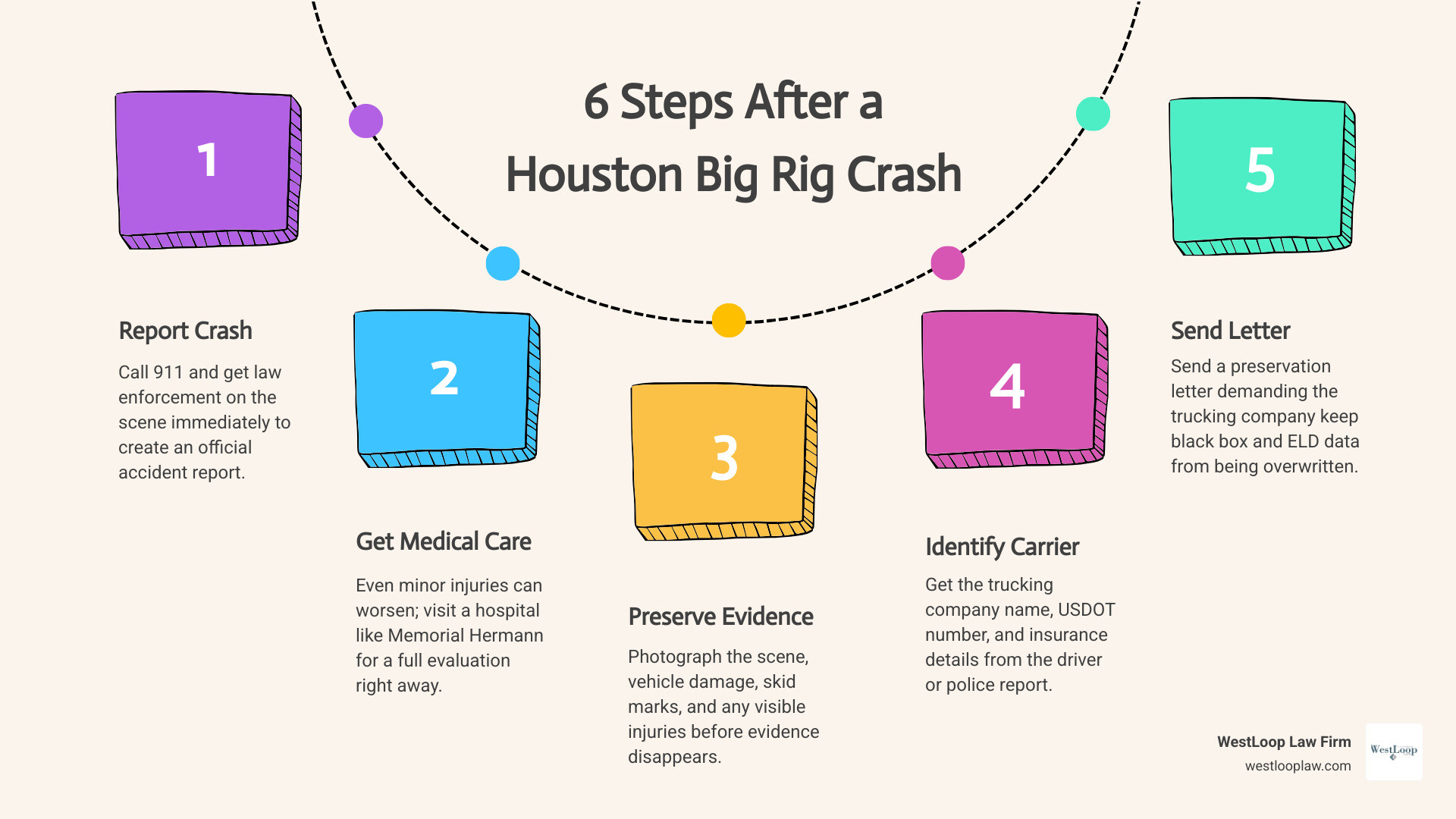
If you or a family member was hurt in a truck crash, here is what a Houston big rig crash claim typically involves:
- Report the crash — Call 911 and get law enforcement on the scene immediately.
- Seek medical care — Even minor-seeming injuries can worsen; get evaluated right away.
- Preserve evidence — Photograph the scene, vehicles, and any injuries.
- Identify the trucking company — Get the carrier name, DOT number, and insurance details.
- Send a preservation letter — This legally demands the trucking company hold black box and ELD data before it is overwritten.
- Consult a truck accident attorney — Liability in multi-vehicle big rig crashes is rarely straightforward.
Big rig claims differ from regular car accident claims in important ways. Trucking companies carry large insurance policies, employ defense teams quickly, and begin protecting their interests the moment a crash happens. Victims who wait too long risk losing critical evidence.
The crashes are happening on roads you likely drive every day — I-10 near Eldridge, the Katy Freeway at SH-99, and the Eastex Freeway through north Houston. The consequences are often devastating, and the legal path forward can feel overwhelming.
This guide breaks down exactly how these claims work, what your rights are, and what steps to take to protect your recovery.
Houston big rig crash claims word roundup:
Recent Fatalities on I-10 and Katy Freeway Highlight Systemic Safety Issues
Driving in Houston can sometimes feel like a high-stakes obstacle course, but the reality on our major highways has grown increasingly dangerous. Recent collisions on the Katy Freeway (I-10), Eldridge Parkway, and State Highway 99 (SH-99) highlight the severe risks local drivers face daily alongside commercial traffic.
Just this month, on July 23, 2026, commuters witnessed a terrifying sight on the eastbound Katy Freeway near Highway 99. A major collision involving multiple vehicles—including two 18-wheelers—resulted in a dangling big rig near Highway 99. The tractor-trailer’s cab plummeted off the overpass to the ground below, leaving the trailer suspended precariously over the edge. While it was a miracle that only minor injuries were reported in this AOL news coverage of the dangling big rig, the incident completely paralyzed local traffic and underscored how quickly a highway merge can turn catastrophic.
Unfortunately, other recent wrecks have had far more tragic outcomes. Earlier in July 2026, a fatal pre-dawn fire near State Highway 6 claimed two lives when an 18-wheeler overturned directly onto a passenger vehicle, sparking an immediate, intense fire that blocked the morning commute for hours.
Just weeks prior, a devastating Eldridge Parkway double-fatal crash occurred when an eastbound 18-wheeler struck a passenger sedan, causing the smaller vehicle to roll over and slide down the highway while the truck flipped onto its side, spilling diesel across the lanes and killing both drivers.
These consecutive tragedies point to a larger, systemic safety issue within Houston’s heavy commercial corridors. When commercial vehicles collide with passenger cars, the weight disparity alone makes severe injury or death highly probable. Navigating the aftermath of these incidents requires a deep understanding of local traffic patterns, commercial safety records, and the necessary legal maneuvers detailed in our guide on Houston 18 Wheeler Accident News and Legal Next Steps.
How Investigators Determine Fault in Multi-Vehicle 18-Wheeler Wrecks
When a multi-vehicle collision occurs on a major Houston highway, determining who is at fault is rarely a simple task. Trucking companies, their insurance carriers, and law enforcement agencies all launch immediate investigations, but they do so with very different goals in mind.
To reconstruct what happened, professional accident investigators analyze physical and digital evidence, including:
- Skid marks, gouge marks on the pavement, and oil or diesel spill patterns.
- The final resting positions of all involved vehicles.
- Damage profiles on each vehicle to determine angles of impact.
- Traffic-camera footage, dashcam recordings, and eyewitness statements.

A prime example of this meticulous process is the recent Eastex Freeway fatal crash investigation handled by the Houston Police Department Vehicular Crimes Division. In that mid-July 2026 incident, an SUV attempting to exit the freeway made contact with a Freightliner Cascadia 18-wheeler, lost control, struck a barrier wall, and caught fire, resulting in two fatalities. Investigators performed impairment testing on the commercial truck driver (who showed no signs of impairment and was released) while focusing heavily on the physical dynamics of the exit maneuver to determine why the initial contact occurred.
In Harris County, these investigations carry immense weight. Because Texas follows a modified comparative negligence system, a victim’s recovery can be reduced—or entirely barred—if they are found to be more than 50% at fault. This is one of the many reasons why Truck Accident Lawyers Houston Why Harris County Cases Hit Different is a critical resource for understanding how local juries and investigators view highway dynamics.
The Role of Black Boxes and ELDs in Houston Big Rig Crash Claims
In the modern trucking industry, some of the most reliable witnesses are entirely digital. Commercial semi-trucks are equipped with sophisticated electronic systems that log critical data before, during, and after a collision.
The two most vital pieces of electronic evidence are:
- Event Data Recorders (EDRs): Commonly referred to as the truck’s “black box,” this device records technical vehicle metrics in the seconds leading up to a crash. It captures speed, brake application, throttle position, steering angles, and system faults.
- Electronic Logging Devices (ELDs): These devices automatically record a driver’s driving time and duty status, replacing old paper logbooks that could easily be altered.
Accessing this data is central to proving negligence. For instance, the black box might reveal that a truck was traveling at 70 mph in a 55 mph construction zone, or that the driver never applied the brakes before striking a stopped passenger car. For a deeper look at how this technology works, read our breakdown of All About Trucking Black Box Data.
Furthermore, comparing ELD records against physical toll road receipts, GPS tracking, and loading dock timestamps can reveal systemic violations. If there are discrepancies in the driver’s logged hours, it often leads to intense Trucking Log Book Disputes that can break a trucking company’s defense.
How Federal Hours-of-Service Rules Impact Houston Big Rig Crash Claims
The Federal Motor Carrier Safety Administration (FMCSA) enforces strict Hours-of-Service (HOS) regulations to prevent driver fatigue. These rules dictate exactly how many hours a commercial driver can be behind the wheel before they must take a mandatory rest break.
Despite these clear federal boundaries, some trucking companies pressure drivers to bypass HOS limits to meet tight delivery deadlines. When a driver operates a massive 80,000-pound rig while sleep-deprived, their reaction times mimic those of an impaired driver.
If we can prove that a trucking company encouraged or ignored HOS violations, it elevates the claim from simple driver negligence to systemic corporate liability. To hold these companies accountable, it is essential to work with a legal team prepared to act as a Trucking Regulations Violation Lawyer to dissect these federal compliance failures.
Texas Trucking Regulations and Insurance Requirements
The state of Texas is a major hub for freight transport, which means the Texas Department of Transportation (TxDOT) and state law enforce strict rules regarding commercial driver licensing (CDL) and fleet operations.
One of the most critical aspects of Texas trucking law is the minimum liability insurance requirement. While standard passenger vehicle owners in Texas are only required to carry $30,000 in bodily injury liability per person, commercial motor carriers must carry significantly higher limits:
- $750,000 minimum for general, non-hazardous freight.
- $1,000,000 to $5,000,000 minimum for hazardous materials (such as fuel transport tankers frequently traveling through Houston’s energy corridor).
While these high policy limits mean there is typically adequate compensation available for catastrophic injuries, it also means the insurance companies will fight twice as hard to protect their bottom line. Filing a Houston Trucking Insurance Claim requires navigating a maze of corporate structures, parent companies, and third-party logistics providers.
Often, the root cause of a crash isn’t just a driver’s split-second mistake; it is the carrier’s hiring practices. Trucking companies are legally required to perform background checks, verify CDL credentials, and monitor their drivers’ safety histories. When a fleet fails to do so, our In Depth Guide to Houston Trucking Firm Negligence explains how negligent hiring, training, or maintenance practices can be used to hold the corporate entity directly responsible.
Compensation and Legal Options for Victims and Families
If you survive a crash with an 18-wheeler, the physical, emotional, and financial toll can last for years. Texas law allows victims and their families to pursue compensation for a wide range of damages.
The immediate concern for most families is managing overwhelming medical debt. From emergency helicopter transports to Memorial Hermann or Houston Methodist, to long-term physical therapy and surgeries, we help families find structured paths forward using our resource on Truck Accident Medical Bills A Practical Guide to Paying.
Beyond medical bills, victims are often left unable to work, resulting in significant lost wages and a loss of future earning capacity. To understand what categories of damages apply to your specific situation, you can consult our comprehensive 18 Wheeler Accident Compensation Guide.
Recovering Damages Through Houston Big Rig Crash Claims
When we build a claim, we categorize your losses into three main types of damages:
- Economic Damages: These are quantifiable financial losses, including past and future medical bills, lost wages, rehabilitation costs, and property damage.
- Non-Economic Damages: These address intangible losses that do not have a direct price tag, such as physical pain and suffering, mental anguish, loss of companionship, and loss of enjoyment of life.
- Punitive (Exemplary) Damages: In rare cases where a trucking company acted with gross negligence or malice—such as knowingly sending a truck with failed brakes onto the Katy Freeway—a court may award punitive damages to punish the behavior and deter others.
To see how these damages translate into real-world recovery, we outline the legal strategies and past case structures in our Houston Truck Accident Settlements Complete Guide.
Immediate Steps to Protect Your Rights After a Highway Collision
The moments directly following a commercial truck crash are chaotic, but the actions you take can heavily influence your physical recovery and your eventual legal claim.
If you are involved in a collision with a big rig in the Houston area, follow these steps to protect yourself:
- Call 911 immediately: Ensure that the Houston Police Department, Harris County Sheriff’s Office, or Texas Highway Patrol dispatches officers to write an official accident report.
- Seek medical attention: Even if you feel fine, adrenaline can mask severe internal injuries, concussions, or spinal damage. Visit an emergency room, such as Memorial Hermann, right away.
- Document the scene: If it is safe to do so, use your smartphone to take photos of vehicle damage, license plates, the trucking company’s logo, road conditions, and any nearby traffic signs or construction barriers.
- Gather witness information: Get the names, phone numbers, and email addresses of anyone who stopped to help or witnessed the collision.
- Do not sign anything from the insurance company: Insurance adjusters may call you quickly, offering a fast settlement. These initial offers are almost always lowball figures designed to make your claim go away before you understand the full scope of your injuries.
For a detailed look at what to do (and what not to do) in the days following a wreck, read our guides on What to Do If You’re Hit by a Truck in Houston TX and avoid the common pitfalls highlighted in 4 Mistakes Truck Accident Claims Houston.
Frequently Asked Questions About Houston Truck Wrecks
Who is liable in a multi-vehicle big rig crash in Harris County?
Liability in a commercial truck wreck can extend far beyond the driver sitting behind the wheel. Depending on the circumstances, responsible parties may include:
- The Trucking Company: For demanding unrealistic delivery schedules or failing to maintain their fleet.
- Third-Party Maintenance Providers: If they failed to properly repair critical components like brakes or steering.
- Cargo Loading Companies: If improperly secured or overloaded cargo caused the truck to jackknife or tip over.
- Parts Manufacturers: If a defective tire or component failed on the highway.
To learn more about how liability is split among these parties, refer to our analysis: Truck Accident Lawyers Houston Who Really Pays After an I-10 Crash.
How long do I have to file a truck accident claim in Texas?
In Texas, the statute of limitations for most personal injury and wrongful death claims is two years from the date of the accident. If you do not file a lawsuit within this two-year window, you will likely lose your right to seek compensation forever.
However, because physical evidence can disappear and memory fades, it is highly recommended to start the process as soon as possible. We discuss these timelines and exceptions in our guide on How to Navigate a Houston Big Rig Crash Claim.
What if the trucking company destroys the black box data?
Trucking companies often have policies that allow them to overwrite or delete electronic data after a certain number of days or engine cycles. If they destroy this evidence after being put on notice, it is called “spoliation of evidence.”
To prevent this, we send an immediate, formal “spoliation letter” demanding they preserve all digital logs, black box data, maintenance records, and communication logs. If they destroy evidence after receiving this letter, courts can instruct juries to assume the destroyed evidence proved the trucking company’s guilt. We use these methods as part of our 7 Proven Ways to Win Houston Big Rig Accident Claims.
Securing Your Recovery with Committed Houston Advocacy
Recovering from a major highway collision requires more than just medical treatment—it demands a legal team that understands the complex intersection of personal injury and probate law, especially when a crash leads to a tragic loss of life.
At Westloop Law Firm, we stand up to multi-billion-dollar trucking companies and their aggressive insurance adjusters on behalf of injured Houstonians. We handle the heavy legal lifting—from securing black box data to navigating complex probate court requirements for wrongful death claims—so you can focus entirely on healing.
If you or a loved one has been injured on our highways, reach out to an experienced Houston Trucking Accident Lawyer at Westloop Law Firm today for a comprehensive, compassionate evaluation of your claim. Let us help you secure the compensation and peace of mind you deserve.